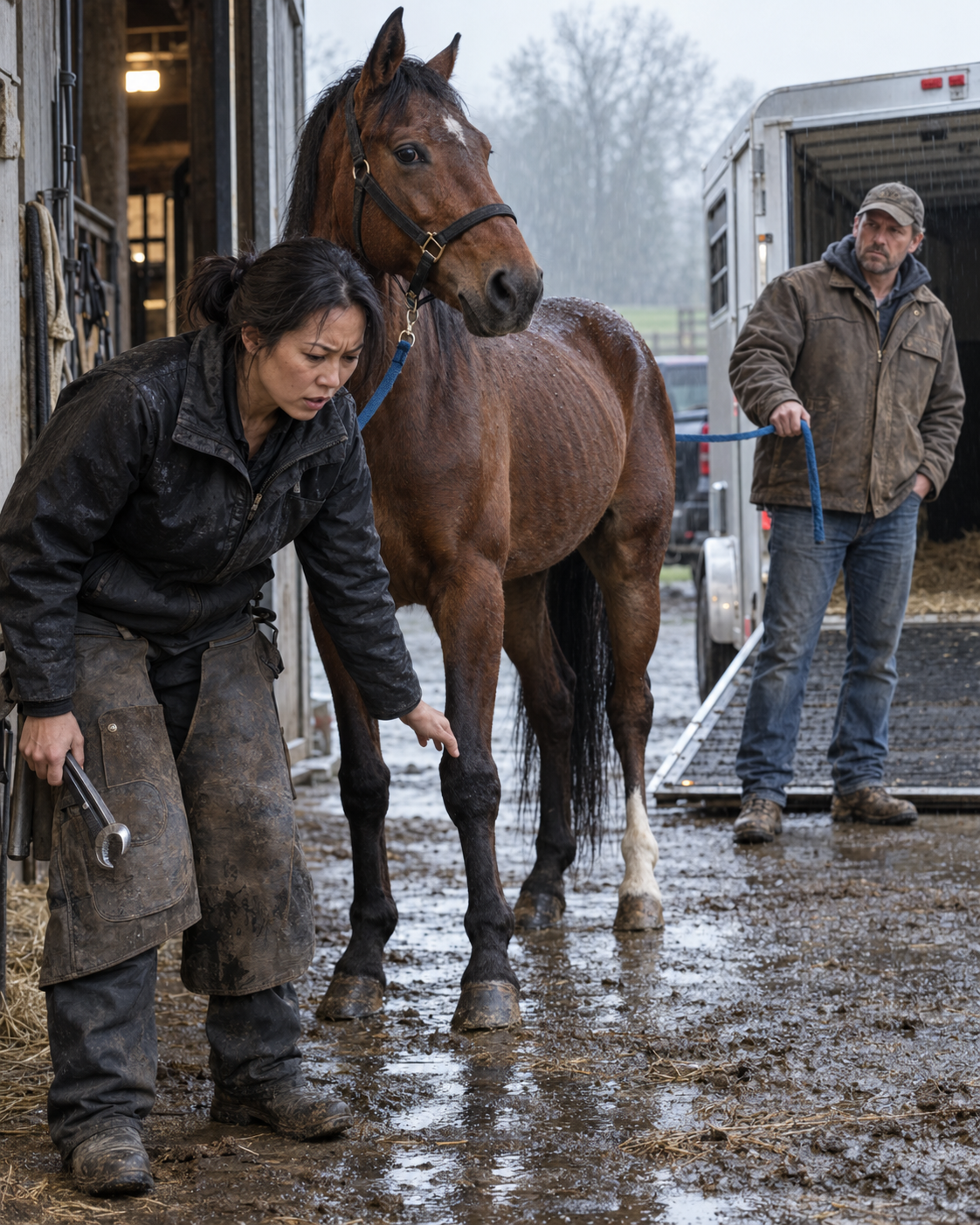
The horse that came off Dean Mercer’s trailer had Atlas’s black halter, Atlas’s blue lead rope, and a white sock halfway up his left hind leg.
Atlas had four dark legs.
I stood beside the open gate while rain ticked on the trailer roof. The bay gelding at the ramp planted both front feet and pulled back until the lead snapped tight.
Dean braced one boot against the rubber mat.
“Come on, Atlas.”
“That isn’t Atlas,” I said.
Dean looked at me as if I had made a joke he did not understand.
The horse’s ribs showed beneath a dull coat. A narrow star marked his forehead. Atlas had no star. More importantly, the left front hoof turned inward by several degrees, and the shoe sat too far forward at the toe.
I had trimmed and shod Atlas every six weeks for five years. I knew the shallow crack above his right heel, the old wire scar beneath his chestnut hair, and the way he lowered his head when I touched the pocket of my work apron.
The horse on the ramp did none of those things.
Dean tugged the lead again. “He’s been difficult since yesterday.”
“He’s difficult because he doesn’t know you.”
My younger brother, Eli, stepped out of our barn carrying a bucket of feed. The gelding flinched so hard that one hind hoof slipped off the ramp.
“Stop pulling him,” I said.
I took the rope from Dean and turned sideways, giving the horse room to look at me. After a minute, he followed me down. He moved stiffly and kept his ears fixed on the trailer.
Dean closed the ramp.
“Ten days at my place and suddenly you don’t recognize your own horse?”
“I recognize every foot on my client list,” I said. “This horse has never been on it.”
Atlas had gone to Mercer Ridge Stables while Eli and I replaced two storm-damaged beams in our barn. Dean operated the largest boarding facility in the county and had collected Atlas himself. I had sent Atlas’s feed, blanket, veterinary instructions, and a copy of his microchip number.
Now Dean reached into his cab and brought out a clipboard.
“Intake sheet says bay gelding, small star, white left hind.”
I read the page. My name appeared at the top. The description was typed. At the bottom, beside the date Atlas left my farm, was a signature that resembled mine only if you looked quickly.
“I didn’t sign this.”
“You signed on my driver’s tablet.”
“I signed a pickup receipt. There was no horse description on the screen.”
Dean shrugged. “Maybe you never looked closely at him.”
Eli laughed once, without humor. “She’s a farrier.”
Dean’s expression changed. The friendly confusion disappeared.
“You asked me to return the horse registered to your account. I did. If you’re refusing delivery, I’ll take him back and add transport to your balance.”
The gelding’s head rose when Dean stepped toward him.
“No,” I said. “He stays here until we know who he is.”
“You can’t keep a horse you say isn’t yours.”
“And you can’t leave me a different one.”
Dean opened his truck door. “Call me when you’ve calmed down.”
He drove away before I could photograph the trailer’s empty stalls.
The strange gelding stood in the rain wearing my horse’s halter.
That detail frightened me more than Dean’s forged description. A mix-up could put the wrong horse on a trailer. A mix-up did not usually include changing the halter first.
We moved the gelding into the small quarantine paddock. He drank for almost two minutes, then ate as if he expected the hay to disappear.
Eli watched him from the fence.
“Where’s Atlas?”
It was the question I could not yet answer.
Atlas was not valuable because of a famous bloodline. He was a twelve-year-old grade gelding I had bought from a rescue for nine hundred dollars. But five years of careful training had made him steady around traffic, tarps, children, and nervous riders. I used him in weekend confidence clinics for adults returning to riding after injuries.
A quiet, reliable horse could sell for many times what I had paid.
I called Dean. He did not answer.
Then I called Dr. Lena Ortiz, our veterinarian. She arrived forty minutes later with a microchip scanner and a technician.
The scanner beeped over the left side of the gelding’s neck.
The number was not Atlas’s.
Lena entered it into the registry. The chip belonged to a horse named Jasper, a ten-year-old bay transferred six months earlier from North Fork Rescue to a livestock dealer called Vale Stock.
The registry had no later owner update.
Lena photographed the chip reading beside the gelding’s markings. She also found rain rot beneath his mane, an untreated sore under his belly, and teeth that had not been floated in years.
“He didn’t become this horse in ten days,” she said.
I sent Dean the chip number and asked, in writing, where Atlas was.
His reply arrived four minutes later.
**Our records identify the delivered animal as your horse. Any dispute will need to follow the boarding contract. Your outstanding care and transport charges remain due.**
I had paid the invoice that morning.
When I tried to open my client portal, my access had been disabled.
Lena told me to call the sheriff’s office. The deputy who arrived listened, took photographs, and wrote down both chip numbers. But when Dean emailed him the intake sheet and boarding agreement, the deputy’s certainty softened.
“This may be a civil ownership dispute,” he said.
“It is not a dispute over one horse,” I said. “My horse is missing, and someone else’s neglected horse was left in his place.”
He agreed to make an incident report, but he would not issue a seizure order based on records he could not authenticate at the gate.
That was frustrating. It was also realistic. I needed evidence showing where Atlas had gone, not only proof that Jasper had arrived.
I started with my own records.
Every time I worked on Atlas, I photographed all four hooves for my farrier log. The images showed the dates, the shape of each foot, the right-heel crack, and the handmade lateral extension I used on his left hind shoe. Lena’s veterinary file contained his microchip number, dental chart, and the wire scar beneath his chest.
Eli found the original rescue bill of sale in our fire box.
At 2:20 that afternoon, a message appeared on my business page from someone named Tessa Rourke.
**Are you looking for a bay gelding from Mercer Ridge?**
I called the number she included.
Tessa had worked weekend shifts at Dean’s stable for three months. She said Atlas had been moved from the boarding barn to the sale barn two days after arriving.
“Dean told me his owner had stopped paying,” she said.
“I paid before he picked Atlas up.”
“I know. Your feed bins had your farrier-business labels. That’s how I found you.”
She had quit the previous evening after being told to put a blue halter onto Jasper and load him under Atlas’s stall card.
“Why didn’t you refuse then?”
“I did. Dean loaded him himself.” Her voice shook. “I should have called you last night.”
“You’re calling now. Where did they take Atlas?”
She had photographed the transport board before leaving because two other stall names had been erased. Atlas’s line showed a destination code: **BHA—Lot 61**.
Tessa had also been responsible for filing digital pickup receipts. When she saw details appear beneath my signature a day after collection, she exported the system’s audit history before resigning. She agreed to bring it to the auction and explain how it had been created.
Blue Heron Auction held its monthly performance-horse sale the next morning.
The auction catalog was already online.
Lot 61 showed a bay gelding standing square in front of a white fence. The listing called him “Arthur,” an experienced family trail horse available through Vale Stock.
The photograph was taken from his left side, hiding the wire scar. But his right heel was visible when I enlarged the image. So was the shallow crack I had treated since spring.
The listing’s video made the identification certain. A rider opened a red umbrella beside his shoulder. Atlas did not move. I had taught him that exercise in our own arena.
The sale was scheduled for ten. Horses began shipping out as soon as buyers paid.
Dean had not simply exchanged two similar animals. He had routed my trained horse through the same dealer that still appeared on Jasper’s microchip record.
The deputy called the auction, but the manager, Simone Price, said she needed verifiable documentation before she could hold a consigned animal. She had received a transfer affidavit signed by Dean stating he was authorized to sell the horse for unpaid board.
I checked my bank record. The payment had cleared at 8:06 that morning—more than two hours before Dean delivered Jasper and claimed I owed him.
The boarding contract mattered now. Its lien clause allowed sale only after written notice and twenty-one days without payment. Atlas had been gone ten days. I had never received notice.
We sent Simone the cleared invoice, contract, incident number, bill of sale, chip registration, veterinary record, and my dated hoof photographs. Lena signed a declaration explaining the markings and the chip found in Jasper.
Simone agreed to block remote bidding on Lot 61 until we arrived. She would not release Atlas to us without law enforcement or Dean’s consent, but she would not let the horse leave while ownership was credibly disputed.
That was the first practical victory.
At 8:30 the next morning, Eli and I reached Blue Heron with Lena and the deputy. Tessa had agreed to meet us and give a statement.
Dean was already there.
He stood outside stall 61 with a Vale Stock agent and two men examining Atlas’s legs. When Atlas heard my voice, he pushed his nose between the bars and gave the low, breathy call he used at feeding time.
I wanted to open the stall immediately.
Instead, I stopped several feet away and let Lena scan him in front of the deputy, Simone, and the consignor.
The number matched my registry.
Dean folded his arms. “A chip proves what horse it is. It doesn’t prove she still owns it.”
So we laid out the rest.
My bill of sale established ownership. The paid invoice showed no debt. The contract showed the notice period had not passed. Tessa’s photograph placed Atlas on Dean’s transport board under the auction code. The catalog video showed him being marketed under another name. My hoof images matched the heel crack and custom shoe still on his feet.
Then Tessa handed the deputy the audit-history copy from Dean’s tablet system.
The version stored on the day Atlas left my farm said only **one bay gelding received with feed and blanket**. It carried my electronic signature.
The detailed description with Jasper’s star and white leg had been added the following day.
Dean had assumed the screen I signed was the only version anyone would ever see.
Simone removed Lot 61 from the sale.
The deputy asked Dean and the Vale agent to remain in the office while he contacted an investigator. Lena took custody of Atlas under the auction’s disputed-property policy, and I led him to our trailer.
We did not ride home in triumph. Jasper was still standing in my quarantine paddock, and the records suggested he had been passed between businesses without receiving basic care.
The investigation lasted three months. It found four horses whose stable names, chip records, or sale papers did not align. Not every mismatch was theft. Two were negligent paperwork. Atlas and Jasper were different. Their records showed an exchange designed to turn a trained horse into sale money while leaving a lower-value animal with an owner who could be pressured into accepting him.
Dean’s boarding license was suspended pending an administrative hearing. The prosecutor filed fraud and livestock-theft charges, which remained unresolved when the county issued its report. Vale Stock surrendered Jasper and another horse to North Fork Rescue rather than contest their care orders.
I could have sent Jasper away that first afternoon. Instead, I had him treated while the rescue arranged a foster placement. Six weeks later, he walked onto a trailer without bracing his feet or throwing his head.
Atlas came home the morning after the auction. Before I released him into the pasture, I removed the blue halter Dean had put on Jasper and hung it on the quarantine gate for the rescue driver.
Then I checked all four of Atlas’s legs.
Dark hair. The old scar. The heel crack growing out cleanly beneath a shoe I had made with my own hands.
He put his nose against my apron pocket.
I gave him the peppermint he had been asking for since the moment I found him.
For two days, a false name and someone else’s halter had made him merchandise. None of that changed who he was.
But getting him home had required more than recognizing him.
It required records that could not be talked over, a worker willing to correct what she had helped load, and an auction manager willing to stop a sale before certainty became someone else’s receipt.