The air four hundred feet beneath the city streets always tasted of iron, wet lime, and rotting grease.
For twelve years, my universe was bounded by the curved concrete walls of the Line 4 drainage main, where the city’s sewage and storm runoff met in a roaring, subterranean torrent.
My name is Leo, and while the city above slept in heated apartments and drank wine at sidewalk cafes, I was the ghost down in the dark.
Whenever a pressure valve seized or a greaseberg choked the primary outfall, my supervisor, Marcus, didn’t call an engineering firm.
He called me.
I would slide down the rusted ladder into freezing, waist-deep water, wrenching open jammed sluice gates with my bare hands while my skin absorbed the harsh sting of industrial solvents.
Marcus collected a six-figure salary, drove a slate-grey Porsche, and took credit for every seamless morning commute across the metropolitan transit network.
My payment was a rusted locker in the sub-basement and a wage that hadn’t seen a cost-of-living adjustment since 2012.
The arrangement worked for Marcus until I started keeping notes.
It began with a hairline fracture in the north pylon—a structural failure caused by cheap slag concrete substituted during the 2018 budget cuts.
When I flagged the defect in my daily digital log, Marcus didn’t order repairs.
Instead, he locked me out of the central maintenance portal, deleted my safety inspection archives, and told me over the radio to “stop inventing crises to pad your overtime.”
Over the next three months, I didn’t stop.
Every time Marcus signed off on a fraudulent structural certification, I printed a physical duplicate, tucked it into a heavy-duty waterproof sleeve, and hid it inside the dry cavity of the old steam pipe junction beneath City Hall.
The climax arrived on a rainy Tuesday afternoon.
I was three hundred feet down in the Junction 9 drainage vault, inspecting a corroded expansion joint, when I heard the heavy mechanical whine of the surface winch above.
I paused, wiping greasy sweat from my forehead, and looked up toward the primary access shaft.
Before I could reach the safety ladder, three tons of wet concrete ballast came screaming down the chute, crashing into the junction with deafening force and completely sealing the exit pipe behind a wall of grey sludge.
Freezing water began to pour from the overhead relief valves, rising rapidly toward my chest as the secondary intake locked automatically.
I didn’t panic. I didn’t scream into my radio.
I knew why the concrete had dropped.
Upstairs, Marcus wasn’t waiting for a rescue team. He was waiting for the air to run out.
What Marcus didn’t know—what none of them knew in their gleaming corporate offices—was that I had spent the past three winters rebuilding the 1904 emergency bypass tunnel with my own tools, bypassing the central control grid entirely.
It took me four hours of hacking through rusted iron bolts and crawling on my stomach through five inches of freezing industrial runoff, but by seven o’clock that evening, I reached the maintenance hatch that led directly beneath the central transit board room.
Above my head, muffled through the mahogany floorboards, I heard the polite applause of television cameras.
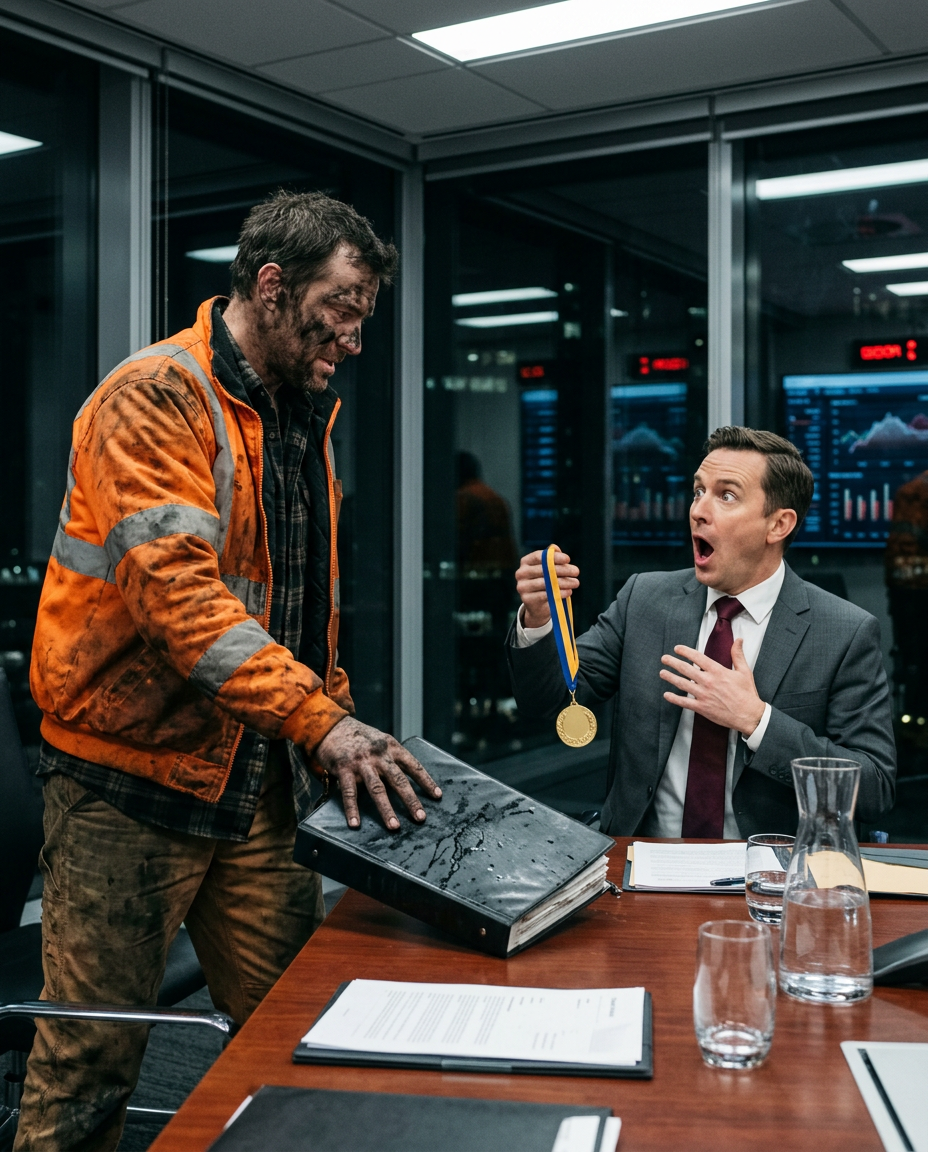
I pushed my way up through the floor hatch, dripping in black grease, rust, and tunnel muck, and stepped directly onto the plush crimson carpet of the boardroom.
The room froze instantly.
Forty city councilmen, transit commissioners, and high-ranking directors sat around the horseshoe-shaped table, watching a live-feed monitor where Marcus stood at the podium in a tailored navy suit.
On the screen, Marcus was wiping a theatrical tear from his eye.
“It is with profound sorrow,” Marcus was telling the press corps, his voice trembling with practiced grief, “that we mourn the tragic loss of Leo Vance, our most dedicated senior technician, who perished this afternoon in an unforeseen structural collapse at Junction 9.”
The camera panned to a framed photograph of me smiling next to a safety plaque.
Beside Marcus stood the mayor, holding a gleaming brass bravery medal meant to be posthumously awarded to my grieving widow.
I stepped out from behind the mahogany projection screen, dragging my heavy rubber boots across the pristine carpet, leaving dark, oily smears in my wake.
The room went dead silent.
Marcus turned around on the live-feed monitor, his eyes widening in absolute terror as he stared at the back of my head—then turned around in the actual room to find me standing ten feet away from him, alive, breathing, and dripping filthy drainage water onto the marble floor.
The mayor dropped his brass medal. It hit the floor with a sharp, echoing clang.
“You’re… you’re dead,” Marcus choked out, backing away until his spine hit the mahogany paneling. “The ballast… the shaft—”
“The shaft was blocked,” I said, my voice echoing off the vaulted ceiling with terrifying calm. “Just like the audit reports you tried to bury.”
I reached into the front pocket of my heavy canvas coveralls, pulled out a thick, grease-stained vinyl ledger, and slammed it onto the center of the executive table.
“This is every fraudulent inspection signature you filed since 2021,” I told the room, looking directly at the pale, sweating face of the transit commissioner. “And the original hard copies are currently sitting on the desk of the federal prosecutor two blocks away.”
Marcus grabbed his briefcase and lunged for the double doors, but two transit police officers standing by the entrance didn’t move an inch to help him.
They just stared at the grease dripping from my hands, waiting for my next command.