The air in the subterranean kiln room of Atelier Vane always smelled of sulfur, crushed feldspar, and burning applewood.
For five years, my world was bounded by those damp stone walls, where the temperature fluctuated between freezing drafts and the suffocating twenty-two-hundred-degree heat of the wood-fired chambers.
My name is Kaelen.
To the elite collectors who paid forty thousand dollars for a single porcelain moon jar at our annual gallery openings, Master Alistair Vane was a solitary genius—a modern-day master who communed with the elements to extract the impossible blue wood-ash glazes that defined his legendary style.
To the actual studio, however, Alistair was a man who slept until noon, drank vintage burgundy in his climate-controlled office, and hadn’t touched a throwing wheel or stirred a slip batch since 2018.
I was the one who mixed the clay. I was the one who monitored the Cone 10 reduction firing curves through thirty-six-hour shifts without sleep.
And, most importantly, I was the one who finally cracked the formula for the volatile copper-cobalt crystal melt that gave Vane’s signature vessels their iridescent, deep-space sheen.
When I presented my first successful test tile to him two years ago, Alistair took it, wiped my inventory number off the back with a wet sponge, and placed it directly into his personal exhibition case.
“A happy accident of raw materials, Kaelen,” he had said dismissively, adjusting his silk cravat. “The kiln simply cooperated with my vision.”
The final betrayal arrived on a crisp autumn evening during the International Ceramic Guild’s annual symposium, hosted this year in our city’s grand auditorium and broadcast live to thousands of artisans and gallery directors worldwide.
The hall was packed with murmuring critics, television cameras, and wealthy patrons holding flutes of champagne.
Alistair stood at center stage beneath a battery of blinding spotlights, wearing an immaculate black velvet jacket and holding a microphone like a televangelist.
I was standing off to the side near the digital projection booth, wearing my usual ink-stained work shirt, waiting to assist with the live-glazing demonstration.
Midway through his keynote speech about artistic purity, Alistair suddenly stopped talking about glazes.
He turned his body directly toward the cameras, his expression shifting from scholarly serenity to theatrical sorrow.
“Before we conclude tonight’s technical retrospective,” Alistair announced, his voice carrying rich and resonant through the auditorium’s acoustic baffles, “we must address a profoundly painful matter of professional integrity within our own ranks.”
The murmurs in the auditorium died away instantly.
“For months, rumors have circulated regarding unauthorized copies of my proprietary crystal-melt formulas appearing on the secondary market,” Alistair continued, placing a dramatic hand over his heart. “After a thorough internal security review, we have traced the source of this industrial espionage straight to my own assistant, Kaelen.”
He pointed a long, manicured finger directly at me.
The camera operator, taking his cue, immediately swung the heavy broadcast lens around to center on my face on the giant projection screen behind the stage.
“Kaelen has systematically exfiltrated my private thermal logs, copied my molecular balancing charts, and attempted to market fraudulent imitations under his own name,” Alistair proclaimed, his voice trembling with manufactured grief. “It is a devastating betrayal of artistic trust. I move that the guild revoke his certification effective immediately.”
A wave of shocked gasps swept through the crowd.
In the live chat sidebar displayed on the side monitors, thousands of comments scrolled past at blinding speed: *Disgraceful.* *Expel him.* *Thief.*
Alistair looked across the stage at me, a tiny, triumphant smirk twitching at the corner of his lips. He expected me to flee into the night, or to stand there stammering tearful denials while security dragged me out in front of the world.
I did not move.
I did not blink.
I slowly stepped out from the shadows of the projection booth and walked deliberately toward the center of the stage, ignoring the harsh glare of the spotlights.
I reached into the pocket of my work trousers, pulled out a heavy, solid-brass trimming-caliper, and placed it squarely on the podium right beside Alistair’s notes.
“Industrial espionage, Alistair?” I asked, my voice cutting through the hall with absolute, chilling clarity.
Alistair blinked, momentarily startled by my composure. “Step away from the podium, Kaelen. Security is already—”
“Security isn’t touching anything until page four hundred,” I interrupted.
I reached out and pressed the master system override button on the podium’s control panel.
Instantly, the massive, high-definition presentation wall behind Alistair cut away from his slide deck.
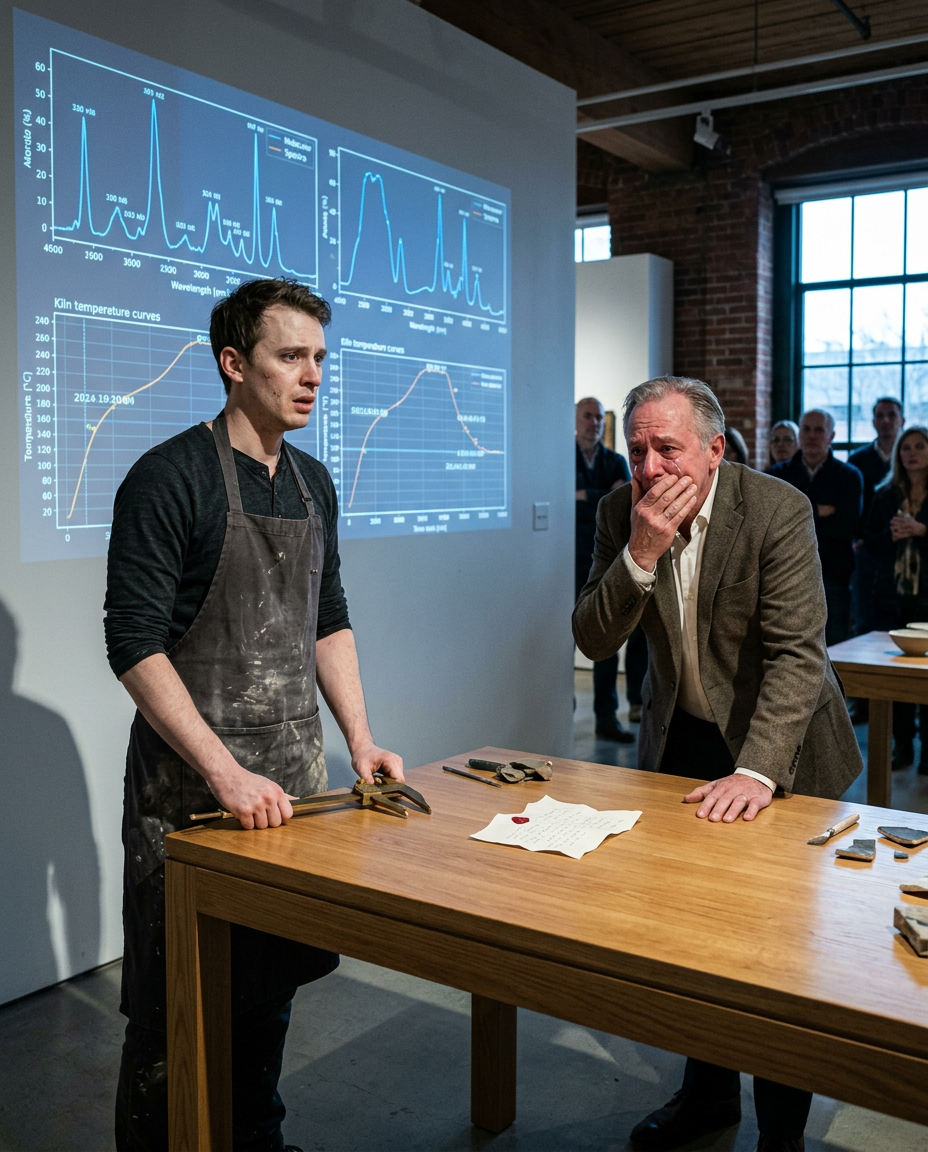
The glowing blue slides vanished, replaced by an intricate, cascading matrix of color-coded molecular graphs, real-time kiln telemetry curves, and cryptographic audit logs.
The audience leaned forward, squinting at the towering numbers displayed in bright white text against the dark screen.
“These are the internal temperature logs of Kiln Number Three,” I explained, my voice echoing evenly off the vaulted ceiling. “Every single firing cycle, gas flow rate, and oxygen-reduction valve adjustment executed in this studio for the past five years.”
I tapped the screen with my finger, highlighting a series of cryptographic digital signatures embedded deep within the code.
“Every log is stamped with my personal biometric hash at 3:14 AM on alternating Tuesdays—the exact moments when Alistair was documented dining at the Hotel Majestic across town.”
Alistair’s face turned the color of wet chalk. He grabbed the edges of the podium so hard his knuckles turned white.
“That data… that’s proprietary network interference,” he stammered, his polished composure dissolving into frantic panic. “He hacked the studio archive—”
“You can’t hack an offline, analog-relay data logger, Alistair,” I said softly, stepping closer until I was standing right beside him under the hot lights. “Which means the gallery’s insurance underwriters are going to be very interested to learn that you didn’t invent the crystal-melt glaze at all. You bought the patent rights from my university thesis after you failed your own junior guild examinations in 2017.”
I turned my gaze slowly toward the front row, where the three primary international guild judges sat in stunned silence.
“The studio, the equipment, and the legal copyright for every glaze formula catalogued under Atelier Vane belong to the Kaelen Research Trust,” I added, unbuttoning my work cuffs and rolling them back with deliberate slowness. “And as of five minutes ago, my legal counsel has officially filed notice of default on your gallery lease.”
I picked up my brass calipers from the podium, turned my back on the cameras, and walked steadily down the center steps toward the exit, leaving the master of ceramics standing alone in the dark under his own failing spotlight.