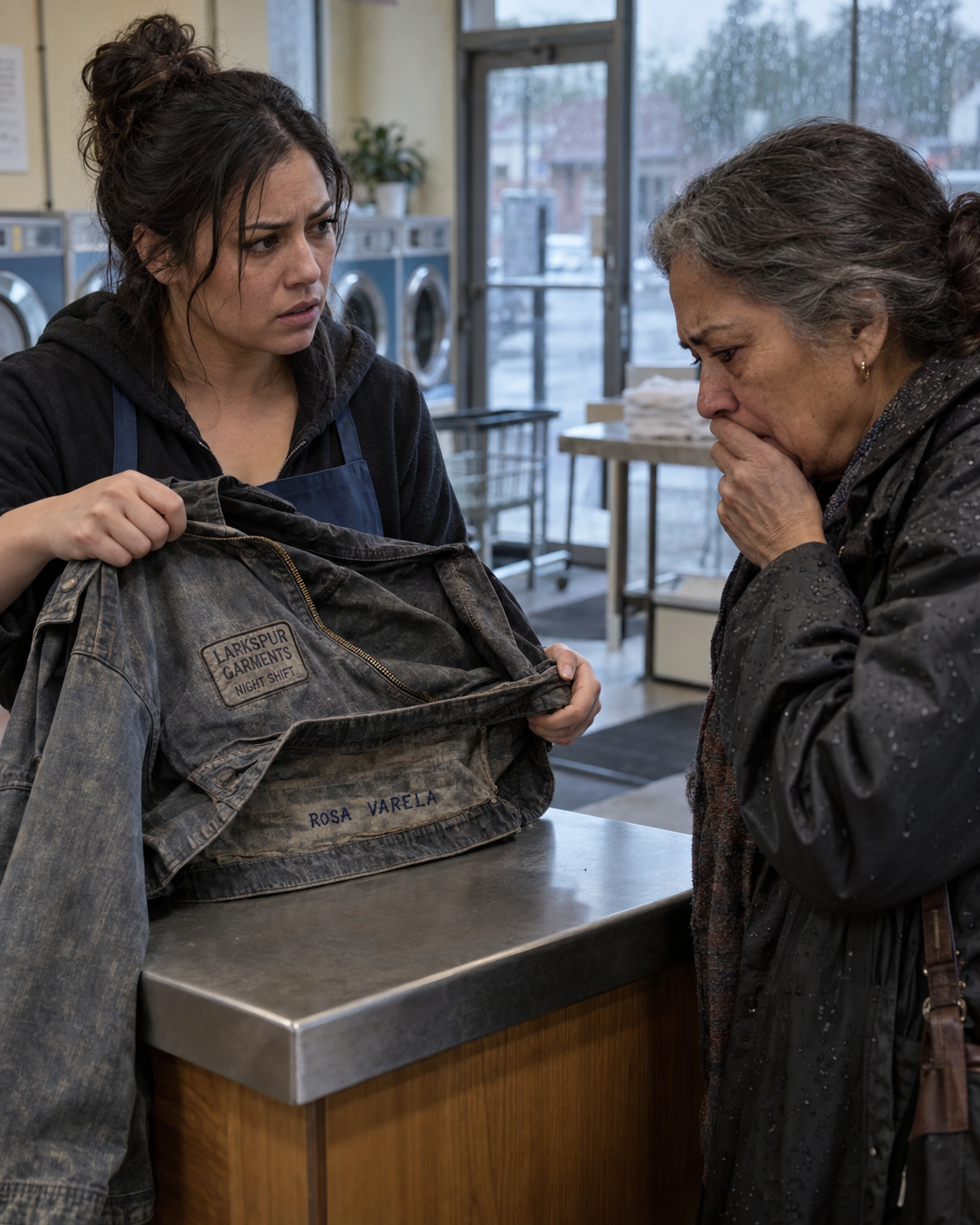
The jacket was stiff with old smoke and industrial detergent when I pulled it from the last locked bin behind my mother’s dryers.
Its cuffs had gone grey at the edges. A faded patch above the pocket read:
LARKSPUR GARMENTS — NIGHT SHIFT.
I had seen that name on the memorial wall outside the library for eight years.
Eleven names were cut into brushed steel beneath a sculpture shaped like folded cloth. My mother, Elena Moreno, had attended the dedication. I knew because a photograph had appeared in the paper: her standing at the back in her work apron, one hand pressed to her mouth.
I had been angry with her that day.
I had been angry with her for a long time.
Three weeks earlier, at her funeral, the lawyer had told me the laundromat was mine along with its debts, a leaking roof, two failing dryers, and a purchase agreement that would close the following Friday. I had seven days to empty the building before handing the keys to a developer.
I was sorting the bins because that was what people did after someone died. They made piles. Keep. Sell. Donate. Throw away.
A loose thread snagged my thumb as I lifted the jacket.
Inside the hem, under a fold of lining, a name had been sewn in dark blue thread.
ROSA VARELA.
The stitching was careful but not professional. Each letter leaned slightly to the right.
I crossed to the bulletin board near the register, where my mother had kept an old clipping under a magnet shaped like a lemon. The memorial photograph was there, yellowed at the corners.
Rosa Varela was the third name down.
The front bell rang before I had decided what to do with that.
A woman stood just inside the laundromat, rain shining on the shoulders of her coat. She looked from the closing-sale sign in my window to the jacket in my hands.
“Are you Lila?” she asked.
I nodded.
“My name is Ana Becerra. Marta from Saint Jude’s called me yesterday.” She stopped, as though saying my mother’s name required permission. “She said Elena had died. Elena told her that, if anything happened to her, I should come before this place was cleared out.”
She had not come by accident. My mother had expected her.
Ana noticed the exposed hem.
Her fingers curled against her palm.
“May I?” she asked.
I held the jacket out. She did not take it. She only leaned close enough to read the name.
“That was the name I used at Larkspur,” she said.
I looked again at the thread.
“Rosa Varela?”
“It was on the payroll card. It belonged to my cousin’s wife. She let me use it when I first came here.” Ana’s eyes stayed on the jacket. “My real name is Ana Becerra.”
The words did not settle easily.
“You’re saying the memorial has your work name on it.”
“Yes.”
“And you survived.”
She nodded once. Then she looked toward the dark back room where the metal bins stood.
“Did Elena keep more?”
Before I could answer, a black SUV slowed outside the window.
Ana saw it first. Her face tightened, and she stepped away from the counter.
The man who entered a minute later was silver-haired, narrow-shouldered, and dressed for an office rather than rain. He introduced himself before I recognized him from the old articles.
Calder Voss.
Former staffing coordinator for Larkspur Garments. Current records consultant for the insurance trust handling the reopened compensation review.
He had been in the newspaper again two months earlier, when the county announced it would recheck unresolved Larkspur claims. At the time Calder entered my laundromat, twelve days remained before the trust’s deadline for new evidence. The old staffing records he had supervised were back under scrutiny. If they had been mishandled, the trust could face new claims, and Calder’s role would be questioned.
Now he was standing under my mother’s hand-painted sign.
MORÉNO LAUNDRY — WASHED WITH CARE.
“I’m sorry about Elena,” he said. “I learned about the property transfer from the buyer’s due-diligence file. I wanted to make sure you knew there may be safety requirements for stored fire-damaged materials.”
His eyes landed on the jacket.
“You knew she kept these,” I said.
“I knew she cleaned clothing for some Larkspur workers after the fire. That was a difficult time for everyone.”
Ana had gone very still beside the folding table.
Calder noticed her. He gave a small pause that looked like recognition.
“Ms. Becerra,” he said. “I hadn’t realized you were back in town.”
“I never left the county,” Ana said.
He smoothed one thumb across the edge of his umbrella handle.
“The review has brought up old memories. That does not mean old assumptions become evidence.”
He placed a business card on the counter. The trust’s name was printed beneath his.
“If you find anything connected to Larkspur, don’t move it around. Call the number. There are procedures.”
After he left, Ana sat down hard at the folding table.
“He’ll say the garments were contaminated or improperly stored,” she said. “He said that before. He said anything we touched would be used against us.”
“Why did my mother keep them?”
Ana looked toward the bins again.
“Because she was the only person who offered to keep them without asking us for papers.”
The first jacket had belonged to Ana. Four days after the fire, she had escaped through a loading-bay door with Miguel Torres and three others. They had spent the next week moving between a church kitchen, an apartment over a bakery, and a shelter near the bus station.
They were afraid of police, immigration officers, and the agency that had hired them. Several had worked under borrowed names. Calder’s staffing office had collected names from relatives, old documents, and people desperate enough to accept any shift.
When the company made its first victim list, it used payroll names.
Some of the people listed had survived.
Some of the dead had never been identified correctly.
Ana did not tell me all of that at once. She kept stopping to correct herself, to remember whether someone had stayed at the church two nights or three. She apologized for not knowing the names of everyone who had run.
“You don’t need to apologize,” I said.
“I do,” she replied. “We all disappeared in different directions. That was what he wanted.”
My mother had taken in the smoke-damaged work clothes because people had nowhere safe to keep them. She washed what could be washed, sealed what could not, and wrote down where each person had gone in an alteration notebook.
At Ana’s request, Elena stitched the borrowed payroll name into the hem of Ana’s jacket. Not as proof that Ana was Rosa Varela, but so the name could be matched later to the person who had worn it and the location where Elena had met her.
“She said memory becomes weak when people are frightened,” Ana told me. “She said thread lasts longer.”
The next morning, I opened the cabinet behind the dryers with the key I had found in my mother’s recipe tin.
Inside were six more Larkspur jackets, each in a separate plastic sleeve. Every sleeve had a date, a number, and my mother’s handwriting.
The names inside their hems were sewn in different colors.
Underneath the jackets lay the alteration notebook, wrapped in a floral towel.
Most pages were ordinary work: replace zipper, shorten sleeves, patch left knee.
But between them were entries from the week after the fire.
Blue thread — Saint Jude’s kitchen — A.B. — 6/18
Green thread — bakery apartment — M.T. — 6/20
Red thread — Park Avenue shelter — 3 persons, names withheld
At the back of the notebook, my mother had tucked a sealed envelope addressed to me.
Lila,
These are not mine to expose. They belong to the people who trusted me with them. If they return, help them keep their choices.
I sat on the floor beside the cabinet with that letter in my lap until Ana found me.
For years, I had reduced my mother to the empty chair at my graduation. The letter did not erase that hurt or explain why she had never told me enough. But it changed what I thought her silence had been.
That afternoon, a city building inspector arrived with an order to seal the rear storage area. Someone had reported that fire-damaged textiles were being kept in an unlicensed commercial space.
He was polite and embarrassed. The order was real. The bins could not remain accessible until a hazardous-materials contractor assessed them.
“If they remove those jackets,” Ana whispered, “we may never see them again.”
The inspector said I could request a preservation hold if the material was relevant to an active claim or investigation. Until then, the contractor would collect it.
I understood that I would lose them if I did nothing.
I photographed every sleeve, every notebook page, every thread color and date. Then Ana called Marta at Saint Jude’s, who connected us with a workers’ legal clinic. By evening, an advocate named Priya Shah had filed a written submission with the compensation review, attaching Ana’s sworn statement and my inventory.
The review chair ordered the jackets preserved where they were, under the inspector’s seal, until an independent archivist could document them.
The sale could still go forward. The roof still leaked. But Calder could no longer have the bins quietly hauled away.
Two days later, Priya received a message from Miguel Torres.
Ana had given his name to the clinic after finding it in Elena’s notebook. She had not called him herself; the last time they spoke, he had begged her never to contact him again. The clinic sent him the notice, Ana’s statement, and a photograph of the blue stitching in the first jacket.
He asked to meet in a diner near the highway.
Miguel arrived carrying a dented biscuit tin.
He had white hair, work-scarred hands, and the wary posture of someone prepared to leave before the questions got difficult.
“I kept this because I thought someday I’d need to prove I didn’t abandon anybody,” he said.
Inside was a photograph of five people outside the bus station four days after the fire. Ana stood near the center. My mother stood at the edge, holding a plastic bag of folded clothes.
There were transit receipts too, including one issued to Miguel’s borrowed payroll name.
Calder had arranged the tickets.
“He said the victim list had already gone to the county,” Miguel told us. “He said if we came forward, the company would call us frauds. He made it sound like we would bring trouble to every person who had helped us.”
“Why keep the receipts?” I asked.
Miguel turned one over between his fingers.
“My brother died at Larkspur. His name was real. When I saw a memorial name that wasn’t, I knew the list was wrong. I just didn’t know how to fight people with offices and lawyers.”
He agreed to testify after Priya explained that the hearing would not force survivors to solve every identity question themselves. The panel needed to decide whether the original records were reliable enough to close the compensation review.
That was a decision he could help make.
Sofía Aranda came into the story through the inventory.
Her daughter, Maribel, had never been formally identified after the fire. Priya found Sofía’s name in an old family submission attached to the review file: a photograph, dental records, and a note saying Maribel repaired uniforms at Saint Jude’s when workers needed extra cash.
Ana remembered her then.
“Maribel fixed my cuff the night before the fire,” she said. “She had a way of securing the tear so it wouldn’t pull loose in the wash.”
One green-thread jacket had no claimed survivor attached to it. Elena’s notebook described it only as: “left at church by woman from night shift; repair on left cuff; hold for family.”
Sofía was invited to the hearing because the garment might be relevant to her daughter’s unresolved file. She came, Priya told me, but she did not promise she would speak.
The hearing took place in the library auditorium, a few steps from the memorial wall.
Calder sat with the trust’s counsel and a stack of binders. He did not try to intimidate anyone.
Instead, he questioned the evidence calmly.
“Elena Moreno was not a records officer,” he said. “These notes may reflect compassionate efforts to help distressed people, but they cannot establish identity or cause of death.”
He was right about part of it, and I hated that he was.
Then Priya asked the review archivist to explain how she had found a document after our preservation filing.
The filing had led the chair to order a search of the trust’s off-site records warehouse for materials connected to Calder’s old staffing files. In a mislabeled box of agency payment records, the archivist found an emergency payment voucher dated eight days after the fire.
Calder had authorized cash “relocation assistance” for night-shift workers. The voucher listed a sequence of transit-ticket numbers.
Miguel slid his receipt across the table.
The number was within that sequence.
The trust’s counsel had also found that the victim list was filed before the voucher, using a staffing roster later edited by Calder’s office. The version sent to the county did not show which names had been borrowed, disputed, or reported by family.
Calder leaned toward his lawyer and began speaking quietly. He no longer looked at Ana.
The evidence still did not answer every question. It did not identify every victim or tell us who had ordered the original shortcuts. But it showed that the list had not been a settled account of who lived and who died. It had been built from payroll records while survivors were being moved out of town.
When Ana stood, she held the blue-thread jacket against her chest.
“My name is Ana Becerra,” she said. Her voice shook on the first sentence, then steadied. “I worked under Rosa Varela’s name. I survived the fire. Rosa’s name should not be on that wall because of me. It is there because someone used a payroll list instead of finding out who was alive.”
Sofía rose from the second row when Priya showed her the green-thread jacket.
She did not touch it at first.
Then she turned the cuff over and traced the repair with one finger: two short stitches, one longer stitch beneath them.
“My daughter did that,” she said.
She looked at Ana. Ana nodded, crying silently now.
“That doesn’t prove this was her jacket,” Sofía added. “It proves she was there. It proves she was working for those people.”
It was enough to change the hearing.
The panel suspended closure of the compensation review and referred the original victim list, staffing records, transit payments, garments, and witness statements to an independent identification team. Calder was removed from the review because he had overseen both the old staffing records and the current archival search.
There were no handcuffs. No instant verdict.
Outside, people gathered near the memorial wall in a silence that felt more honest than the speeches from eight years before.
Ana stood in front of Rosa Varela’s name.
“I borrowed it because I needed work,” she said softly. “I should have brought it back sooner.”
Sofía stood beside her.
“You came back,” she said.
The laundromat sale did not disappear. The developer gave me a short extension after the preservation order complicated the transfer, and I used it to keep the shop open through the end of the month. I did not know whether I could save it after that.
I repaired one dryer. Ana came in on Thursdays to help me sort the garments once the archivist returned them in sealed sleeves. Miguel stopped by twice, carrying coffee and asking whether I needed quarters rolled.
Near the front window, I hung a plain wooden board.
Names We Are Still Carrying.
The first card was written by Ana.
ANA BECERRA.
Below it, in smaller letters, she wrote:
Used Rosa Varela’s name. Survived.
Sofía placed a photograph of Maribel beside it. I opened my mother’s notebook to the green-thread page and set it beneath the board, protected under glass.
By evening, the washers had started their low, familiar turning. Rain tapped the front windows. Someone’s child laughed near the vending machine.
I stood behind the counter and watched the cards lift slightly each time the door opened.