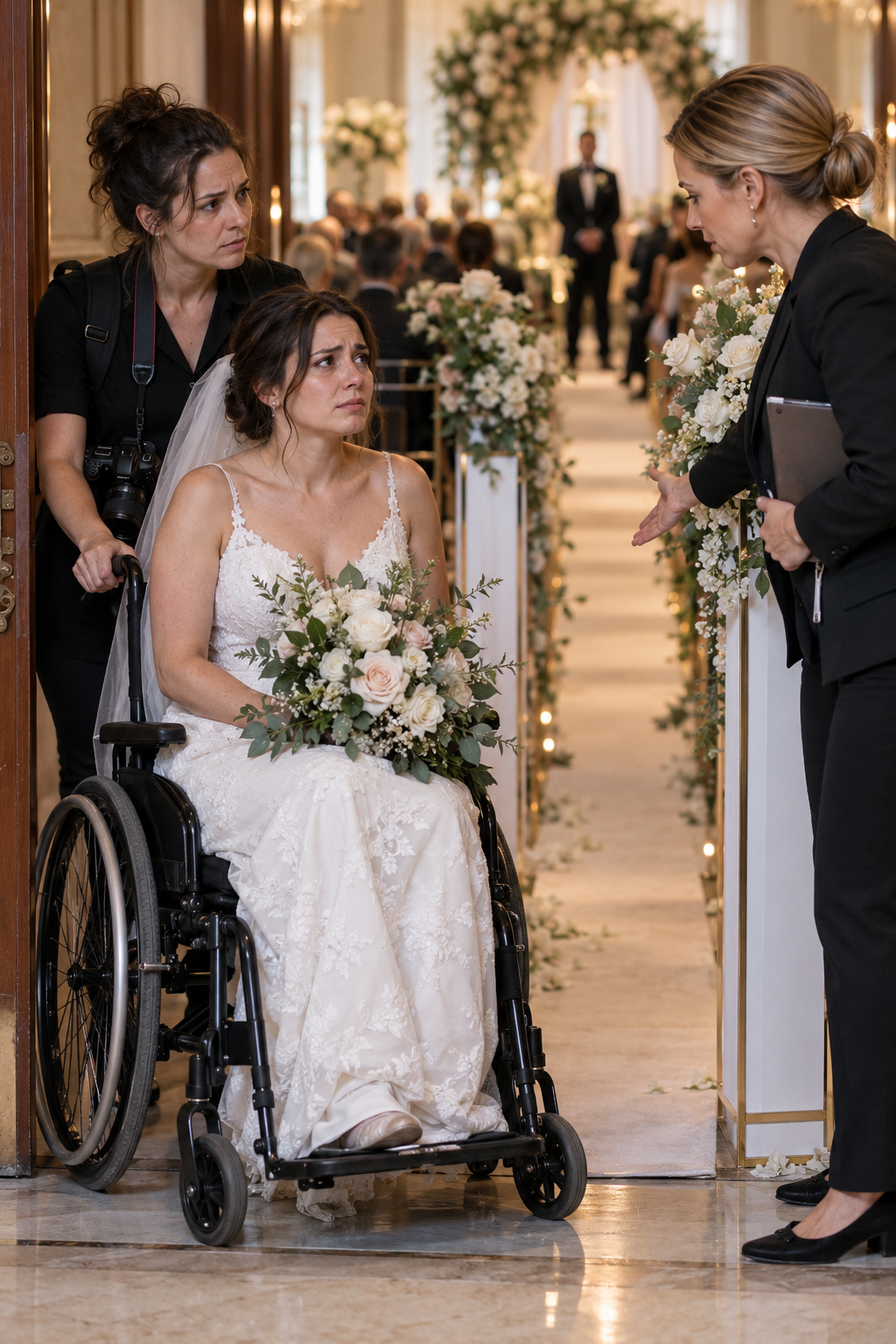
The wedding planner asked me to hide the bride’s wheelchair twelve minutes before the ceremony.
She did not whisper. She pointed toward a service corridor beside the ballroom and said, “Put it in there. Her father can help her walk the aisle, and we’ll bring it back after the photographs.”
Lena Hart was sitting three feet away.
Her hands tightened around the stems of her bouquet, but her voice stayed level.
“I’m entering in my chair.”
Tessa Vale, the planner, smiled as if Lena had misunderstood a seating chart.
“The aisle is too narrow now. The floral installation was expanded this morning. Walking will photograph better, and it’s only twelve steps.”
I had photographed weddings for eleven years. I had heard planners ask brides to turn toward better light, delay a first look, remove a watch, even change the order of speeches. I had never heard one talk about a mobility device as if it were an empty coat rack.
Lena had multiple sclerosis. She could stand for short periods, but heat, stress, and fatigue made her balance unpredictable. Her chair was not a prop she had brought because she expected a long day. It was how she intended to reach the person waiting for her.
I set my camera on the table.
“The chair stays with Lena,” I said.
Tessa looked at the badge clipped to my belt. “You’re the photographer.”
“Yes.”
“Then photograph the plan.”
The plan had changed.
Three weeks earlier, I had attended the final venue walk-through with Lena and her fiancé, Miles. Lena had rolled down a clear six-foot aisle while her father walked beside her. We had checked the turn near the first row, the small threshold at the ballroom doors, and the space beside Miles at the front. Lena had laughed because her father kept practicing when to hand her the bouquet.
At the walk-through, the aisle had been wide enough.
Now two rows of waist-high floral plinths crowded it from both sides. The opening between them was narrower than Lena’s wheels.
“What happened to the layout we approved?” Lena asked.
Tessa adjusted the tablet against her chest. “The florist had additional inventory. It elevates the room.”
“It blocks me from entering it.”
“We can solve that discreetly.”
Discreetly meant making Lena’s body disappear from the part of the wedding everyone would watch.
Her father, Daniel, stood behind her with one hand suspended near her shoulder. He wanted to help, but Lena had warned all of us during the walk-through: ask before touching the chair. Daniel lowered his hand.
“Can the flowers be moved?” he asked.
Tessa shook her head. “The bases are weighted and the guests are already seated. We cannot dismantle the aisle without delaying the ceremony.”
From inside the ballroom, the string quartet began the piece that was supposed to start five minutes before the procession.
Lena looked down at the satin ribbon wrapped around her wheel rim. Her younger sister had fastened it there that morning—something pale and soft against the black frame.
“I chose this venue because they told me I could use the center aisle,” she said.
Tessa crouched, bringing her face level with Lena’s.
“And you still can. Your father supports you, you take twelve beautiful steps, and your chair waits just out of frame.”
Lena’s expression changed at the word beautiful.
She had told me during our first meeting that strangers often congratulated her whenever she stood.
“They think the best version of me is the one who looks least disabled,” she had said. “I don’t want my wedding photographed that way.”
That sentence was written in my planning notes. It had guided every choice I made about camera height, portrait locations, and timing. Tessa had received the same accessibility notes.
I asked the venue captain to join us.
Marcus came through the ballroom doors, saw the blocked aisle, and stopped.
“This isn’t the approved floor plan,” he said.
Tessa’s smile vanished for the first time. “It’s an aesthetic adjustment. We’re resolving it.”
Marcus examined one of the plinths. Each white pedestal held a steel base beneath the flowers. Heavy, yes. Permanent, no.
“We can move four,” he said.
“And leave gaps in the design?” Tessa asked.
“Leave a route for the bride.”
Tessa turned to Lena. “The photographer, florist, quartet, kitchen, and one hundred and forty guests are working to a schedule. If we rebuild the room now, your ceremony starts late.”
There it was: not a physical impossibility, but a bill for insisting on access. Everyone else’s time would be placed on Lena’s shoulders.
Miles appeared at the far end of the aisle. He was not supposed to see Lena before she entered, but one of the groomsmen had told him something was wrong.
“What’s happening?” he called.
Tessa stepped into the doorway, trying to keep him inside.
Lena answered before anyone else could.
“They changed the aisle. Tessa wants me to walk.”
Miles came toward us. He looked at the plinths, then at the empty space they had taken.
“We measured this,” he said.
“The floral design was enhanced,” Tessa replied.
“No. The floral design was moved.”
Tessa said the ceremony could proceed immediately if Lena used the side entrance. That door opened beside the musicians, only a few feet from the front. Lena could roll in without using the aisle at all.
It was another solution that removed the problem by removing her entrance.
I picked up my camera and showed Lena the frame I had prepared from the doorway. The aisle formed a line toward Miles, with the guests on both sides and her father’s place beside her.
“This photograph still works if the flowers move,” I said. “The question is whether this is the entrance you want.”
Lena looked through the doors.
“Yes.”
That answer gave us something firmer than an argument about schedules.
Marcus called four banquet workers. The florist objected that moving the pedestals would disturb the symmetry. Lena’s sister took off her heels and began lifting greenery from the first base. Daniel removed his jacket.
Tessa stood in the middle of the doorway.
“If vendors alter the installation, I cannot guarantee the florist’s work.”
Miles walked to the nearest plinth, wrapped both arms around it, and dragged it six inches before Marcus stopped him from damaging the floor.
“Then tell us where to put it,” Miles said.
Guests in the back rows had begun turning around. The quartet faltered, recovered, and kept playing.
Lena closed her eyes.
I thought she might call off the entrance, not because she had changed her mind, but because a private access request had become a roomful of attention.
Instead, she asked me for my phone.
I gave it to her.
She opened the voice recorder and placed the phone on her lap.
“Tessa,” she said, “please tell me why the aisle approved at our accessibility walk-through was narrowed this morning.”
The planner stared at the red recording bar.
“You cannot record vendors without consent.”
“We’re in a one-party-consent state,” Marcus said. “And I’m here.”
The story did not need a legal trap. Lena was not trying to win a lawsuit in the doorway. She wanted the explanation spoken plainly enough that no one could turn it into a misunderstanding later.
Tessa said the venue had submitted photographs from past weddings to a design magazine. The florist believed a denser aisle would improve the chances of this wedding being featured. She had assumed Lena would prefer a few walking photographs because those were the images publications tended to select.
No one had asked Lena whether being published mattered to her.
No one had asked whether twelve steps were safe.
Tessa had seen a wheelchair and decided the ceremony would look more elegant without it.
Lena stopped the recording.
“My wedding is not your submission,” she said.
Then she turned to the guests.
She did not give a speech. She simply told them the aisle had been narrowed after the accessibility walk-through and would take a few minutes to correct.
“I’m sorry for the delay,” she began.
A woman in the second row interrupted her.
“Don’t apologize.”
Someone else stood and moved a chair. Then another guest did the same. Marcus directed people while the banquet workers shifted the plinths outward. The florist adjusted the loose greenery instead of watching it be crushed.
It took seven minutes.
The result was not symmetrical. Two flower towers sat closer to the walls than the others, and one arrangement leaned slightly toward the third row.
The aisle was wide enough.
Daniel took his place beside Lena. Before they entered, he bent to straighten the pale ribbon on her wheel. He did not touch the chair until she nodded.
The quartet began again.
Lena rolled through the center doors under her own power. Her father walked beside her carrying the bouquet for the first half of the aisle, exactly as they had practiced. Halfway down, he handed it back.
Miles was crying before she reached him.
I photographed the satin ribbon moving over the wheel, Daniel’s empty hands, the guests turned fully toward Lena, and the uneven flowers framing a route that existed because she had refused to vanish from it.
Tessa stayed through dinner but did not direct another photograph. Marcus reassigned the remaining timeline to his assistant.
Two weeks later, Lena and Miles came to my studio to choose their album images.
The technically cleanest frame showed Lena after the ceremony, standing for a portrait beneath the windows. She liked it, but she did not choose it for the first page.
She chose the entrance.
In the photograph, one floral tower was visibly out of line. Her father looked nervous. Miles had one hand over his mouth. The ribbon on her wheel was slightly blurred.
“It looks like what happened,” Lena said.
The venue refunded the planning fee and removed Tessa from its preferred-vendor list after reviewing the approved floor plan and the recording. The magazine never saw the wedding because Lena declined the submission release.
She did allow me to post one photograph on my portfolio.
Not the standing portrait.
The entrance.
Months later, another bride emailed me after seeing it. She used a walker and had been told to leave it outside her ceremony photographs.
She wrote, “I didn’t know I was allowed to want pictures that looked like my actual life.”
I forwarded the message to Lena.
Her reply came a minute later.
“Tell her the aisle belongs to her before it belongs to the flowers.”