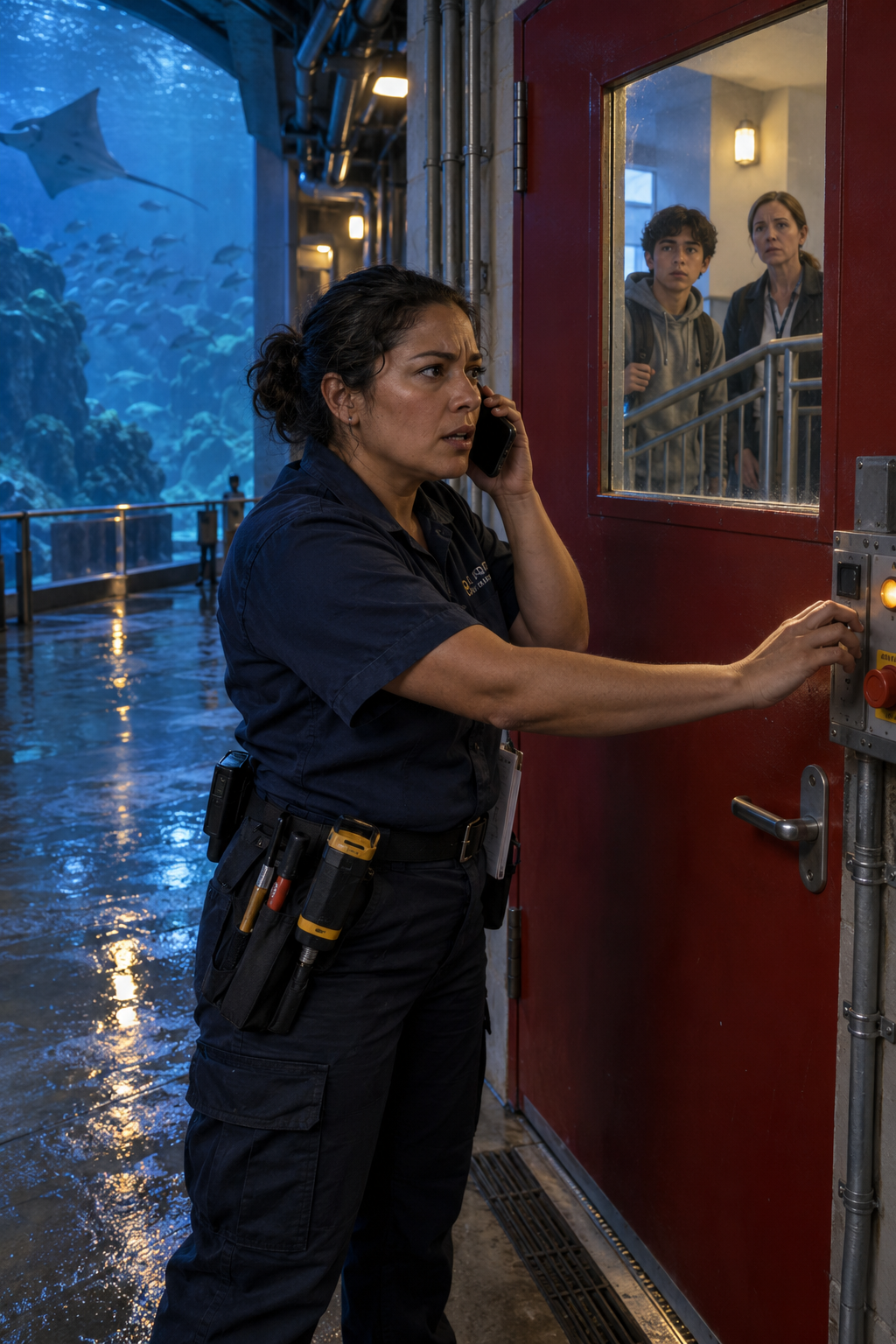
My son called from behind a locked flood door seven minutes after the aquarium’s evacuation board turned green.
“Mom,” Eli said, trying not to sound frightened, “Ms. Chen and I are still in the river tunnel.”
I was standing in the main electrical room beneath a screen that showed every public zone as clear. Outside, a September storm was pushing seawater over the harbor road. Inside, the aquarium’s automatic barriers had dropped to protect the lower galleries.
The board said the river tunnel was empty.
My sixteen-year-old son said otherwise.
“Where exactly are you?”
“On the maintenance landing by the otter pumps. Amina hurt her ankle, so Ms. Chen stayed with us. The red door closed before we reached the stairs.”
Amina was twelve. She was part of the overnight science program Eli had volunteered to help.
“Is water coming in?”
“Under the outside door. It’s across the floor, not on the landing.”
I told him to keep everyone on the steel stairs and put Ms. Chen on the phone.
Then I ran.
I had maintained electrical systems at Blue Harbor Aquarium for nine years. I knew which pumps could run on backup power, which doors failed open during a fire, and which barriers did the opposite during a flood. The red doors were designed to divide the lowest level into sealed compartments. Once sensors detected outside water, each door locked until the control room confirmed that pressure had equalized.
They protected the exhibits, the generators, and the life-support equipment.
They could also trap anyone a head count failed to find.
Facilities director Owen Baird met me at the lower stairwell. He was carrying the evacuation tablet.
“The system shows that section clear,” he said.
“My son is inside it.”
He looked at the green square as if Eli’s voice had to be the error.
“Everyone scanned at assembly.”
“The wristbands were collected before bedtime.”
The overnight staff had removed the students’ paper bands because several children complained they scratched. A chaperone placed all twenty-four bands in a zip bag and scanned the bag at the assembly point during the evacuation.
The board had counted bands, not children.
Owen’s face changed.
He radioed security and asked for a manual count. Twenty-one students and two adults were in the upper theater. Eli, Amina, and Ms. Chen were missing.
The fire department was already responding, but flooded streets had slowed its arrival. Estimated time: eighteen minutes.
I reached the red barrier separating us from the river tunnel. Through the wired-glass window, I could see Eli and Ms. Chen on a raised landing. Eli had one arm around Amina’s shoulders. The public corridor below them shone with a thin sheet of water under blue exhibit lights.
Eli lifted his phone when he saw me.
I pressed mine to my ear.
“Good,” I said. “You’re exactly where you need to be.”
“Can you open the door?”
I looked at the control panel. The indicator above the manual release was red.
Not safely from this side.
Opening the barrier against rising water could send the corridor’s load into the electrical room behind me. That room fed pumps supplying oxygen to three large marine habitats. Owen’s concern was not imaginary. If salt water reached the low-voltage cabinet, we could trade one emergency for another.
“We wait for fire rescue,” he said. “They’ll bring inflatable seals and open it from the dry end.”
Amina cried out behind the door. Ms. Chen had tried to adjust her ankle.
Eli said, “The water just reached the bottom step.”
The landing was four steps high.
I asked him to show me the corridor with his camera. The water was moving from the seaward exit toward the barrier. Not fast, but steadily.
The display beside me showed the outside drain valve as closed. That valve should have opened when the barrier dropped, allowing seepage to collect in a sump instead of the corridor.
“Why is drain three shut?” I asked.
Owen checked his tablet. “The actuator faulted during last month’s test. The replacement is on order.”
“Was the tunnel supposed to be used overnight?”
“It passed inspection with a manual drainage plan.”
“Where’s the manual pump?”
He did not answer immediately.
The portable pump had been moved to the penguin loading bay after a pipe leak that morning. No one had returned it.
The barrier system was operating exactly as designed around two pieces of equipment that were not where the emergency plan required.
Waiting eighteen minutes was no longer the safe option.
I called our senior aquarist, Priya, who was monitoring the life-support room upstairs. I asked how long the large tanks could hold normal oxygen levels if we isolated the lower electrical cabinet.
“With circulation reduced? Twelve minutes without stress, maybe fifteen,” she said. “Backup aerators will stay on.”
I needed less than two.
The red barrier had a service interlock. If I cut power to the vulnerable cabinet, closed two upstream breakers, and engaged the mechanical drain handle from the other side, Owen could release the door for ninety seconds without exposing live equipment to water.
The problem was reaching that drain handle.
It sat in a narrow service alcove inside the sealed compartment, twenty feet from Eli’s landing. The water there looked ankle-deep and could hide debris or energized equipment.
I would not send a child into it.
Ms. Chen could not leave Amina safely.
There was another route.
Behind the freshwater exhibit, a dry maintenance crawlway connected to the top of the pump platform. It was built for technicians, not evacuation. The hatch on our side was above a filter rack; the hatch on theirs opened behind the otter pumps, six feet from the manual drain.
I told Owen my plan.
He said, “You’re not going through there alone.”
“I fit. You don’t.”
That was true. It was also not sufficient.
I clipped a radio to my collar, put on an insulated flotation vest, and tied a guide rope to the anchor beside the hatch. Security officer Darius checked the knot and took the other end. Priya confirmed the affected circuits were isolated before I touched the access ladder.
Every step had a reason. No one was going to turn panic into a second rescue.
The crawlway smelled of dust and cold metal. I moved on my elbows beneath bundled pipes while rain hammered somewhere above the concrete. Halfway through, the aquarium lights flickered as the building transferred another system to generator power.
Eli’s voice came through my radio.
“Mom?”
“I’m in the service passage.”
“You hate tight spaces.”
He remembered a stalled elevator from when I was a child, a story I had regretted telling him because he used it whenever I avoided crowded lifts.
“I hate lots of things,” I said. “Keep talking.”
He described what he could see. Amina was breathing fast but answering questions. Ms. Chen had wrapped the ankle with a sweatshirt. The water was at the second step.
Then he said something that made me stop.
“There’s water coming from the wall now.”
Acrylic viewing panels lined the river tunnel. I imagined a cracked exhibit and thousands of gallons behind it.
“Which wall?”
“The gray one under the EXIT sign.”
That was not an exhibit panel. It was the emergency overflow channel. Water spilling there meant the blocked sump had reached its bypass level.
We had less time than I thought.
I reached the far hatch and pushed it open. Eli was on the landing across the corridor. He began to step down toward me.
“Stay there,” I said.
I lowered myself beside the otter pumps. The water reached my boots. My voltage tester showed no live current in the isolated zone.
The manual drain wheel was stiff from disuse. I pulled once. Nothing.
Owen’s voice came through the radio. “Fire rescue is ten minutes out.”
The water rose against my shins.
I braced one foot against the wall and turned the wheel with both hands. Rust broke loose. The drain opened with a sound like a bathtub emptying beneath the building.
The corridor current changed direction.
Priya began the electrical isolation upstairs. One by one, the pumps in the lower room wound down. The enormous tank beside the public gallery became quieter than I had ever heard it.
“Cabinet is dead,” she said. “Backup aerators active. Your window starts now.”
Owen engaged the barrier release.
The door moved two inches and stopped.
Something blocked the bottom track.
Through the glass, I saw a yellow plastic stool wedged beneath the edge. It had floated from the children’s activity station and jammed when the barrier settled.
Eli could reach it from the landing if he stepped into the water.
I could reach it from my side.
Darius tightened the guide rope as I crossed. The drain was pulling water past my legs toward the sump. I kept one hand on the rail, crouched, and dragged the stool free.
The door shuddered upward.
Ms. Chen carried Amina down two steps. Eli took her other side. They crossed through the opening while Owen counted the seconds aloud.
Amina first.
Ms. Chen second.
Eli stopped beside me.
“You too,” he said.
We crossed together with thirty-four seconds left. Owen lowered the barrier again before Priya restored the cabinet.
By the time firefighters reached us, all three were in the upper theater. Amina had a badly sprained ankle, not a fracture. Eli refused a blanket until Ms. Chen took one.
The aquarium’s animals never lost oxygen support. The flood reached the third step, then receded through the reopened drain.
At dawn, I sat with Eli on the loading dock while the rain weakened over the harbor.
He asked whether the green evacuation board had been broken.
“No,” I said. “It counted exactly what we told it to count.”
That answer stayed with me.
Blue Harbor canceled the remaining overnight programs until the flood plan was rebuilt around people instead of wristbands. The portable pump received a fixed storage cradle with a removal alarm. The faulty drain actuator was replaced before the lower gallery reopened. Every sealed zone gained a direct voice check, and no one could scan a bag of bands as a group again.
Owen did not become a villain after the water went down. He had made the wrong choice because a green screen appeared more reliable than a frightened voice. In the review, he said that plainly.
Eli returned to volunteer work two months later.
On his first night back, I watched the evacuation drill from the electrical room. The board turned green only after each zone leader spoke to the control desk and named the people standing in front of them.
The river tunnel reported last.
“Three students, one teacher, one volunteer,” a voice said.
Then Eli leaned toward the radio.
“And we’re actually here.”