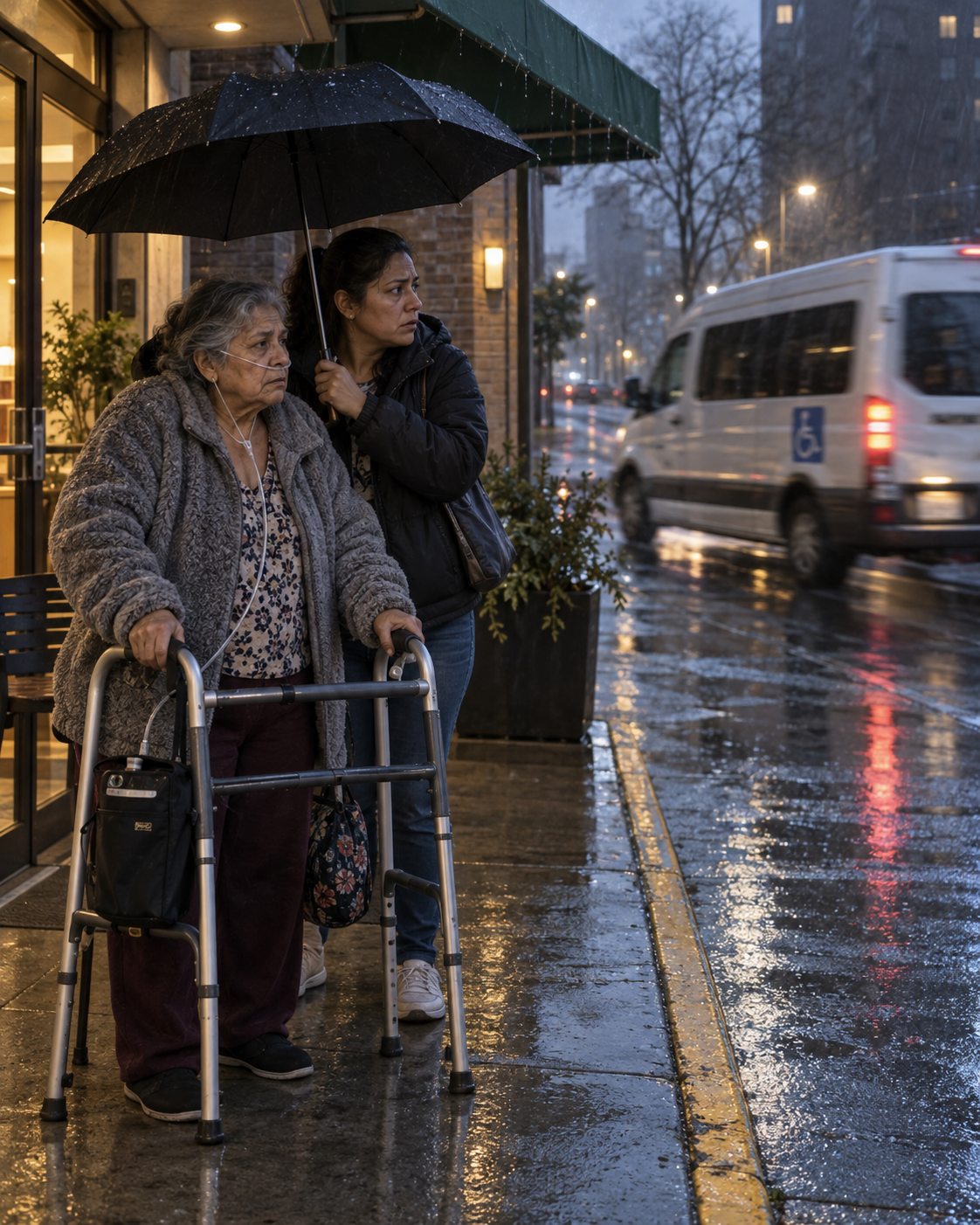
At 5:42 on a wet Tuesday morning, the disability van slowed in front of my mother’s building, passed her without stopping, and disappeared through the next light.
Mom was exactly where the transit office had told her to be: under the green awning, oxygen bag over one shoulder, folding walker locked in front of her. I was beside her holding an umbrella over both of us.
Three minutes later, my phone buzzed.
**Rider not present. Trip canceled.**
My mother read the message over my wrist.
“They did it again,” she said.
Again was the word that changed everything.
Until then, I had believed the missed rides were a string of small failures—the kind that happen when an overworked dispatcher, an unfamiliar driver, and a computer schedule all disagree before sunrise. That morning was different. I had watched the driver look toward us. I had seen the brake lights flare. And I had received a notice claiming the curb had been empty while rainwater was still dripping from my coat.
Mom’s dialysis appointment was at 6:15. If she missed the first hour, the clinic could not simply push every patient behind her. They would have to shorten her treatment or find an opening later in the day.
I called the number on the cancellation message.
After eleven minutes of hold music, a dispatcher named Evan answered.
I gave him the trip number and said, “The rider was present. I was present. Your van drove by us.”
Keys clicked in the background.
“The driver logged a no-show at 5:44.”
“Then the driver logged something false.”
His voice became careful. “I can submit a service concern, but the trip has been closed.”
“Can you reopen it?”
“Not once the vehicle is reassigned.”
I looked at Mom. She had lowered herself onto the walker’s narrow seat. The awning protected her head but not her shoes, and water had begun to darken the toes.
“How is she supposed to get to treatment?”
There was a pause. Then Evan said, quietly, “If you can arrange another ride, keep the receipt.”
That was not an answer the transit office advertised.
I ordered an accessible taxi. It arrived at 6:18 and cost sixty-four dollars. The clinic managed to fit Mom into a late chair, but she spent six hours there instead of four because they had to work around the patients who had arrived on time.
When I picked her up, she was exhausted and embarrassed.
“I don’t want you missing work over this,” she said.
I repaired commercial sewing machines for alteration businesses, cleaners, and upholstery shops. My customers could wait for a belt replacement. Mom’s blood could not wait for a scheduling office to admit what I had watched happen.
At her kitchen table, I opened the transit app and found four canceled trips in eight weeks. Each had the same code: **Rider not present**.
Mom remembered waiting for three of them. On the fourth, she had been in the lobby because the lift at the front entrance was jammed. She had called dispatch seven minutes before pickup to explain. The trip was still marked as a no-show.
“Why didn’t you tell me there were four?” I asked.
She folded the taxi receipt until it was the width of her thumb.
“Because every time I call, they ask whether I know what time means.”
My mother had spent thirty-one years running the front office of a roofing company. She had scheduled crews, inspections, deliveries, and emergency repairs. She knew what time meant.
The next afternoon, I filed a written complaint with Harbor Mobility, the private company operating the city’s disability vans. I attached the cancellation screenshot, the taxi receipt, a photograph I had taken of Mom beneath the awning, and the original photo’s metadata showing 5:43 a.m.
The response came from operations manager Grant Pell.
He wrote that the company had reviewed the trip and confirmed the driver had waited the required two minutes. He added that repeated no-shows could lead to a temporary suspension under rider policy.
That last sentence was not necessary to answer my complaint. It was there to make the cost of arguing clear.
I replied with one question: Where, exactly, had the driver waited?
Pell sent a satellite image with a red circle near the rear service entrance of Mom’s building.
The accessible pickup point was at the front awning. The rear entrance had three concrete steps and a locked delivery door.
For a moment, I thought I had found the whole problem: bad map pins.
Then I enlarged his image. The red circle was not a system marker. It had been drawn onto the screenshot.
I called the city’s accessible transportation office and asked for the official pickup-point record. The coordinator emailed me the form Mom had signed two years earlier. It included a photograph of the green awning and the words **NO REAR ACCESS—STAIRS** in capital letters.
I sent both images to Pell.
He did not answer my question. Instead, he called Mom.
She put the phone on speaker because she had trouble hearing him over her oxygen concentrator.
“Mrs. Alvarez,” he said, “we want to keep providing you with service, but your account is attracting a pattern of disputes.”
“My account is attracting vans that don’t stop,” she said.
Pell exhaled. “Your daughter’s tone is making resolution difficult.”
Mom glanced at me. “My kidneys are making delay difficult.”
The call ended with no replacement ride, no correction, and a warning that another reported no-show could trigger a fourteen-day service-suspension review.
That gave us practical stakes beyond one missed appointment. It also gave us a deadline. Mom had another dialysis pickup on Friday.
I began with the building’s doorbell camera. The property manager let us view the Tuesday recording but would not release a copy without a formal request. On screen, the van appeared at 5:42:17. It slowed for nine seconds. It never pulled to the curb. Mom and I were visible beneath the awning the entire time.
I wrote down the timestamp and camera number. Then I submitted a preservation request through the city transportation office so the recording would not be overwritten after thirty days.
Mom watched me complete the form.
“You learned that language from your father,” she said.
My father had been a union steward. He believed that if a rule could be used against a worker, the worker should know the rule better than the person quoting it. After he died, Mom kept his accordion file of grievances in the bottom drawer of her desk.
Inside it, I found a note he had written across a faded training handout: **Never argue only about the result. Ask what record created it.**
So I stopped arguing about the no-show and asked what record had created it.
The city contract required each van to transmit location data when a driver selected ARRIVED, RIDER BOARDED, or NO SHOW. I requested the event record for Mom’s trip, along with the public portion of Harbor Mobility’s performance reports.
While I waited, I called the dialysis clinic’s social worker, Nia Brooks. I expected advice about reimbursement. Instead, she asked for Mom’s trip number.
“Is this Harbor?” she said.
“Yes.”
Nia was silent long enough that I checked the call had not dropped.
“I have six patients whose rides have become unreliable since June,” she said. “Four were marked absent at least once. The complaints come back as driver-confirmed.”
She could not give me patient names, but she could ask whether they wanted my number. By evening, two riders had called.
Mr. Lyle used a powered wheelchair. His van had reported waiting at his address while its own automated text said it was eight minutes away. Denise Cho had been marked absent from a rehabilitation clinic even though a nurse had waited with her at the designated entrance.
Both had received the same warning about “a pattern of disputes.”
The problem was no longer one driver or one bad pin.
The city sent Mom’s location record the following morning. At 5:44:03, the driver had selected NO SHOW.
The coordinates were not behind her building.
They were seven blocks away, beside a coffee warehouse.
I placed the coordinates, Pell’s marked-up map, and the doorbell-camera timestamp on one page. The sequence was simple enough for anyone to understand: the van passed Mom at 5:42, traveled on, and declared her absent at 5:44 from somewhere else. Pell’s review had supposedly confirmed a two-minute wait that had never occurred.
But one false record still did not explain why multiple riders were being treated the same way.
The performance reports did.
Harbor Mobility received a monthly incentive for completing a high percentage of trips within a thirty-minute pickup window. Trips canceled as rider no-shows were removed from the late-trip calculation. A missed pickup counted against the company. A no-show counted against the passenger.
The rule did not prove that managers had ordered false entries. It did show who benefited from them.
On Thursday afternoon, Pell finally answered my email. He said Mom’s Friday ride would proceed, but a field supervisor would “observe compliance at the registered location.” The phrasing made Mom sound like the thing being inspected.
Nia helped us file an urgent complaint with the city mobility ombudsman, Imani Reed. We sent only records we could verify: the official pickup form, my photograph, the preserved-camera reference, the vehicle coordinates, the cancellation notice, and Pell’s written response.
Imani called that evening.
“Do not stage anything different tomorrow,” she said. “Your mother should follow her normal instructions. I will be at the lobby before pickup, but Harbor will not be told I’m there.”
“Are you trying to catch the driver?” Mom asked.
“I’m trying to observe the system,” Imani said. “The driver may be following pressure we haven’t seen yet.”
That distinction mattered.
At 5:30 Friday morning, Mom and I took our place beneath the awning. Imani waited inside with the property manager, positioned where the lobby camera would record her arrival. Nia had arranged a backup clinic slot and an accessible taxi on standby. For once, Mom’s treatment did not depend entirely on whether Harbor did the right thing.
At 5:41, the van turned onto the block.
It pulled to the curb.
The driver, a tired-looking man named Rafael, lowered the window but did not open the lift.
“Mrs. Alvarez?”
Mom raised her hand.
Rafael looked at the tablet mounted beside the steering wheel. A message appeared. I could not read it, but I saw his shoulders tighten.
He picked up the radio.
“Dispatch, rider is visible at the front location.”
The reply came through loudly enough for us to hear.
“Unit twelve, hold. Supervisor verification required.”
We waited in the rain for four minutes.
Then Pell’s voice came over the radio.
“If the registered point is inaccessible, code the trip and clear.”
Rafael looked from the green awning to Mom’s walker.
“The registered point is accessible,” he said.
“Your map says rear service door.”
“Passenger is standing at the front pickup marker.”
There was another pause.
“Unit twelve, maintain schedule.”
Rafael did not touch the NO SHOW button. He opened the door and lowered the lift.
That was when Imani stepped outside and identified herself.
Pell had assumed the driver would choose his supervisor’s instruction over the evidence in front of him. Rafael’s refusal changed the balance before Imani said another word.
She asked him to preserve the tablet messages and radio traffic. Then she rode with Mom to the clinic, not as a surprise rescuer but as the official observer assigned to the complaint we had filed.
The review took six weeks.
During that time, the city did not declare anyone guilty. It did something more useful first: it suspended Harbor’s performance incentive, prohibited passenger suspensions based on disputed no-shows, and required the company to retain location and dispatch records for every challenged trip.
Those records showed twenty-seven no-show entries created away from registered pickup points over four months. Eleven had been entered after dispatch messages about schedule recovery. Some drivers had objected in the message log. Others had followed instructions.
Pell was removed from scheduling duties while the city conducted a contract review. Harbor reimbursed verified backup transportation costs and corrected the affected rider accounts. The city also changed the calculation that had rewarded a canceled trip more than a late one.
Rafael kept his job. In his interview, he admitted he had passed Mom on Tuesday. Dispatch had redirected him before he reached the curb, then told him to close the trip two minutes later. On Friday, after seeing her waiting, he could not make the same entry again.
Mom never met the other twenty-six riders. She did not become the face of a campaign, and she refused a reporter’s request for an interview.
“I don’t want to be brave on television,” she told me. “I want my ride to arrive.”
Her next three vans did.
On the fourth trip, snow had begun before dawn. The driver was nine minutes late and called from the curb to apologize. Mom put on her coat, checked her oxygen bag, and walked out beneath the green awning.
The app labeled the trip **Delayed**.
Not completed. Not canceled. Not absent.
Delayed.
It was an ordinary, accurate word. After months of being told she had not been where she stood, accuracy felt like the first part of getting her freedom back.