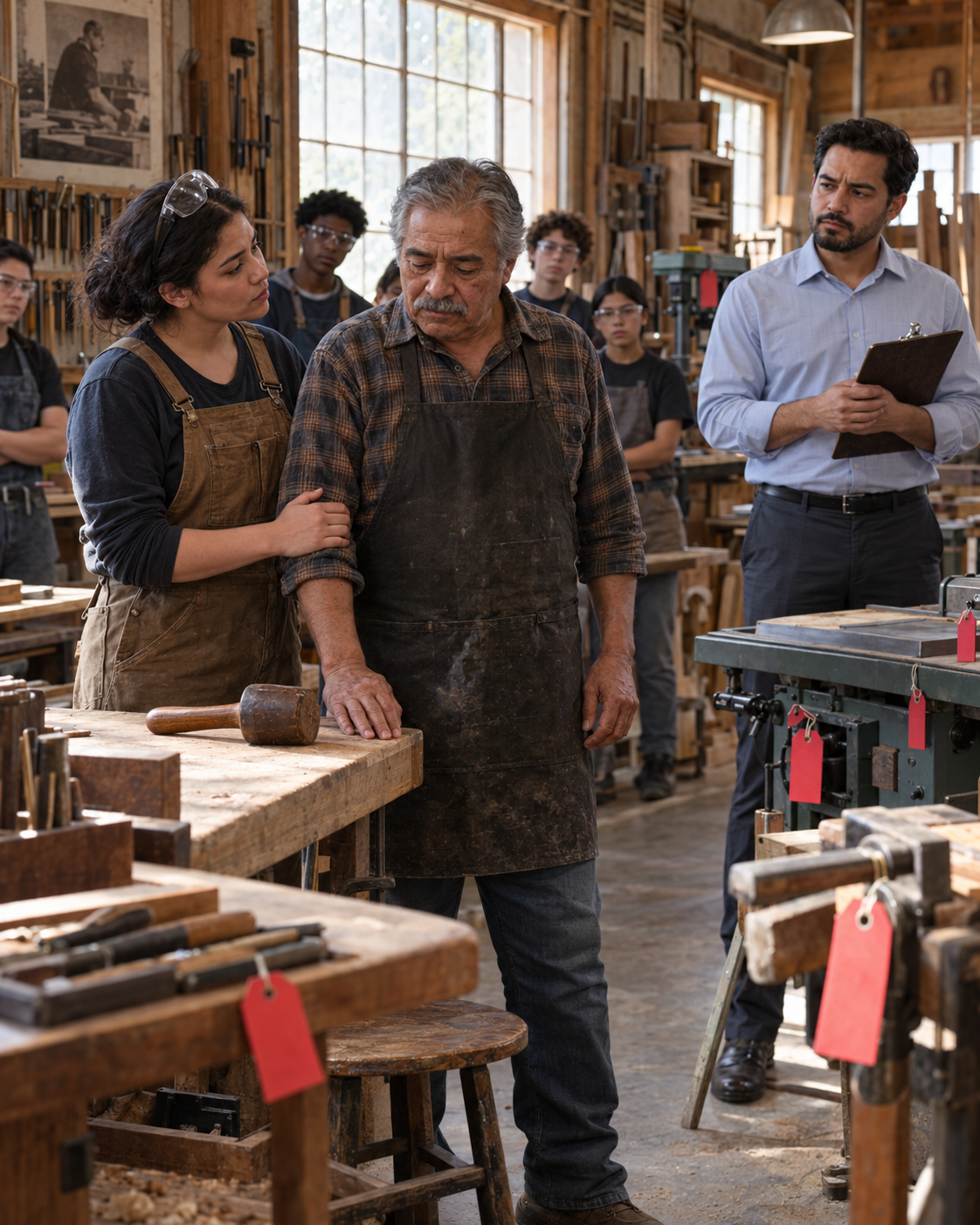
The first red auction tag was tied to my father’s table saw while his hand was still resting on the switch.
He was showing twelve-year-old Luis how to keep both palms flat on the push block. Six teenagers stood around the workbench in safety glasses, waiting for the thin strip of maple to clear the blade.
Then Luis pointed at the tag.
“Mr. Mateo,” he said, “does that mean this is for sale?”
My father looked down. The tremor in his right hand made the paper flutter against the steel housing.
I crossed the shop so fast I knocked a jar of pencils onto the floor.
There were tags everywhere.
One on the drill press. One on the planer. One looped through the handle of the wooden cabinet my father had built before I was born. Even the three-legged stool he used on bad Parkinson’s days had a red card hanging from it.
LOT 47, the card said. PREVIEW FRIDAY. AUCTION SATURDAY.
Saturday was the last class of the students’ twelve-week program.
My brother Adrian stood in the office doorway with a clipboard under his arm.
“You were supposed to wait until they left,” he told the auction employee behind him.
I tore the tag off the stool. “You were supposed to tell us there was an auction.”
Dad switched off the saw and removed his glasses. “Elena.”
He said my name quietly, but I was already walking toward Adrian.
Six months earlier, Dad had asked him to handle the shop’s bills. Adrian was an accountant. I repaired bicycles out of a van and taught the Thursday woodshop class. Dad’s tremor had made handwriting difficult, and the medication schedule exhausted him. Letting Adrian manage invoices had seemed practical.
Apparently, Adrian had decided that managing meant deciding.
“The building has an offer,” he said. “A real one. Dad’s care is getting more expensive, the shop lost money three months in a row, and half these machines haven’t paid for themselves in years.”
“So you sell them while he’s using them?”
“I’m selling the equipment before the buyer closes on Monday.”
Dad’s face did not change. That frightened me more than anger would have.
“Class is over for today,” he told the students. “Put your projects on the finishing rack. We meet Saturday as planned.”
Adrian exhaled. “There won’t be a shop Saturday.”
Dad looked at him. “Then we will need to be efficient.”
After the students left, I pulled every tag I could reach. Adrian followed me, tying them back on.
“The building belongs to all three of us,” I said.
Our mother had left it equally to Dad, Adrian, and me. Adrian had persuaded me months ago to sign a limited authorization so he could negotiate a sale if the right offer came. I had imagined we would discuss the right offer. I had not imagined a clipboard appearing in the middle of class.
“You signed,” Adrian said.
“For the building. Not Dad’s tools.”
“The big machines are shop assets.”
“And the stool?”
His eyes flicked toward it. For one second, he looked ashamed.
“The auction company tagged the room,” he said.
Dad walked past us to the locked cabinet behind his bench. He needed two tries to fit the key. I reached for it, and he pulled his hand away.
“Both of you go home,” he said.
“Dad, I can stop this.”
“That is the problem.”
He opened the cabinet himself.
Inside, every shelf was empty.
I had seen that cabinet full three days earlier: carving chisels wrapped in canvas, hand planes polished black at the handles, his father’s brace drill, and the walnut mallet Dad had used to tap every joint I made as a child.
“Where are your tools?” I asked.
“Safe.”
Adrian stared into the cabinet. “You moved assets?”
Dad shut the door. “You may both come back tomorrow when you remember I am in the room.”
The next morning, blue dots had appeared beside some of the red tags.
Dad sat at the workbench with a paper cup of coffee. He had marked the planer, the wide-belt sander, the dust collector, and two commercial saws.
“Those can go,” he said.
I thought Adrian had pressured him overnight. “You don’t have to agree because he scared you.”
Dad set down his cup.
“Elena, your brother thinks a tremor means I cannot choose. You think loving this place means I will never choose to leave it. You have different reasons for making me invisible.”
The words landed cleanly.
He slid a folder toward us. Inside was a list of equipment in his narrow block printing. Beside each item was a blue dot, a name, or the word CLASS.
He had started the list eleven weeks earlier.
The machines with blue dots were expensive to maintain and unnecessary for teaching. Tools with names beside them had never truly belonged to the shop. They had been lent to former apprentices who brought them back when Dad needed them for a particular job. The items marked CLASS were teaching kits Dad had assembled over thirty years—small saws, clamps, squares, planes, and safety equipment.
At the bottom was an email from Rosa Chen, director of the community college’s evening program. She had offered Dad two rooms in an old maintenance building, accessible by a ramp, for one Saturday class a month. The students would pay nothing.
“You planned to close?” I asked.
“I planned to change.”
Adrian flipped through the pages. “The college isn’t buying the equipment.”
“They do not need to. The class tools are mine.”
“And your care?” Adrian asked. “The bathroom rail, the medication, somebody to be with you after surgery?”
Dad tapped one line on the list. The restored Italian lathe was gone. I had assumed it was being serviced.
He had sold it privately for enough to pay for the bathroom work and four months of home help.
“You sold the lathe?” I said. “You loved that machine.”
“I love not falling in the shower more.”
For the first time, Adrian almost smiled.
Then he saw the date on the college agreement.
“You knew eleven weeks ago,” he said. “You let me carry the accounts and chase buyers while you made another plan with Elena.”
“I didn’t know,” I said.
Dad looked from him to me. “Neither of you asked what I wanted. One asked what everything was worth. The other kept promising nothing would change.”
Adrian closed the folder. “The buyer closes Monday. The auction stays.”
“For the blue dots,” Dad said.
“The auction company has a contract for the contents.”
“Then you wrote a contract for things you did not identify.”
On Friday, buyers began arriving for the preview at nine.
So did people I had not seen in years.
Tasha Green, who had apprenticed with Dad before opening a cabinet shop, carried in two canvas rolls of chisels. Omar Bell returned a mortising machine in the back of a bakery van. Mrs. Alvarez arrived with a block plane Dad had lent her husband in 1998. A retired theater carpenter brought six clamps, each engraved with a different name.
They were not donations. They were returns.
By noon, the empty cabinet was full again, and the wall above the teaching bench held tools labeled for former students, neighbors, and people Dad had quietly helped start businesses.
The auction manager stopped attaching tags.
“I need ownership confirmed,” she told Adrian.
He looked at the crowded shop and then at Dad. “You called all these people.”
“Rosa did,” Dad said. “I asked her to tell them it was time to bring things home.”
I realized this was not Dad’s attempt to save the shop. It was how he had decided to end it: by separating the business from the work that mattered.
Saturday morning, the auction opened at the front of the building. In the back, Dad’s students arrived for class.
The noise should have been impossible—the auctioneer calling numbers, machines starting for demonstrations, parents folding chairs against the wall. But Dad stood at the center bench and held up Luis’s maple box.
The lid would not close. One corner was nearly an eighth of an inch high.
“What do we do with a mistake?” Dad asked.
Luis looked at the floor. “Start over?”
Dad shook his head. “First, we find where it begins.”
He placed the walnut mallet in Luis’s hand and guided him toward the joint. His own hand shook. His voice did not.
At the front, the planer sold. Then the wide-belt sander. Then the two commercial saws. Each blue dot disappeared from Dad’s list.
When the auction manager reached the teaching bench, Adrian stepped in front of her.
“Not this section,” he said.
She checked her clipboard. “It’s included in the room inventory.”
Adrian took the red tag from Dad’s stool, then the one from the cabinet. “The inventory was wrong.”
He did not apologize. Dad did not thank him.
But when Luis tapped the joint flush and the lid finally settled, Adrian was watching.
The building sale did not close Monday.
Adrian negotiated a sixty-day extension with the buyer. I spent those weeks helping Rosa turn the college rooms into a shop. Dad chose which benches went, which tools followed, and which scraps of wood were finally just scraps.
He sold the three-legged stool himself and bought a taller drafting chair with a backrest. He refused the old cabinet because the college doors were too narrow and because, he said, a cabinet should not become a shrine.
On the last moving day, Adrian arrived in a white shirt and ruined it carrying the drill-press base up the ramp. He and Dad spoke about the electrical bill. Nothing else.
Dad teaches one Saturday morning a month now. He sits more than he used to. The students do the lifting. I teach the Thursday class, and Adrian still handles the accounts, but every expense over five hundred dollars requires Dad’s signature or his recorded approval.
He has not given either of us a key to the tool cabinet.
Last Saturday, I watched Luis finish a new box at the college bench. He reached for Dad’s walnut mallet, the one tool Dad had never marked with a blue dot or a name.
Dad stopped his hand.
“Ask first,” he said.
Luis did.
Dad smiled and handed it over.