The hotel told me to throw away 214 wedding meals while the bride’s grandmother sat on an evacuation bus across the street.
At 5:18 that evening, every plate in my banquet kitchen was ready.
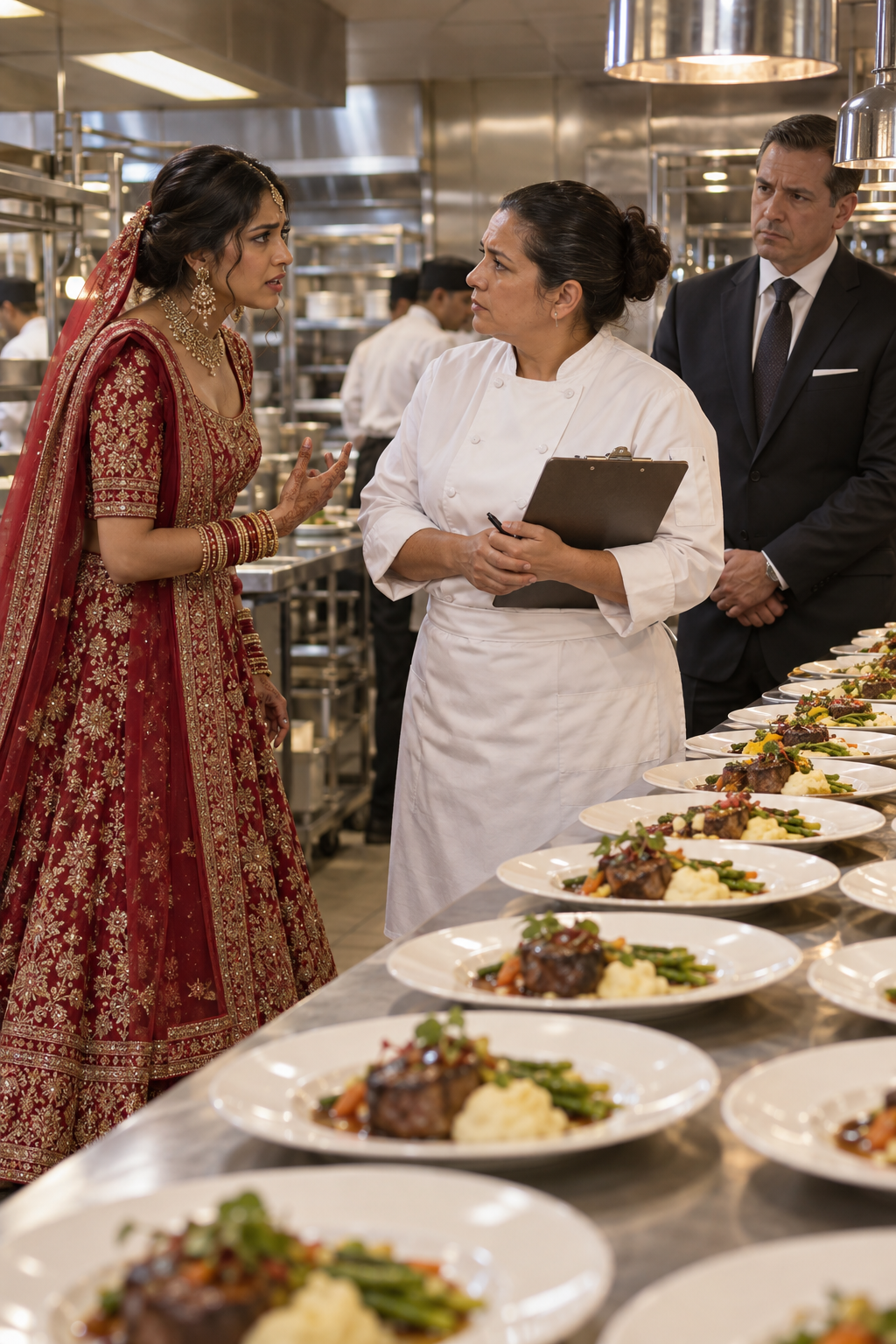
Braised short ribs. Saffron rice. Green beans with toasted almonds. Twenty-eight vegetarian plates marked with small copper picks. The pastry team had finished the last sugar flowers on a five-tier cake.
Upstairs, the ballroom waited for Priya Shah and Daniel Reed.
Then the fire alarm sounded in the senior apartment building next door.
Smoke came from an electrical room on the third floor. Firefighters evacuated ninety-six residents into buses along the curb. The rain was hard enough that wheelchairs had to be covered with plastic sheets between the lobby and the vehicles.
Priya’s grandmother, Nani, lived in apartment 318.
The bride saw her through the hotel windows.
At 5:31, Priya postponed the ceremony.
At 5:42, hotel events director Martin Cole entered my kitchen and told me to stop service.
“The family has canceled the reception,” he said. “Document the waste and clear the hot line.”
“Canceled or delayed?”
“Canceled for tonight.”
The short ribs were above safe holding temperature. The rice had been cooked in batches and transferred directly to covered pans. We had food for more than twice the number of people sitting on those buses.
“What is the evacuation plan for the residents?” I asked.
“That is not our event.”
Martin’s answer was technically true.
The hotel had offered its covered entrance to paramedics, but management would not admit residents beyond the lobby. The ballroom was contracted as a private function space. The buses were supposed to take evacuees to a community center once the fire department determined which streets remained open.
I asked whether we could donate the meals.
Martin shook his head. “Prepared banquet food does not leave through the loading dock without an approved receiver. Liability, allergens, chain of custody. You know the policy.”
I did know it.
I was executive chef at the Calder House Hotel. My name appeared on the temperature logs, and if food left our control warm, unlabeled, and late, people could get sick. “Donate it” was not a magic phrase that made transport safe.
But safe food, labeled and served inside the building, was different.
“The ballroom is empty,” I said.
“It is not an emergency shelter.”
“It has tables, accessible bathrooms, and two hundred fourteen hot dinners.”
Martin’s expression hardened. “The bride’s family paid for exclusive use. Until they release the room, no one else enters. After cancellation, we reset it.”
He left me with instructions to photograph the plates before disposal.
My sous-chef, Theo, stood beside the pass holding a tray.
“Do we start?” he asked.
I looked at the clock.
Hot food could remain safely held because our equipment was working. We had time, but not endless time. Once the kitchen broke down the line, rebuilding service for more than two hundred plates would be difficult.
“Keep everything hot,” I said. “Ten minutes.”
At 5:49, Priya walked through the swinging kitchen doors in a red wedding lehenga, rain darkening the hem. Her veil had been pulled away from her hair and wrapped around one arm.
Martin followed her.
“Guests are not permitted in the kitchen.”
“She is not a guest,” I said. “She bought what’s on the pass.”
Priya ignored both of us.
“How long can you hold the food?”
“Safely? The equipment can maintain it. Quality starts dropping within the hour.”
“Can you feed the people outside?”
“Here, yes. If management opens a room and we record dietary information. Offsite, only if an approved organization receives and transports it correctly.”
Priya nodded as if she had come for that exact distinction.
“Open the ballroom.”
Martin said the wedding contract did not allow a public event. Priya took out her phone and called her father, who was listed as the purchaser.
Mr. Shah arrived with Daniel and two members of the wedding party. His first concern was Nani. Firefighters had checked her oxygen level and moved her to the front bus, but she refused to leave for the community center without knowing what had happened to Priya’s ceremony.
His second concern was the contract.
“We are not canceling use of the ballroom,” he told Martin. “We are changing our guest list.”
Martin said ninety-six unregistered people created security, staffing, and insurance problems.
Daniel asked, “What do you need to solve those problems?”
That question changed the room.
Not whether rules existed. What each rule required.
The hotel needed a person to control entry, a documented head count, clear aisles, assigned staff in the room, and confirmation from the fire commander that bringing evacuees inside would not interfere with operations.
The kitchen needed dietary information and a service plan that kept plated food within temperature limits.
The residents needed permission to leave the buses and somewhere accessible to wait.
Priya’s wedding guests needed to decide whether they were willing to share the room they had expected to occupy privately.
None of that could be solved by one generous speech.
It could be solved, piece by piece.
The fire commander approved moving residents across the covered hotel drive because the community-center route was delayed by flooded intersections. A senior-building nurse came inside with a binder listing allergies, texture restrictions, and diabetic meal needs. My team separated appropriate plates, prepared plain rice and vegetables for uncertain cases, and kept ingredient cards at each service station.
Hotel security opened the ballroom through the side entrance nearest the buses. Wedding ushers became door counters. Guests shifted their place cards to half the tables and cleared the rows closest to the entrance for wheelchairs and walkers.
Martin still refused.
He stood beside the kitchen door and told Priya the hotel would keep the ballroom closed unless the event was formally converted, with extra staffing charges and a revised liability acknowledgement.
Her father asked the price.
Martin named a figure that included security, cleaning, linen replacement, and overtime.
It was not imaginary. It was also more than the situation required.
Priya looked at the five-tier cake through the pastry-room window.
“Remove the champagne service, late-night dessert station, and lounge furniture,” she said. “Apply those charges to staff and cleaning.”
Martin began to explain that package components were nonrefundable.
“I’m not asking for money back,” she said. “I’m telling you where the labor goes.”
Daniel took off his suit jacket.
“We have one hundred and eighteen guests upstairs,” he said. “Most of them are already asking how to help. What remains?”
Martin looked from the bride to her father to the kitchen line we had not yet shut down.
His false assumption had been that a wedding family would protect the appearance of its celebration before anything else. Once they did not, the policies became practical questions instead of leverage.
At 6:17, he authorized the room conversion.
The first resident entered ten minutes later.
There was no perfect transformation. Some people were frightened and wet. One man kept asking whether his cat had been found. A woman in a blue robe refused short ribs and accepted only tea. Several wedding guests did not know where to stand.
We served slowly.
Nani came in beneath Priya’s uncle’s umbrella. She saw her granddaughter in wedding clothes carrying a stack of napkins and began scolding everyone within reach.
“You were supposed to be married already.”
Priya knelt beside her wheelchair.
“The building caught fire, Nani.”
“That is the building’s problem.”
“You were in it.”
Nani considered this, then pointed toward Daniel.
“Is he still here?”
Daniel raised his hand from across the room.
“Then feed people and marry him later.”
It was the first time Priya laughed all evening.
We served 201 of the 214 meals. The remaining thirteen stayed labeled in the cooler for residents who went to the hospital or arrived late from another bus. No plate went into the trash.
The wedding cake remained untouched.
Priya and Daniel did not turn the evacuation into a surprise ceremony. Nani was exhausted. The fire department was still working, and the couple did not want residents to feel they had become a wedding backdrop.
At eight thirty, the community center route reopened. Some residents left. Others were allowed home after firefighters cleared two floors. Nani spent the night with Priya’s parents.
Martin gave the family a revised bill the next morning. They disputed part of it, paid the documented overtime, and declined the hotel’s offer of a discounted replacement reception.
Three weeks later, Priya and Daniel held their ceremony in her parents’ garden with forty-two guests. Nani sat in the front row wearing the copper place-card pick from the meal she had eaten at Calder House.
They asked me to cook.
I made saffron rice, green beans, and one small tray of short ribs.
No five-tier cake. No ballroom. No loading dock argument.
After dinner, Priya handed me a photograph someone had taken in the hotel kitchen. She was in her wedding clothes, I was holding my clipboard, and Martin stood behind us looking unconvinced. Along the edge of the frame, untouched plates stretched beneath the heat lamps.
“I hated that moment,” she said. “But I’m glad someone caught it.”
“Why?”
“Because everyone remembers the dinner. I want to remember the decision before it.”
I kept the photograph in my office.
Not because we fed ninety-six people. The kitchen had the food and the skill to do that.
I kept it because the easiest order I received that night was to throw everything away—and the bride was the first person who asked what would have to change so we did not.