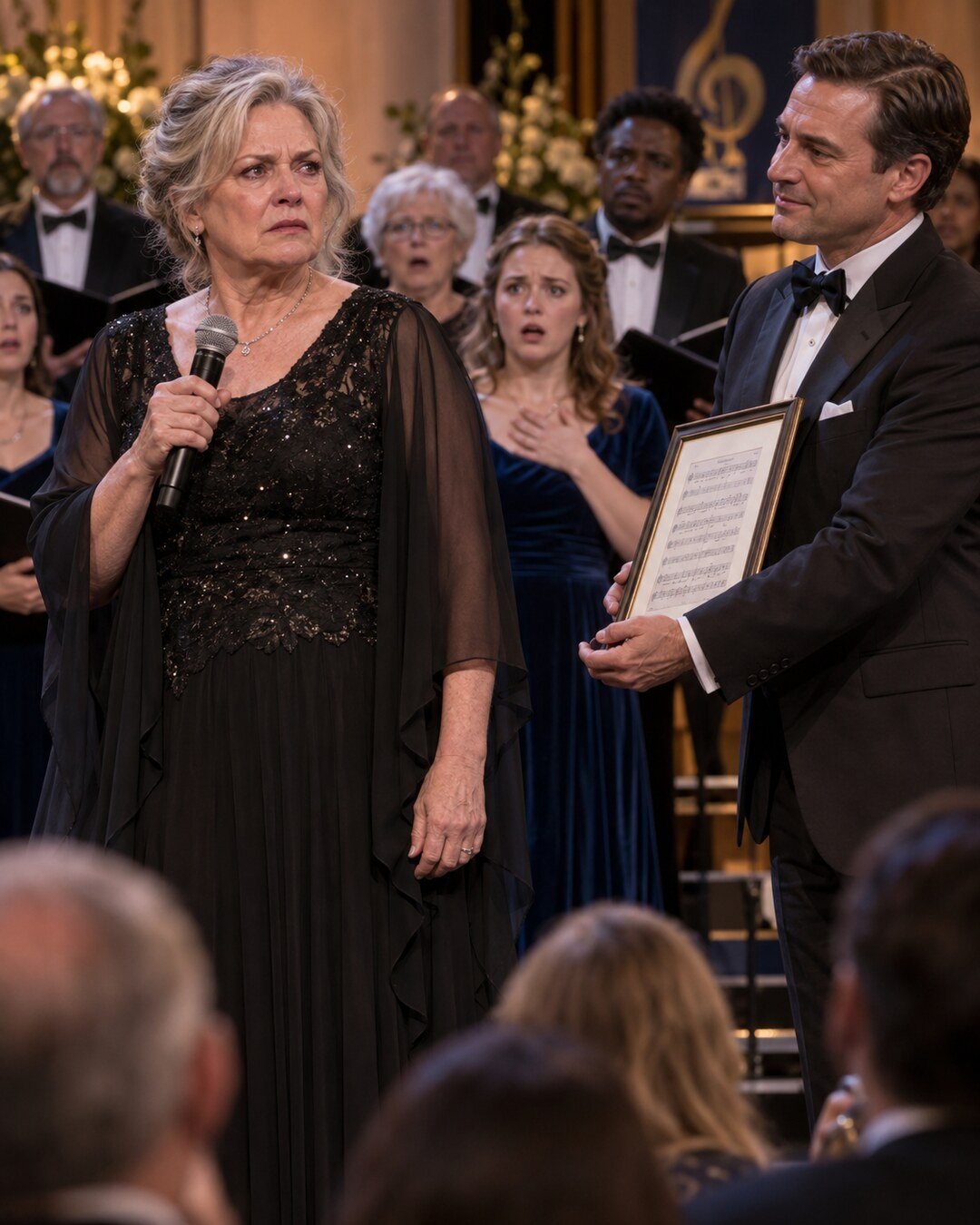
My choir director announced my retirement while I was still holding the microphone.
“Tonight,” Colin told six hundred people, “we say goodbye to the voice that has carried Riverside Voices for eighteen years.”
The audience rose before I understood that the applause was for me.
Behind Colin, the projection screen filled with a photograph of my younger face. Someone rolled a framed sheet of music onto the stage. The altos were crying. My name was printed across the bottom of the program beside two words I had never approved:
FINAL PERFORMANCE.
Colin smiled and opened his arms as if he had given me a gift.
I had not resigned.
Three months earlier, I had told him that I might need to miss several rehearsals in the autumn. My older sister, June, was beginning treatment for breast cancer, and I was the only relative close enough to drive her to appointments.
“I’m not leaving,” I had said in his office. “I may need a short break after the September benefit.”
Colin had nodded, written something in his black notebook, and asked whether I would consider helping “prepare the next generation.”
I thought he meant mentoring Lila Hart, a twenty-four-year-old soprano with a bright, fearless voice. I said yes.
Now Lila stood at the far end of the front row wearing the blue dress Colin had chosen for our benefit concert. She looked as shocked as I felt.
The microphone in my hand was still live.
The room waited for me to cry, bow, and accept the frame.
Riverside Voices was not my job. Nobody depended on my singing to pay rent. But after my husband, Daniel, died, the choir had been the first place where I could take a full breath without feeling guilty for surviving him.
For eighteen years, I had sung births, memorials, fundraisers, citizenship ceremonies, and winter concerts where half the audience came only because a relative had forced them. I had missed two performances: one for Daniel’s funeral and one for pneumonia.
Colin had been our director for twenty-two months.
He was talented. He was also impatient with anything he could not improve on a spreadsheet.
Under him, our audiences grew. He arranged livestreams, changed the logo, shortened the winter program, and persuaded local businesses to sponsor concerts. He also began speaking about “visual energy” and “future-facing voices.”
The phrases always arrived when he moved an older singer away from the front row.
I had challenged him twice in rehearsal. The first time, he said camera placement required balance. The second time, he reminded us that the choir needed new donors to survive.
Neither conversation became a fight. That may have taught him the wrong lesson about me.
Onstage, Colin lifted the framed music.
“Miriam,” he said, “you have given this community more than we can measure.”
I looked past him at the choir.
Several people would not meet my eyes. Others seemed honestly confused. My friend Ruth pressed both hands to her mouth.
I could have corrected him immediately.
But the concert was raising money for a neighborhood cancer transport service—the same kind of service June would need on days I could not drive her. Families in the audience had bought tickets because the service had carried them through treatment.
If I turned the stage into an argument, Colin would blame me for damaging the fundraiser. He knew that. It was why he had chosen this night.
I lowered the microphone.
“Thank you,” I said without it.
The audience applauded again.
Colin leaned close enough that only I could hear him.
“We’ll talk after. Let them have the moment.”
He assumed the moment belonged to him because he had built it.
The first half ended with a tribute video I had never seen. Choir members spoke about my generosity, my terrible rehearsal coffee, and the way I hummed every starting note before Colin gave it.
Ruth appeared last.
“You chose the right person to carry your solo,” she said on the screen. “We’ll miss you.”
I turned toward Lila.
She was staring at Colin.
During intermission, I found him in the corridor behind the stage, checking messages on his phone. Lila followed us before he could close the dressing-room door.
“You said she chose me,” Lila said.
Colin looked from her to me. “This is not the place.”
“It became the place when you put it in the program,” I said.
He shut the door.
On the dressing table lay a second program for the next season. Lila’s photograph filled the cover. My name appeared once, under FOUNDING VOICES, beside three singers who had died.
I touched the page.
“How long have you been planning this?”
Colin loosened his bow tie. “The committee approved a succession campaign in May.”
“A campaign is not my resignation.”
“You told me your availability was changing.”
“For my sister’s treatment.”
“And I planned responsibly. We cannot build ticket sales around uncertainty.”
Lila crossed her arms. “You told me Miriam wanted to step back and had asked me to take the autumn solo.”
“Because she agreed to mentor you.”
“Those are not the same thing.”
Colin’s jaw tightened. “People have already donated to the tribute fund.”
That was the first thing he said that frightened me.
“What tribute fund?”
He explained that the concert page offered a box where viewers could donate “in honor of Miriam Cole’s final performance.” The money went to cancer transport. My name was not receiving the money, but it was being used to solicit it.
He had turned my sister’s illness into the excuse for removing me and my invented retirement into a fundraising hook.
“Take the page down,” I said.
“After the concert.”
“Now.”
“If we change it in the middle of a livestream, people will think something improper happened.”
Lila gave a short, disbelieving laugh.
Colin looked at me again. “Miriam, be practical. The announcement has been made. If you contradict it, you embarrass the choir, the committee, Lila, and yourself. Finish beautifully. We can describe it later as a misunderstanding.”
“You want me to perform the misunderstanding.”
“I want you to protect what you helped build.”
He said it gently. That was his leverage: not authority, not a contract, but my love for everyone on the other side of the wall.
A stage manager knocked. Seven minutes remained.
I asked Colin for one answer.
“Did anyone hear me say I was retiring?”
He looked toward the programs instead of at me.
“You were clearly preparing to reduce your role.”
“That was not my question.”
He did not answer.
Lila removed the silver soloist pin from her dress and placed it on the table.
“I’m not singing her farewell solo.”
Colin’s face changed then. Until that moment, he had treated Lila as proof that the future had already agreed with him.
“You signed a performance agreement,” he said.
“For the concert. Not for this story.”
The second half was supposed to open with Lila singing the first verse of “Across the Water,” then passing the melody to me. Colin had arranged it as a symbolic transfer. The choir would join, my photograph would return to the screen, and I would walk forward to accept the framed score.
Every part of the deception had a cue.
I could not remove the cues without leaving a hole in the concert.
So Lila and I changed what they meant.
We had four minutes. Ruth brought in the section leaders. I told them the truth in two sentences: I had never resigned, and the tribute had been planned without my consent.
Nobody delivered a perfect speech.
Ruth swore.
Marcus, our bass lead, asked whether this was why Colin had requested farewell videos in secret. Another singer began crying because she had written me a letter she was now ashamed to hand over.
Then the stage manager called places.
“What are we doing?” Ruth asked.
I looked at Lila. “The concert.”
We walked back onstage.
Colin stood at the conductor’s platform. He had removed the retirement slide, but the framed music still rested beside him.
He lifted his hands.
Lila did not step forward.
The choir remained silent.
For several seconds, the only sound in the hall was the soft electronic hum of my microphone.
Colin lowered one hand and whispered, “Miriam.”
I stepped to the center mark.
“Before we continue,” I said, “I need to correct something.”
The hall became so quiet that I heard a program fold in the front row.
“I am not retiring from Riverside Voices. I did not approve a farewell, choose a successor, or give permission for my name to be used that way tonight.”
A murmur moved through the audience.
Colin took one step toward me. Marcus moved from the back row and stood at my shoulder. Then Ruth joined me. Not dramatically. She simply crossed the space and took my hand.
I continued.
“Some of you donated because you believed this was my final performance. The cause is real and important. The story attached to my name was not. The donation page is being corrected, and anyone who feels misled should be given a choice about their contribution.”
Colin reached for the second microphone.
Lila picked it up first.
“I was told Miriam had chosen me,” she said. “She did not. I will sing tonight, but not as her replacement.”
There was scattered applause, then more. I raised my hand.
I did not want applause to do the work of accountability.
“We have a concert to finish,” I said. “But the next song will not be my farewell.”
I turned to Colin.
He could leave, argue, or conduct.
For the first time that evening, the decision he made would be visible as his.
He returned to the platform.
Lila and I began “Across the Water” together.
It was not the arrangement he had printed. We sang the first verse in unison. On the second, she rose above me while I held the lower line. The melody did not pass from one woman to another. It widened.
The choir came in behind us.
I wish I could say the performance was flawless. It was not. Colin missed an entrance. The tenors rushed. I came in half a beat late after seeing June in the third row, crying with one hand over her mouth.
But nobody watching could mistake it for an ending chosen for me.
After the concert, the dressing room filled with flowers, questions, apologies, and anger. Colin asked to speak privately.
I said no.
“We can meet with two choir representatives tomorrow,” I told him. “Tonight, I’m taking my sister home.”
The tribute page was corrected before midnight. Donors received a message explaining that the retirement announcement had been inaccurate and offering refunds. Very few requested one, but the choice mattered.
The next meeting was not clean or cinematic. Colin apologized for “moving too quickly,” and I made him replace the phrase with what he had actually done: used public pressure to manufacture consent.
He took responsibility. He also defended his fear that the choir was aging faster than its audience was growing. Both things could be true. His fear did not grant him ownership over my departure.
The choir committee kept Colin as conductor but required two section leaders to approve solo assignments, promotional copy, and any tribute using a member’s name for the rest of the season. Some singers wanted him gone. Others believed repair required more than punishment. We argued for three hours and left without pretending trust had returned.
I took the autumn break I had originally requested.
Lila visited June with me twice. We did not become symbols of old and new voices. We became friends who disagreed about tempo and always brought too much food to hospital waiting rooms.
When I returned in November, Colin asked in front of the section leaders whether I wanted my old place in the front row.
“For now,” I said.
The framed sheet music from my false farewell is in my closet, still wrapped in brown paper. I kept it because throwing it away felt too much like accepting the meaning Colin had given it.
Someday, I will sing my final concert with Riverside Voices.
I may know the date in advance. I may not.
But when the room stands to say goodbye, it will be because I have finished singing—not because someone else decided the applause would make it true.