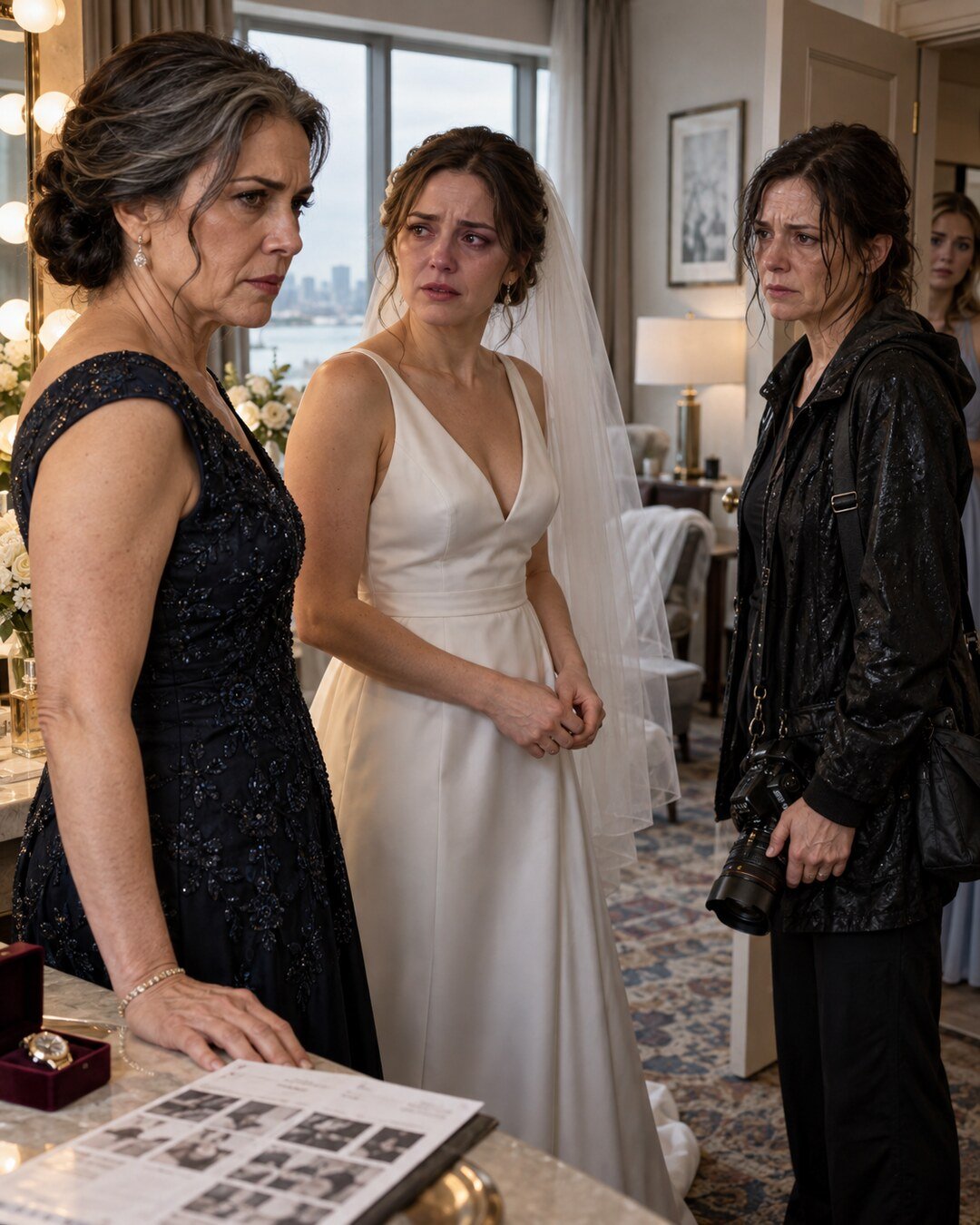
The photographer arrived forty minutes before my daughter’s wedding rehearsal, carrying two cameras and the same crooked smile I had spent twenty years trying not to remember.
I was pinning the last pearl into Tessa’s veil when I saw the woman in the mirror.
For one strange second, my mind refused to give her a name. It noticed details instead: silver threaded through dark hair, rain shining on the shoulders of a black jacket, one hand gripping a camera strap hard enough to bleach the knuckles.
Then she said, “Hello, Elena.”
My sister Claire had left her seven-year-old daughter at a bus terminal with a backpack, eleven dollars, and a promise to return after buying coffee. She never came back.
Now she was standing in the bridal room of an old brick hotel, and my daughter was saying, “Mom, please let me explain.”
I looked from Tessa to Claire and understood the part neither of them had told me.
“You hired her.”
Tessa lowered her eyes. “Yes.”
I had imagined Claire’s return in a hundred useless ways. In some, she knocked on my door sick and sorry. In others, I saw her across a courtroom or a supermarket aisle. I had never pictured her arriving on a vendor schedule between the florist and the string quartet.
Outside the room, someone laughed as bridesmaids carried garment bags down the hall. Inside, the air went still.
Claire set her camera case on a chair. “Tessa contacted me in June.”
“I wasn’t asking you.”
She flinched, and an old, ugly satisfaction rose in me. I hated it immediately.
Tessa touched my wrist. “I knew if I told you, you’d say no before hearing why.”
“That is what a boundary sounds like when you already know the answer.”
Her hand fell away.
Twenty years earlier, a transit officer had called me because my number was written on the inside cover of Tessa’s school notebook. I reached the terminal after midnight. Tessa was asleep beneath a silver emergency blanket, one sneaker missing, her arms locked around a red backpack.
She woke when I knelt beside her and asked the same question three times: “Did Mom miss the bus?”
At first, everyone believed Claire had been hurt. Police checked hospitals. Her car was found two days later at a long-term parking lot near the airport. She had emptied her account, left her phone in the glove compartment, and bought a ticket under her own name.
There had been no sudden emergency. There had been a plan.
I was thirty-one, newly divorced, and renting a one-bedroom apartment above a bakery. I told social services Tessa could stay with me for a week. Then a month. Then a school year. I learned how to braid hair, argue with insurance companies, and sit outside a bathroom door during panic attacks without demanding to be let in.
Claire sent one postcard eight months later. It showed a beach in Portugal and contained six words: I’m safe. Tell her I’m sorry.
I did not tell Tessa until she was sixteen. By then I had adopted her, and she called me Mom.
We built a life sturdy enough to hold the absence. Not erase it. Hold it.
Now Tessa stood in her wedding dress with her chin raised in the way she did when courage and fear were fighting over the same inch of ground.
“I found her website last winter,” she said. “She photographs weddings now.”
That fact struck me with almost comic cruelty. Claire made a living preserving the days other families promised not to leave.
“She uses her married name,” Tessa continued. “I wrote to her as myself. She knew who I was before she accepted.”
I turned to Claire. “And you thought this was appropriate?”
“No,” she said. “I thought it was the only invitation I might ever get.”
“A contract is not an invitation.”
“I know that now.”
Tessa stepped between us. “I gave her rules. She is here for the rehearsal portraits only. She won’t attend the dinner or the ceremony. She won’t meet the family. Her assistant is covering tomorrow.”
The arrangement was precise. That made it worse, not better. Tessa had spent months designing a controlled collision and had decided I was the only person who did not need consent.
“What portrait?” I asked.
She hesitated.
On the dressing table lay a printed shot list. I picked it up before she could stop me.
At the bottom, beneath photographs with the bridesmaids and her fiancé, was one line circled in blue ink:
Bride with mother, fastening heirloom bracelet.
There was no bracelet. I had given Tessa the simple gold watch my mother left me, but it was not an heirloom in the theatrical sense. It was something she wore on bad days because the ticking calmed her.
“You wanted Claire to take a picture of me putting on the watch.”
Tessa’s eyes filled. “I wanted her to see you do it.”
The anger left me so quickly that I had to grip the table.
This was not reconciliation. It was evidence.
Tessa wanted the woman who had abandoned her to look through a lens and record the mother who stayed.
Claire unzipped the camera case, then stopped. “I told her I would do the job and leave. I never asked for anything else.”
“You already asked,” I said. “You asked by showing up.”
A knock sounded at the door. Priya, Tessa’s maid of honor, leaned in with a garment steamer. Her smile vanished when she saw our faces.
“Do you need me?”
Tessa wiped beneath one eye. “Give us five minutes.”
Priya looked at me, waiting. I nodded, and she closed the door.
That small courtesy nearly undid me. A woman who had known Tessa for six years had checked whether I was safe in a room with my own sister. Tessa had not.
I set down the shot list. “I’m not doing the portrait.”
“Mom—”
“You don’t get to turn me into the proof in somebody else’s trial.”
Tessa recoiled as if I had slapped the table.
“I thought you would understand.”
“I understand perfectly. You wanted her to hurt. You wanted me to be what hurt her.”
Claire stared at the floor.
Tessa’s voice cracked. “She got to disappear. She got beaches and another name and a whole career. You got every terrified night, and I got years of wondering what was wrong with me. I wanted her to stand there and see the answer.”
“I am not the answer to what was wrong with you, because nothing was wrong with you.”
“Then why did she leave?”
It was not the child’s question anymore. It came from a grown woman in a wedding dress, furious that adulthood had not made it smaller.
Claire lifted her head. “Because I was a coward.”
Tessa turned on her. “That’s a description, not a reason.”
Claire nodded once. “You’re right.”
She sat in the chair beside her unopened camera case, making herself lower than both of us.
“I had been lying to everyone,” she said. “About money. About work. About how much I was drinking. I owed people I was afraid of. I convinced myself you would be safer with Elena while I fixed it. At the terminal, I meant to call her. Then I thought if I asked, she might say no, and if she said no, I would have to face what I was doing.”
My hands went cold. “So you made sure I couldn’t say no.”
“Yes.”
The word landed between us.
Claire had done to me what Tessa had just done on a gentler scale: arranged the facts, withheld the choice, and counted on love to keep me in the room.
Tessa saw it at the same moment I did. Her face changed.
“Mom,” she whispered.
I did not rescue her from the realization.
Claire continued. “None of that explains twenty years. I got sober after three. By then shame had become an excuse I knew how to live inside. Every year I waited made contact harder, so I used that difficulty as permission to wait another year.”
“Did you know where we were?” Tessa asked.
“Yes.”
“Did you look at my graduation pictures?”
“Yes.”
“My college page? My engagement announcement?”
“Yes.”
Tessa’s expression hardened. “Then you didn’t lose me.”
Claire’s mouth trembled.
“You watched me from a distance because distance protected you.”
“Yes.”
There are confessions that repair a lie and confessions that only reveal its full size. Claire was finally telling the truth, but truth was not the same as restitution.
I wanted her out. I also wanted Tessa never to wonder whether I had ended the conversation before she was finished.
So I asked my daughter, “What do you need right now—not what you planned in June?”
She looked at the cameras, the shot list, and the watch waiting in its velvet box.
“I don’t know.”
“Then nobody takes a picture until you do.”
The hotel coordinator knocked to say the rehearsal would begin in fifteen minutes. Priya had found Claire’s assistant, Marcus, in the lobby. He was qualified, already contracted, and unaware of the family connection. He could cover the portraits if we wanted.
Tessa took several slow breaths.
Then she faced Claire. “I hired you because I wanted control over the first time you saw me. I told myself that made it different from what you did. But I brought Mom into it without asking her.”
Claire began to speak.
“No,” Tessa said. “You don’t get to make me feel better about that.”
Claire closed her mouth.
Tessa picked up the shot list and drew a line through Claire’s name. Her hand shook, but the line was straight.
“Marcus will take the photographs. You need to leave.”
Claire stood. “May I give you a letter?”
“Not today.”
“Another day?”
Tessa glanced at me, then back at her. “You can send it to my therapist. I’ll decide if I want it. Do not contact Mom. Do not contact my fiancé. Do not appear anywhere tomorrow.”
Claire nodded. She closed the camera case she had never fully opened.
At the door, she looked at me. For a moment I saw the sister who used to crawl into my bed during thunderstorms, and the woman who had left a child beneath fluorescent lights. Both were real. Neither canceled the other.
“I am sorry,” she said.
“I believe you,” I answered. “That does not make us ready.”
She left.
Tessa waited until the elevator doors closed before she began to cry. Not delicately. Her shoulders folded, and I caught her before the veil pulled free.
“I’m sorry,” she said into my neck. “I did the same thing to you.”
“No. You stopped when you saw it.”
“Because you made me.”
“That is one of the services mothers provide.”
She laughed once, wetly, and I did too.
We were late to the rehearsal. Nobody demanded an explanation. Priya reset the veil. Marcus introduced himself and asked, before lifting his camera, whether we wanted the dressing-room photographs postponed.
Tessa said yes.
The next morning, she fastened my mother’s watch herself. There was no staged revelation and no absent woman behind the lens. Marcus photographed Tessa checking the clasp, then looking up to ask whether it was too tight.
After the ceremony, he took a picture of us beneath the hotel awning while rain silvered the street. In it, Tessa is not looking at the camera. She is looking at me. My hand is raised toward her cheek, but I have not touched it yet.
Three months later, a letter arrived at her therapist’s office. Tessa chose to read it there. She did not show it to me, and I did not ask.
She has exchanged two more letters with Claire since then. They have not met. Maybe they will. Maybe they will not.
That uncertainty used to frighten me because I mistook a finished ending for a safe one.
The wedding album has no photograph taken by Claire. It does not need one.
The picture that matters was made only after Tessa asked, Marcus waited, and I said yes.