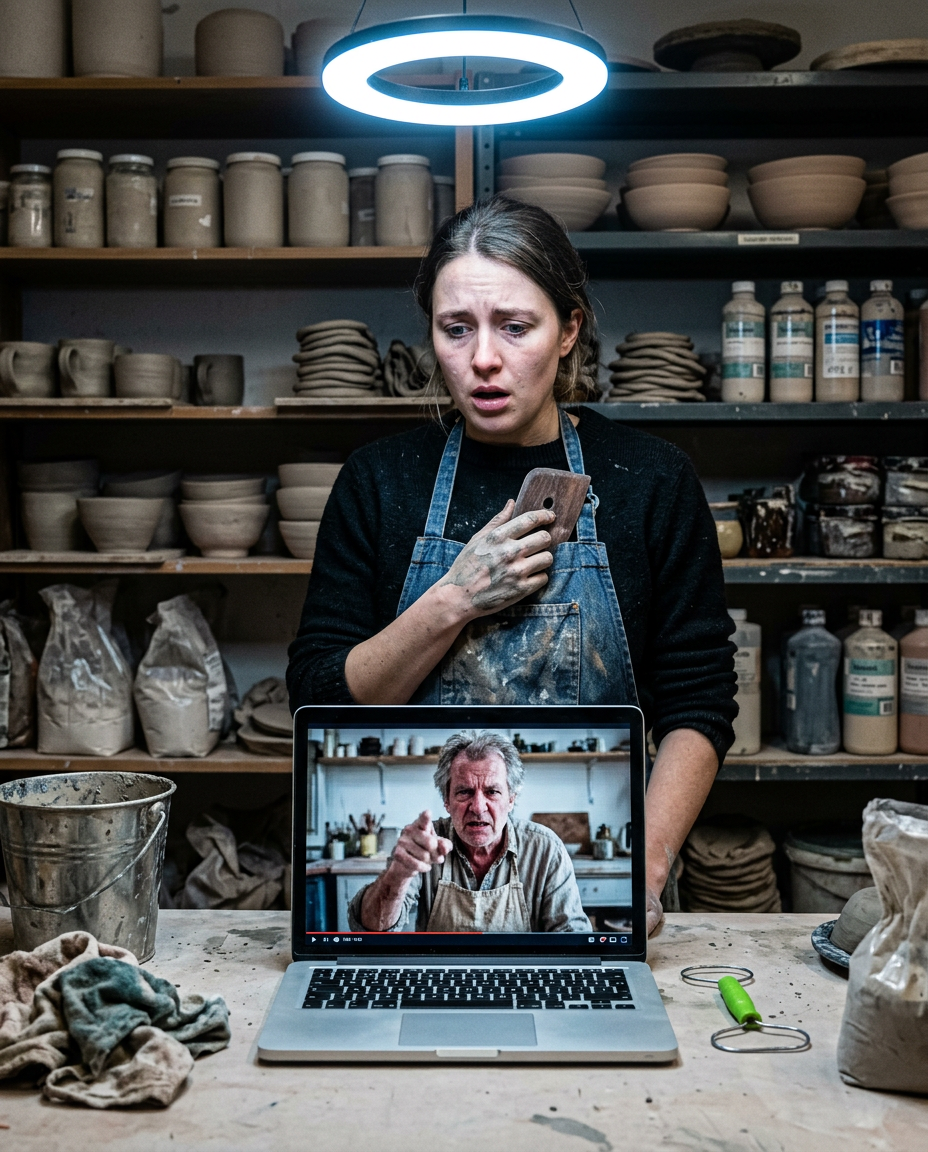
For five years, my world smelled of wet grog, sulfur, and burning pine.
The basement studio of Saltwater & Stone sat directly beneath a grey-shingled cottage on the Mendocino coast, where the salt air seeped through the stone foundations and rusted every metal tool we owned.
My name is Maya, and for sixty months, I was Master Alistair Vance’s invisible hands.
Alistair was a titan of Pacific Northwest ceramics, a man whose minimalist vessels commanded five-figure sums in galleries from Seattle to Kyoto.
To the public, he was a solitary genius meditating over his kiln through the midnight hours.
To me, he was a demanding taskmaster who slept twelve hours a day while I stoked the gas burners, mixed eighty-pound bags of feldspar, and spent three thousand solitary test cycles trying to crack the legendary copper-red reduction glaze—a notoriously unstable formula that had frustrated ceramicists for centuries.
When I finally achieved the elusive oxblood hue in November of my fourth year, Alistair didn’t congratulate me.
He walked into the studio, picked up the test tile, wiped my cataloguing number off the back with his thumb, and put it in his personal exhibition case.
“A fortunate kiln fluke, Maya,” he had said dismissively, adjusting his linen apron. “Chemistry is about intuition, not your tedious little spreadsheets.”
The reckoning arrived on a rainy Saturday during the guild’s annual virtual masterclass.
Four thousand potters, collectors, and gallery directors tuned in from around the world to watch Alistair demonstrate his signature oxblood reduction technique live from the main throwing floor.
I was standing off-camera in the shadows, holding a bucket of reclaimed clay, when Alistair stopped his wheel mid-spin, turned directly toward the high-definition lens, and gestured dramatically to the assistant operating the camera.
“Before we glaze the final series,” Alistair announced, his voice carrying that rich, theatrical cadence that had won him three national awards, “we must address a very serious breach of professional ethics within this studio.”
The live chat sidebar immediately began scrolling with a flurry of worried question marks.
“For months,” Alistair continued, his expression darkening into calculated sorrow, “my proprietary thermal-firing curves—the result of thirty years of solitary research—have been systematically copied. And unfortunately, the source of this industrial espionage is standing right here in our basement.”
He pointed a long, ink-stained finger straight at me.
“Maya Lin has been photographing my private chemical notebooks, exfiltrating trade secrets, and attempting to market her own fraudulent variations of my copper-red glaze behind my back.”
The chat room exploded.
Comments scrolled past at blinding speed: *Disgraceful.* *Fire her.* *Sue her for intellectual theft.*
Alistair looked across the room at me, a tiny, triumphant smirk flickering at the corner of his mouth. He expected me to burst into tears, to stammer apologies, to run up the stone stairs and out into the rain the way his previous two apprentices had done.
I did not move an inch.
I set the clay bucket down on the concrete floor with a heavy, deliberate thud.
The silence that followed was absolute, save for the hum of the kiln’s cooling fans.
I walked slowly out of the shadows, stepping directly into the harsh circle of blue-white ring lighting that illuminated Alistair’s demonstration wheel.
The camera angled automatically to catch my face.
“An industrial secret, Alistair?” I asked, my voice flat, steady, and utterly devoid of fear.
Alistair blinked, momentarily thrown off by my lack of panic. “Maya, step away from the equipment. Security has already been notified—”
“Security hasn’t been notified of anything,” I interrupted, reaching slowly into the deep pocket of my canvas apron. “Because if security arrives, they’ll have to inspect the federal patent registry first.”
I pulled out a crisp, double-sided document bearing the official raised seal of the United States Patent and Trademark Office, along with a thick black leather-bound ledger.
I laid both items down on the wooden wedging table right beside his prized exhibition bowl.
Alistair stared at the papers, his color turning a sickly shade of grey.
“What… what is that?” he stammered, stepping back against his Shimpo wheel.
“That is Patent Application US-2024-098412-A,” I said clearly, looking straight into the camera lens where four thousand guild members were watching. “Filed on behalf of Maya Lin. It covers the precise thermal reduction curve, copper carbonate molar ratio, and oxygen-starvations protocol required to stabilize the copper-red glaze without zinc flux contamination.”
I flipped open the leather-bound ledger to page three hundred and twelve, revealing meticulous, color-coded chemical graphs drawn in my own handwriting, complete with dated gas-pressure logs signed by our regional propane delivery driver.
“You didn’t invent this glaze, Alistair,” I said, turning my gaze slowly back to him. “You couldn’t even calculate the molecular weight of tin oxide without my spreadsheet. And as for the sketchbook you claimed I stole?”
I held up a notched wooden throwing rib carved from applewood, bearing my initials carved into the grain.
“It was sitting in my locker. Which I bought with my own money. Along with every bag of clay you’ve burned this year.”
The chat sidebar had gone completely dead silent.
Alistair’s mouth opened and closed like a landed fish, his hands trembling as he reached out instinctively to grab the patent filing.
I slapped his hand away with a sharp crack against the table.
“Touch those papers again, and I won’t just sue you for defamation,” I said, leaning in close so the microphone caught every whispered syllable. “I’ll foreclose on this entire building by Monday morning. Mom and Dad left the land deed in my name before you ever stepped foot on the Mendocino coast.”
I turned toward the camera, offered a polite, professional nod to the stunned virtual audience, and unclipped my apron.
“The masterclass is over, Alistair,” I said, walking toward the stone stairs. “Clean your own kiln.”