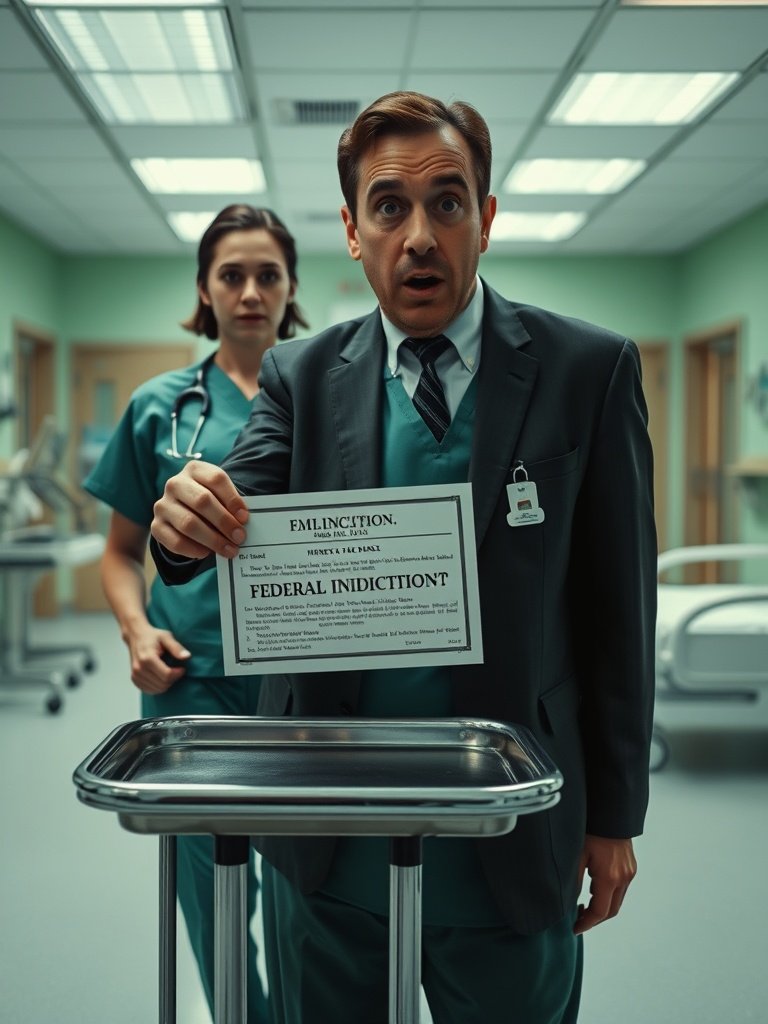
Fifteen years of quiet compliance ended at precisely 7:14 AM on October 14.
Chief Medical Officer Vance stood in the sterile patient ward of St.
Jude Memorial, holding an official termination notice printed on heavy cardstock.
His dismissive smirk mirrored the corrupt hospital administrators who had spent the last six months protecting his fraudulent drug trials.
Fourteen junior nurses watched the confrontation in absolute silence from the stainless-steel charting station, their eyes fixed on the linoleum floor.
Vance sneered as he instructed campus security to escort me out of the building immediately.
I did not raise my voice or plead for my position against his arrogant commands.
Instead, I reached into my clinical bag and placed a certified federal indictment order onto the rolling medicine tray.
I entered a secure override code directly into the wall-mounted pharmacy terminal.
Vance stopped mid-sentence as the central monitoring screens flashed his offshore bribe deposits in bright, unredacted red lettering.
His face turned completely pale in less than four seconds as the federal marshals entered the corridor from the emergency stairwell.
For five years, I had watched patients suffer under Vance’s accelerated clinical trials.
Experimental compounds meant for terminal cancer patients were being altered to mask severe hepatic toxicity.
When I first flagged the anomalous lab results in March, Vance simply filed them away in a locked cabinet and warned me about the fragility of my nursing license.
He assumed a senior nurse from a working-class background had no recourse against a man who golfed with the hospital board chairman.
Every night after my shift ended at 11:00 PM, I stayed behind in the basement archives.
I copied encrypted server logs onto encrypted flash drives and mailed duplicate packages to a federal prosecutor in Washington.
I built a case file so dense and airtight that no amount of hospital philanthropy or political maneuvering could dismantle it.
The morning of the confrontation was meticulously calculated.
I knew Vance always inspected the seventh-floor ward before his weekly administrative rounds at 7:15 AM.
I timed my arrival to coincide with his routine arrogance.
When he handed me the fabricated insubordination report accusing me of tampering with patient records, I did not argue the merits of his lie.
I let him savor the moment of presumed victory.
When he signaled the security guards to grab my arms, my hand was already resting inside my clinical bag.
The certified federal indictment order landed on the silver tray with a heavy, definitive slap.
The silence in the ward was absolute. The federal marshals moved with practiced efficiency, reading Vance his rights before he could stammer a defense. His administrative assistants scattered down the hallway, desperately deleting emails on their corporate phones. I did not lose my nursing license in this ward today. I just took legal receivership of the entire hospital network under federal asset seizure protocols.
As Vance was led past the nursing station in handcuffs, he tried to meet my gaze.
I looked past him, turning my attention to the central terminal where my new administrative clearance was already processing.
The files for the fraudulent drug trials were secured under federal seal, and the victims’ families would finally receive independent medical care.
I walked out of St.
Jude Memorial not through the exit reserved for terminated employees, but through the executive double doors, leaving the hospital keys on the front desk.
The fifteen-year career was finished, but the reckoning had only just begun.