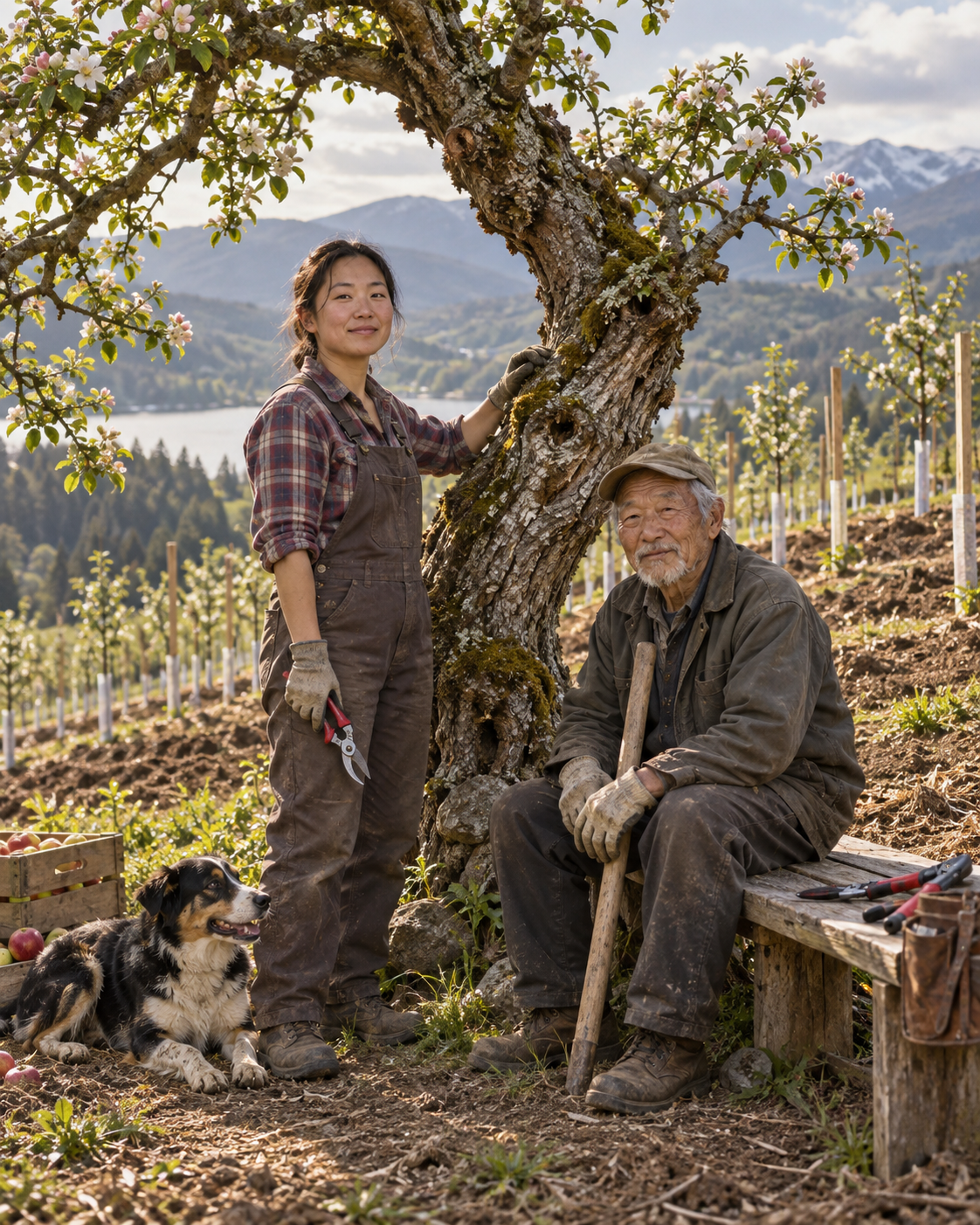
The new owner marked every apple tree with orange paint except the crooked one beside the road.
Our valley treated the orchard like public scenery, though none of us had paid its taxes or picked its fruit in years. When Mara Chen bought it, people complained before her first chainsaw started.
My father had pruned those trees for forty seasons. He called Mara a developer and the orange marks a death sentence.
She invited him to walk the rows.
The trunks were hollow with fire blight. Broken irrigation had drowned one section and starved another. The previous owner had kept selling picturesque boxes while the orchard declined.
“If I leave them,” Mara said, “I get two pretty seasons and then a field of disease.”
Dad pointed to the unmarked roadside tree. It leaned so far that children could reach its smallest apples.
“Why save the sickest one?”
Mara cut a branch and showed us a thin ribbon of healthy wood. The tree was an old local variety called Copper Sweet, missing from commercial catalogues. She had sent cuttings to a preservation nursery. It was not being spared because it was healthy; it was being used to start again.
The town meeting was ugly anyway. Residents demanded that she preserve half the orchard. Mara laid out the arborist reports, replanting plan, and loan terms. Keeping half would spread disease to the new stock and bankrupt the farm before its fourth year.
Dad surprised everyone.
“You want the view,” he told the room. “She needs an orchard.”
He proposed a compromise that did not pretend dead trees were alive. Mara would mill safe trunks into benches and trellises. Volunteers could help collect scion wood under nursery supervision. The town would create a small roadside heritage row on public land, so its survival did not depend entirely on one farmer’s balance sheet.
The cutting took eleven days. Dad attended every one. On the last morning, he asked to make the final cut himself.
For a season the hillside looked brutal—stumps, mud, and thin stakes protected by white guards. Tourists stopped taking photographs. Mara sold vegetables between the young rows to keep cash coming in.
The crooked tree produced only seventeen apples. We held no festival. The nursery returned twenty grafted saplings, and Dad taught volunteers how to tie them without strangling the bark.
Three years later, the new orchard flowered unevenly. Some rows failed and were replanted. Mara posted those losses as openly as the harvest totals.
Dad now sits on a bench made from the old trees and corrects anyone who says Mara destroyed his orchard.
“It was never mine,” he says. “And she didn’t save a tree. She saved what could grow from it.”
The crooked Copper Sweet finally came down in a windstorm. Its wood was too rotten for furniture.
But twenty young versions of it were already rooted along the road.