Someone cut every flower in my greenhouse the night before we opened June’s garden.
Not every plant. Every flower.
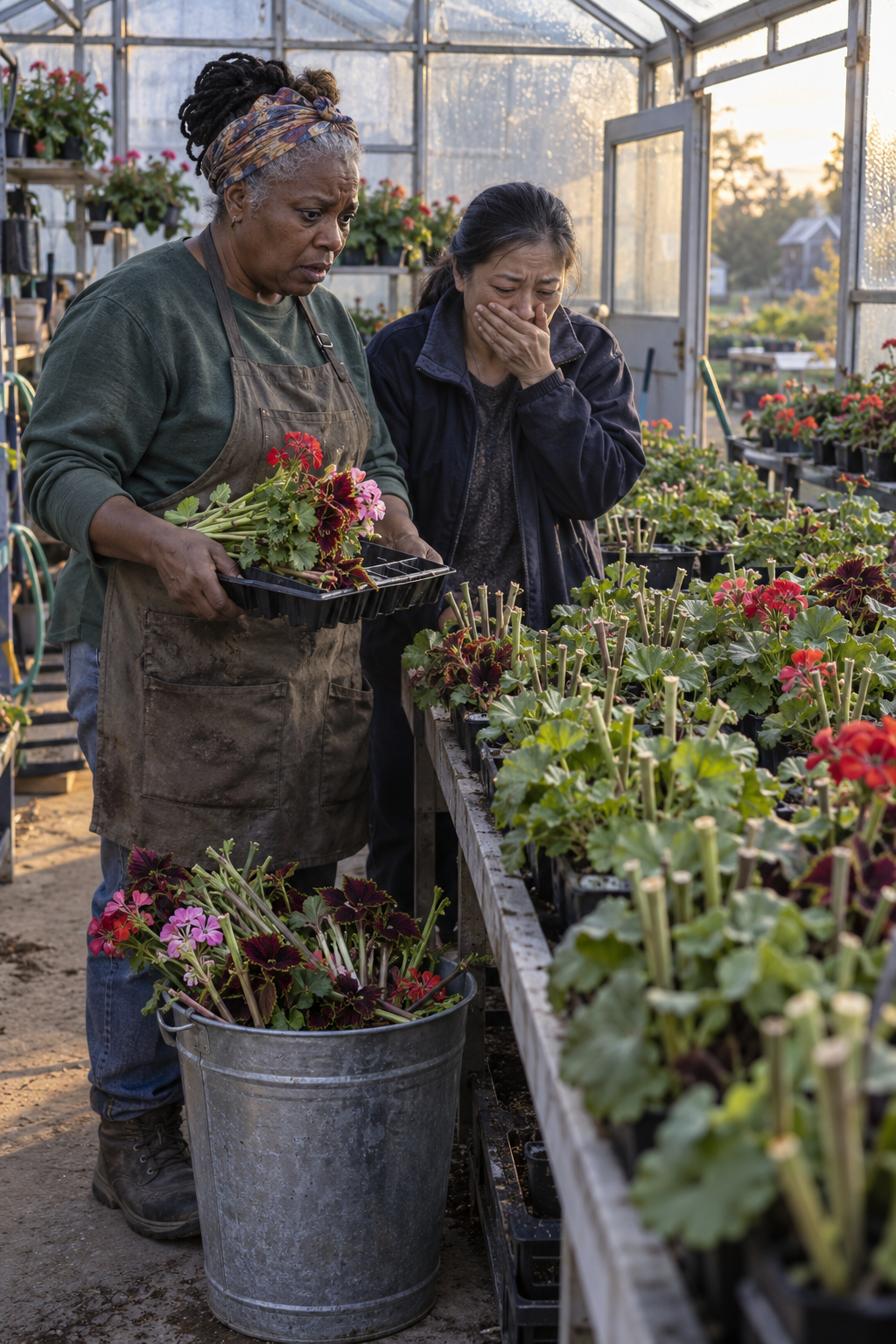
Three hundred geraniums and coleus lined the benches in blunt green rows, their bright tops severed just above the leaf joints. Red petals lay in the soil. Purple leaves covered the floor.
My first thought was frost, which made no sense in August.
My second was vandalism.
Then I saw the cut stems standing upright in galvanized buckets, their ends submerged in water.
Whoever had done it knew enough to keep them alive.
Mei Lin found me holding one of those stems at six in the morning. She had come early to tie the last paper lanterns for her daughter’s memorial garden.
For eleven months, June had worked beside me at Bell Street Greenhouse. She was twenty-six, fast with a propagation knife, impatient with plastic pots, and capable of remembering which retired customer preferred red geraniums and which child was afraid of worms.
She had designed the garden for the empty lot beside the library.
Then a driver ran a red light and killed her on her bicycle.
We postponed the project. Mei almost canceled it entirely. In March, she brought me June’s notebook and said, “If we stop, the lot stays empty and so does everything she planned.”
The town donated compost. The library ran seed workshops. Children painted small clay markers. We grew the plants exactly as June had listed them: red geraniums around the path, lime coleus under the maple, purple tradescantia near the benches.
Opening day was supposed to begin at ten.
At six, none of the plants looked ready for a garden.
Mei walked between the benches without speaking. When she reached the buckets, she covered her mouth.
“Can they be saved?”
“The plants can,” I said. “But they won’t flower again today.”
The cut stems were another question.
I examined the first geranium. The cut was clean and angled. Most vandals tear, stomp, or knock over pots. This person had clipped each stem half an inch below a node—the exact place I taught beginners to cut when taking material for propagation.
June had taught the same method at our Saturday workshops.
On the potting table, I found my old red-handled shears. They had been missing since winter.
Only three people still had keys to the greenhouse: me, my manager Luis, and June’s father, Calvin Lin.
Calvin had built half the wooden benches inside the building. Years earlier, he and I had planned to open the nursery together. I grew the plants; he handled repairs and deliveries. Then his construction business expanded, and the greenhouse became something he believed I should either scale or sell.
June took his place on weekends.
That choice created a distance between them neither admitted. Calvin wanted her to manage his office. June wanted soil under her nails. Their last argument, Mei once told me, had been about the garden. Calvin called it unpaid work for people who would forget her name. June left dinner early.
After she died, he stopped entering the greenhouse.
Or I thought he had.
I called him.
He answered on the fourth ring.
“Did you come here last night?”
A long breath crossed the line.
“Cancel the opening, Ruth.”
Mei heard him through the speaker.
She sat down.
“Why?” I asked.
“Because this isn’t a memorial. It’s advertising.”
The greenhouse’s name appeared in small print on the garden flyers because we had supplied the plants. Calvin had seen a local newspaper preview that described June as my apprentice and called Bell Street “the home of her work.” It did not mention that he built her first raised bed or drove her to horticulture classes when she was seventeen.
He believed I had taken the part of his daughter he did not understand and turned it into a reason for customers to visit my business.
So he used his old key at midnight and removed every bloom we planned to carry to the library.
“Why put the stems in water?” Mei asked.
Calvin said nothing.
“You wanted them dead,” she said. “Why the buckets?”
“I didn’t want them dead.”
He wanted the opening ruined, not the plants. Grief had found a distinction only grief could defend.
Mei ended the call.
Luis arrived and stood in the doorway, staring at the benches.
“We can buy replacements,” he said.
The nearest wholesale nursery had geraniums, but not our varieties and not enough for the design. Even if I emptied the business account, the truck could not return before the opening.
I told him to cancel the delivery van.
Mei looked at me.
“You’re canceling?”
“The van,” I said. “Not the garden.”
The plants in the pots were alive. Their roots were strong. They simply looked like what had happened to them.
And the buckets held hundreds of cuttings.
June’s notebook opened naturally to a page stained with soil. Across the top, she had written: **Propagation table—show people how one plant becomes many.**
Her original garden plan included a public cutting workshop after opening. We had dropped it because the library expected a crowd and I worried beginners would damage the display.
Now damage was the material we had.
We had four hours.
Luis called everyone registered for June’s old Saturday classes. Mei contacted the library and asked them to move folding tables into the lot. I posted one photograph—not of Calvin, not of the key, only of the cut plants—and wrote that the opening would proceed as a propagation day.
I did not explain who had cut them. That truth belonged first to Mei.
At seven, thirteen people arrived carrying jars, clean yogurt cups, rooting mix, and kitchen scissors. At eight, there were thirty-two.
Children washed the painted clay markers. Retired gardeners trimmed crushed leaves. Luis mixed perlite and soil in a wheelbarrow while I showed volunteers how to recut each stem below a node and remove the lowest leaves.
The greenhouse did not look rescued. It looked busy.
That mattered more.
Mei worked at June’s potting table. She labeled every tray with the plant name and date in the same narrow handwriting she had used on June’s school lunches.
At nine fifteen, Calvin appeared at the open door.
No one had invited him.
The old key lay in his palm.
Conversations stopped one by one.
He looked at the benches of clipped plants, then at the volunteers turning his damage into rows of new pots.
“I told you to cancel,” he said to me.
Mei stepped between us.
“You do not get to tell us what to do with what she made.”
Calvin’s face tightened. “They wrote me out.”
“You stayed out,” Mei said.
It was not a clever line. It sounded exhausted.
He looked toward June’s notebook.
“I built that table,” he said.
“And she worked at it.”
“She was my daughter before she was your apprentice.”
“Yes,” I said. “She was.”
I could have demanded the key and ordered him away. Part of me wanted an audience to see him punished.
But the day was not a courtroom, and the volunteers were not a jury.
I asked Mei what she wanted.
She told Calvin to give me the key. Then she said he could come to the garden only if he carried one of the clipped plants exactly as it was. No replacement flowers. No pretending the night had not happened.
He placed the key in my hand.
For a moment, I thought he would leave.
Instead, he lifted a tray of blunt green geraniums from the end of the bench.
We walked the six blocks to the library in a procession no one had planned. Children pulled wagons of cuttings. Adults carried the original pots. The plants that should have been a wall of color looked sparse beneath the August sun.
At the lot, I told the crowd what had happened without naming Calvin.
“Someone cut every flower last night,” I said. “The roots survived. So did the parts that were cut away.”
We planted the original geraniums along the path. Their leaves gave shape to the beds even without blooms. On the folding tables, volunteers filled four hundred small pots with cuttings.
Mei spoke for less than a minute.
“June believed a garden was not finished when it looked perfect,” she said. “It was finished when someone else knew how to keep it alive.”
Then she showed a group of children how to press soil around a coleus stem.
Calvin stayed near the truck. He carried trays when asked and did not speak into the microphone. When a reporter approached him, he said the day was not about him.
That was the beginning of accountability, not the end of it.
The cuttings did not all root. Some rotted. Some wilted on kitchen windowsills. The original geraniums took weeks to bloom again.
Calvin apologized to Mei privately. She did not forgive him that day. She asked him to start grief counseling and to stay out of the greenhouse unless invited. He agreed.
I changed the locks.
Six weeks later, people brought rooted cuttings back to the library. We planted eighty-seven around the bare maple bed. Others remained in homes, classrooms, and shop windows across town.
Calvin did not attend.
Mei and I worked until sunset. As we packed the empty trays, she found one late red flower on the first geranium we had planted opening day.
She did not call anyone over.
She touched one petal, then left it where it was.