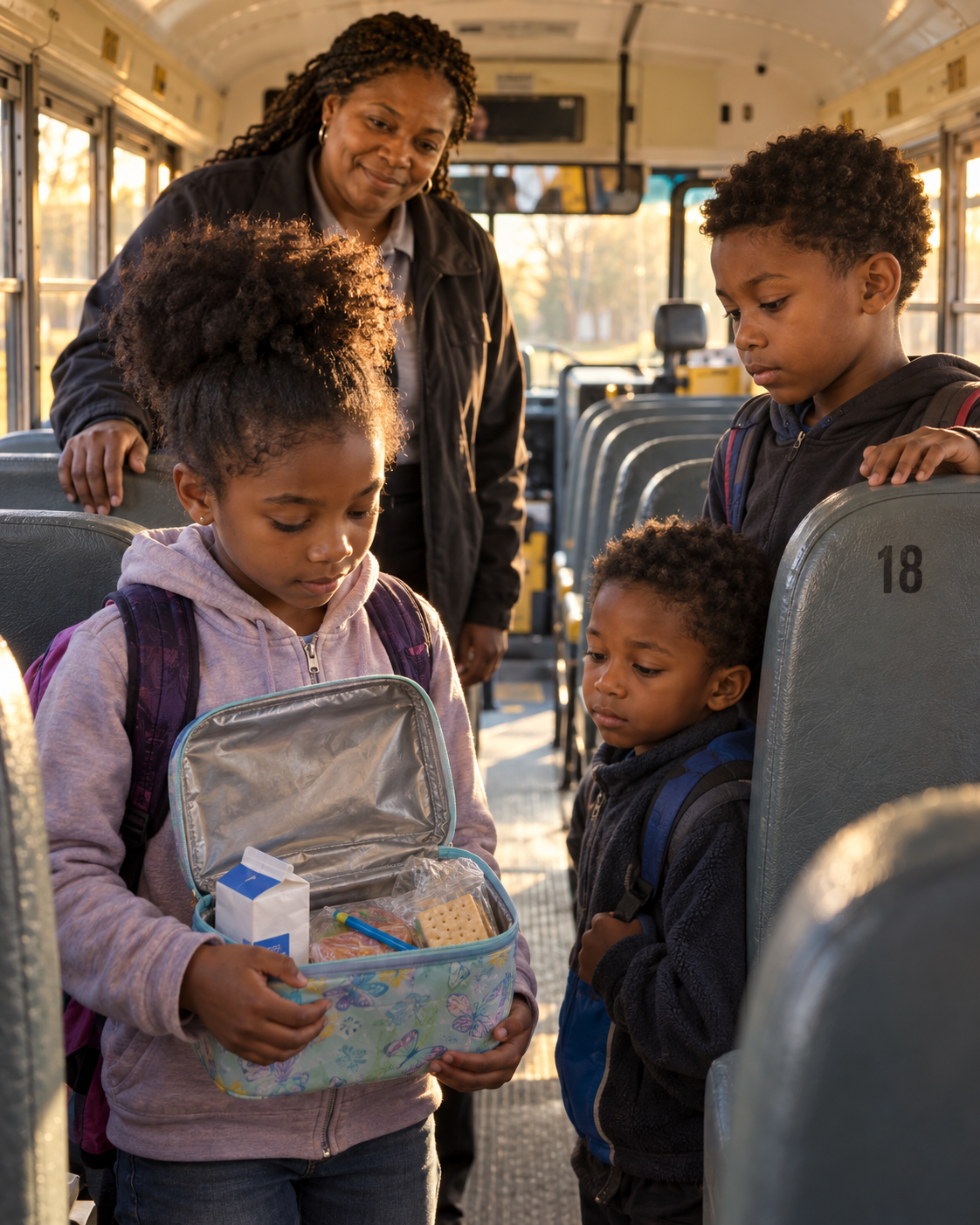
The first time nine-year-old Nia left her lunchbox on my school bus, I found three unopened crackers, a carton of milk, and a note that said, **Please leave this under seat 18.**
I drove route 46. Nia sat in seat 7.
Seat 18 belonged to Micah Bell, a quiet fourth grader who boarded at the Lakeside Motor Inn with his little brother. By the time I checked the bus that Friday, both boys were gone.
I carried the lunchbox into the depot because food could not stay on a parked bus. On Monday, Nia climbed aboard and looked beneath seat 18 before she even greeted me.
“I found this,” I said, holding up the box.
Her face fell. “Did Micah get it?”
“No. Why were you leaving food for him?”
She stared at her shoes. “Because he says he isn’t hungry when he is.”
That was the sort of sentence a child should not have to understand.
I was not allowed to distribute food. Our district had allergy rules, custody rules, and a policy against students exchanging cafeteria items. The rules existed for good reasons. They also meant I could not simply put the lunchbox back.
I asked Nia to sit behind me until the other children had left. She explained that Micah saved most of his school lunch for his five-year-old brother. On Fridays, when the motel breakfast room closed early for cleaning, the boys sometimes ate nothing until Monday’s school breakfast.
“How do you know?” I asked.
“He traded me his blue pencil for my banana. Then he tried to give the banana back.”
Nia had started packing extra sealed food from home. She did not want Micah to feel watched, so she placed it under his seat before the afternoon run.
“My mom thinks I eat a lot,” she said.
I called the school counselor, Mrs. Patel, before leaving the depot. I gave her only what Nia had told me. She said she would check on the family discreetly.
Tuesday afternoon, a transportation supervisor named Mr. Cross boarded my bus with a clear evidence bag. Inside were two granola bars and an apple.
“Were students exchanging food on your route?” he asked.
I looked at Nia. She pressed her forehead to the window.
“A lunchbox was left behind,” I said.
“We received a report that a child is hiding food under seats. With allergies, that is a safety violation.”
“Then solve the safety problem without turning kindness into misconduct.”
Mr. Cross told me not to editorialize. He instructed me to inspect the bus after every run and confiscate any food. Nia would receive a written warning if it happened again.
Micah boarded at the motel that afternoon holding his brother’s hand. The younger boy’s coat sleeves ended above his wrists. When Micah saw the evidence bag on Mr. Cross’s clipboard, he stopped in the aisle.
“It was mine,” he said.
Nia spun around. “No, it wasn’t.”
“I told her to leave it.”
He was trying to take the warning for her.
Mr. Cross asked both children to sit down. He was not cruel; he was afraid of being responsible if a hidden snack harmed someone. But fear had narrowed the problem until all he could see was contraband under a vinyl seat.
That evening, Mrs. Patel called me. Micah’s mother, Dana, had lost her apartment after a rent increase and was working overnight laundry shifts at a hospital. The motel room had no stove, only a small refrigerator. She had applied for food assistance, but notices were going to their old address.
Dana had refused an emergency grocery card when the school offered one.
“She thinks Micah told people they are homeless,” Mrs. Patel said. “He didn’t. She is terrified someone will question whether she can care for them.”
I understood why Micah said he was not hungry and why Nia hid what she gave him. Help that arrives with an audience can feel like another loss.
The next morning, I asked the cafeteria manager, Ms. Romero, what happened to sealed breakfast items children did not open.
“They go into the share bin until lunch,” she said. “Anything left after that is discarded.”
The share bin was supervised, allergy-safe, and already allowed under district rules. Its only problem was timing. Children on my route needed food after school and on weekends.
Ms. Romero showed me an unused cabinet beside the cafeteria exit. Mrs. Patel called the district nutrition director. I called Mr. Cross and asked him to meet us there.
We proposed a Friday take-home shelf stocked only with sealed, labeled items from the share bin, plus grocery bags packed by the school pantry. Any family could use it. No names, no applications at the shelf, and no child singled out.
Mr. Cross crossed his arms. “Transportation cannot carry food.”
“It won’t,” I said. “The children pick it up before boarding. My bus carries backpacks every day.”
Ms. Romero added an allergy card to each bag. Mrs. Patel arranged for families to opt in privately. The nutrition director approved a four-week pilot.
One problem remained: Dana would not opt in.
Nia solved that part without being asked.
On Friday she walked to the shelf, took a bag, and placed it in her own backpack. Three other children followed. Ms. Romero had invited families to take food for anyone in their household; no one had to explain.
When Micah reached the cabinet, half his classmates had already used it. He chose a bag of oatmeal cups, crackers, fruit, and shelf-stable milk.
“My brother likes the chocolate one,” he told Ms. Romero.
No one applauded. No adult photographed him. He simply boarded my bus carrying groceries like several other children.
Dana called the school Monday. I expected anger. Instead, she asked whether the shelf was truly for every family. Mrs. Patel said yes. Dana came in after her night shift, updated her address, and finished the food-assistance paperwork. She also pointed out that motel families needed can-openers and food that did not require an oven. The pantry changed its bags the same week.
Mr. Cross removed the warning from Nia’s record. He added a locked cleanup box to each bus for accidentally abandoned food, so drivers could turn it in safely instead of throwing it away.
The pilot nearly ended before it began. A parent saw the take-home shelf and complained that the school was encouraging children to carry food without medical forms. At the district meeting, Mr. Cross surprised me by defending it. He explained that the shelf used the same sealed inventory and allergy controls as the cafeteria; only the pickup time had changed. Then Nia asked to speak.
She did not name Micah. She said children already shared food, but hiding it made the sharing less safe. “If the grown-ups make a place,” she said, “we don’t have to make one under a seat.” The nutrition director added the sentence to the pilot report. The board approved the shelf for the rest of the year.
I later apologized to Nia for telling several adults what she had done without first explaining who needed to know. She thought about that longer than I expected.
“You can tell if it keeps him safe,” she said. “Just don’t tell it like I rescued him.”
That became our rule too. Nia had noticed a need and acted. Micah had protected her when punishment appeared. Neither child became the other’s project.
The Friday shelf became permanent.
Months later, Micah’s family moved from the motel into a small apartment. On his last morning at Lakeside, he boarded with two lunchboxes.
At school, he gave one to Nia.
“You keep leaving yours,” he said.
She opened it after he walked away. Inside were three unopened crackers, a carton of milk, and a blue pencil.
There was no note.
There did not need to be.