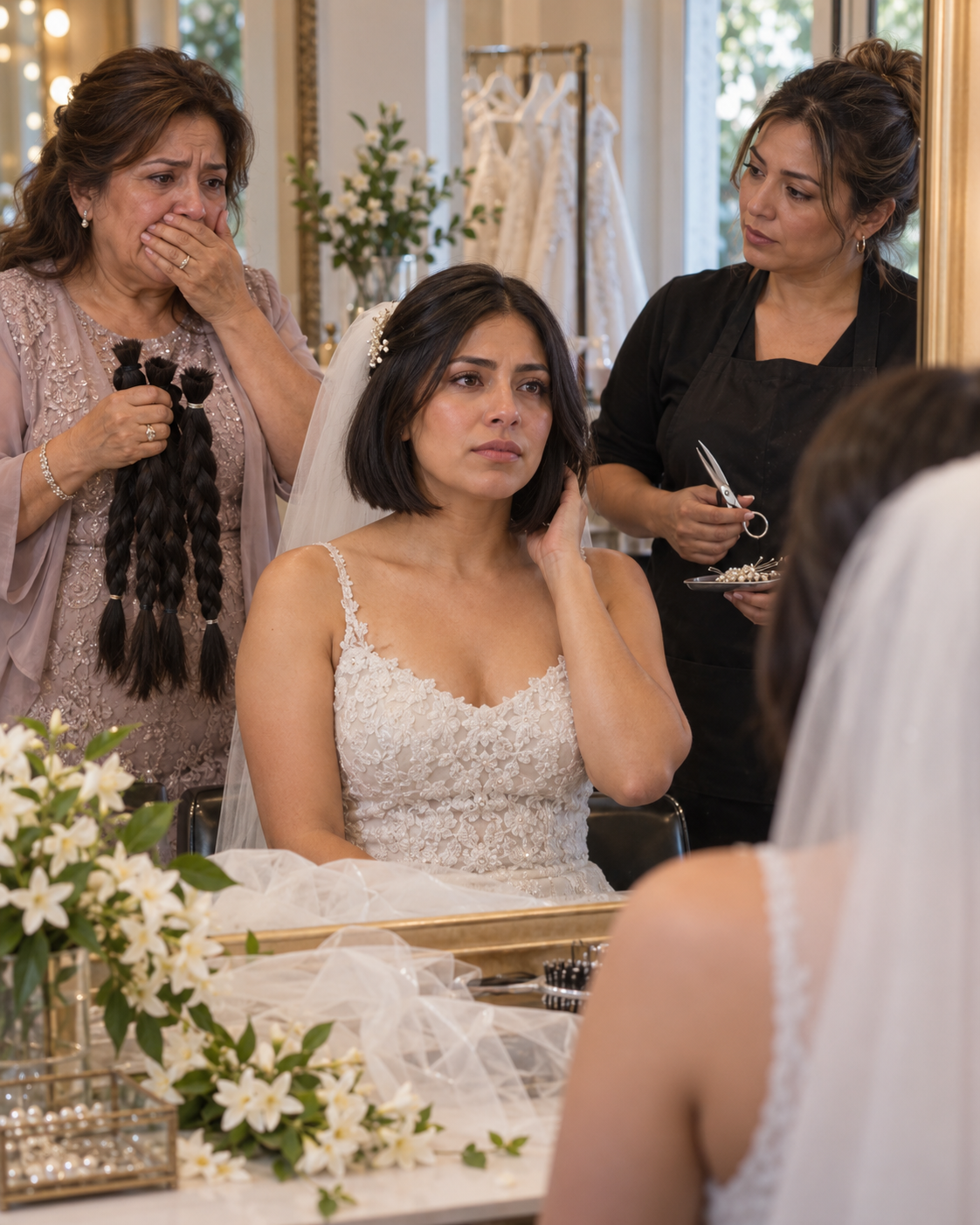
Twenty minutes before her wedding portraits, Marisol locked the salon door, pulled the pins from her veil, and said, “Cut it to my chin.”
Her hair reached the small of her back.
I had spent two hours building the low braided crown approved by her mother, her aunts, and the photographer. White jasmine ran through it in a perfect curve. On the counter lay a printed schedule with my name beside **BRIDAL HAIR — NO CHANGES**.
“How much?” I asked.
She placed one hand below her ear.
“Here.”
Outside the locked glass door, her mother Elena noticed the pins on the floor. She knocked once, then harder.
“Marisol, open this door.”
The bride looked at me through the mirror. “If I open it, I won’t do it.”
I owned the salon, but her mother had booked it, paid the deposit, and brought fourteen relatives that morning. Cutting the bride’s hair would not break a law. It could still end my business with one furious video.
“Are you running from the wedding?” I asked.
“No. I chose Daniel. I didn’t choose to wear the last eighteen years on my head.”
Elena had begun growing Marisol’s hair after chemotherapy took her own when Marisol was seven. Every year, mother and daughter photographed its length. When Elena’s cancer returned, the hair became a family symbol: proof that life kept growing.
Elena had been in remission for nine years.
Marisol had not cut more than two inches since childhood.
“I love my mother,” she said. “But every time I ask for a trim, she says, ‘After the wedding.’ There is always another day I am supposed to wait for.”
The knocking stopped. Daniel’s sister called through the door, asking whether Marisol was safe.
“I’m safe,” Marisol answered. “I need ten minutes.”
I removed the jasmine and unbraided the crown. “I need you to say clearly that this is what you want.”
She faced me, not the mirror.
“I want my hair cut to my chin before I get married.”
I divided it into four thick sections and tied each with elastic. Marisol asked me to save the lengths for a wig charity. Her hands shook as I opened the scissors.
So did mine.
The first cut sounded louder than the knocking had.
A heavy braid came free into my palm. Marisol inhaled sharply, then laughed—a surprised, breathless sound I had not heard all morning.
By the third braid, someone outside had called Elena’s older sister. By the fourth, Daniel had arrived.
He did not demand the door open.
“Mari,” he called, “do you want me inside?”
She touched the uneven ends at her neck. “Not yet.”
“Okay. I’m by the blue chair.”
That answer steadied her more than any speech could have.
I shaped the cut into a soft bob. Without the weight, her hair curled beneath her jaw. The veil comb was too wide and slipped immediately.
Marisol stared at herself.
For one terrible second, I thought she regretted it.
Then she said, “That looks like me.”
When I unlocked the door, Elena entered first.
She saw the four braids on the counter and gripped the back of a styling chair. Nobody spoke.
“Put it back,” she said.
It was not rational, but grief rarely arrives in rational sentences.
Marisol stepped between us. “Mom.”
“You waited eighteen years and chose today?”
“I waited because you kept asking me to.”
Elena picked up one braid. Her anger collapsed into something rawer.
“When mine fell out, you were the only beautiful thing I could still brush,” she said.
Marisol’s face changed. She had known the story, but not that sentence.
She did not apologize for the cut.
Instead, she took her mother’s hand and placed it against the hair at her jaw.
“I’m still here,” she said.
The photographer appeared behind them and asked whether she should delay the portraits. Elena turned on her.
“Do not take a picture of the braids,” she said.
It was the first boundary she defended for her daughter that day.
We had twelve minutes to make the veil work. The original comb depended on the braided crown, so I sewed two small loops into the veil edge and anchored them with pearl pins above Marisol’s ears. Daniel’s sister held my thread. An aunt warmed the curling iron. Elena stood beside the counter holding the cut hair.
Marisol asked Elena whether she wanted one braid kept. Elena held all four against her chest, then shook her head. Saving one as a relic would make the donation feel like another betrayal. We placed every braid in the charity envelope together. Elena wrote the return address in her own hand.
The salon receptionist quietly removed the “before” photograph from our appointment screen. No one in the waiting area needed a preview of a family decision still unfolding.
Before leaving for the ceremony, Elena asked to speak to me alone. She wanted to know whether Marisol had seemed confused or impulsive. I told her exactly what had happened: I asked twice, Marisol answered twice, and the answer remained the same after the first braid fell.
“She knew you might blame me,” I said.
Elena looked through the glass at her daughter laughing with Daniel’s sister. “I do blame you a little.”
“You’re allowed to.”
“And you would do it again?”
“If she gave the same clear answer.”
Elena nodded, not in agreement but in recognition of the boundary.
At the ceremony, Marisol walked down the aisle with the veil floating behind her short curls. Several relatives gasped. Daniel smiled before she reached the first row.
During the first dance, Marisol removed the veil herself and placed it over the back of Elena’s chair. Her mother folded it carefully instead of trying to pin it back on. Later, the photographer asked for a recreation of the childhood picture in which Elena brushed Marisol’s hair. They declined. They chose a photograph of Elena fastening one pearl earring instead.
During the reception, an uncle asked Elena how she could have allowed it.
Elena replied, “She did not need my permission.”
The sentence cost her something. I could hear it.
Two weeks later, Marisol returned with the donation forms. Elena came too. She did not want her own hair cut. She asked for the gray at her temples to remain uncovered in the family photographs she had scheduled for that afternoon.
Before they left, Marisol handed me a small envelope. I expected a tip.
Inside was one wedding portrait. The veil curved around her chin; Elena stood beside her, one palm resting lightly on her daughter’s shoulder.
On the back, Marisol had written, **Thank you for asking me twice and believing the same answer.**
I keep it inside the cabinet where clients cannot see it.
Not every private act of courage needs to become a salon advertisement.