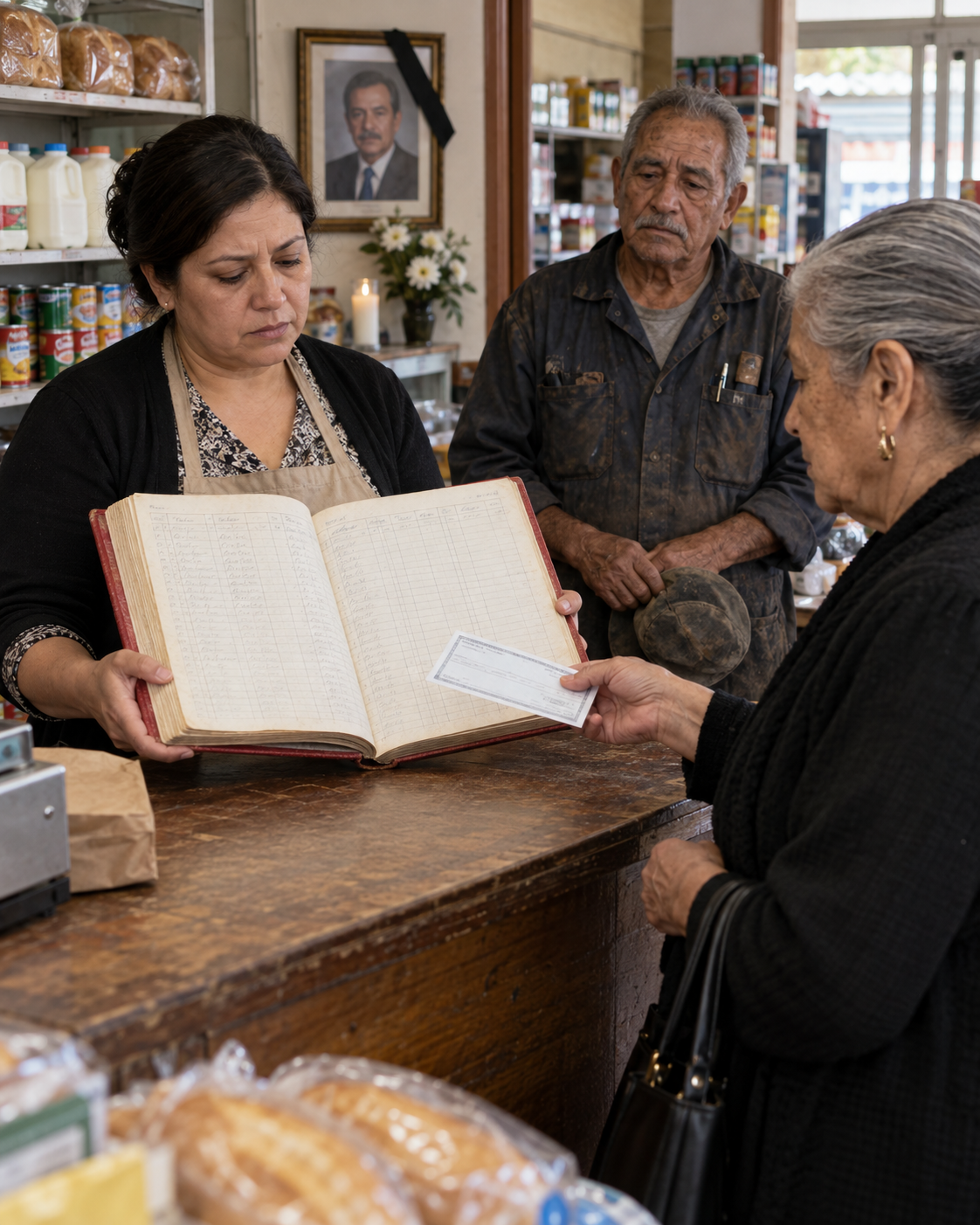
At my father’s funeral, a woman I did not know placed a grocery ledger in my hands and said, “Before you close his store, you should see what people owe him.”
The red book was thick with names and numbers.
Dad’s market had barely covered its bills for years. I had blamed poor inventory, generous discounts, and his refusal to raise prices quickly. The ledger showed something worse: more than eighteen thousand dollars in unpaid groceries.
I owned a bookkeeping firm. Numbers usually calmed me.
These made me furious.
Beside some names, Dad had written six months of bread, milk, diapers, or rice. One family owed twelve hundred dollars. A mechanic named Theo had not paid since March. Mrs. Cho from the flower shop appeared on forty-seven lines.
“Who are you?” I asked the woman.
“Lena Ortiz. Your father let me pay late when my husband was sick.”
“How late?”
She looked at the floor. “Eight years.”
The next morning, I taped a notice to the market door: **ACCOUNTS MUST BE SETTLED BEFORE CLOSING — THIRTY DAYS.**
By noon, someone had torn it down.
Theo came in first. He was nearly seventy and carried no checkbook.
“Your father and I were even,” he said.
“The ledger says you owe $642.”
“Turn the page sideways.”
In the margin, written vertically, were dates and words I had assumed were stock codes: compressor, delivery van, freezer seal.
Theo had repaired store equipment. Dad credited the labor in pencil but never subtracted it from the ink total.
“Why keep a debt that was paid?” I asked.
“He said the ink showed what he gave and the pencil showed what came back. He wanted to remember both.”
That was terrible bookkeeping.
It was also not a collection ledger.
Mrs. Cho’s pages contained pencil notes: funeral flowers, prom corsages, hospital bouquet, no charge. A contractor who owed nine hundred dollars had built the wheelchair ramp behind the store. A college student paid by translating labels for older customers. Lena had stocked shelves every Tuesday during Dad’s surgery.
Some accounts were balanced through work. Others were not.
I spent a week meeting people. I did not romanticize the book. Two customers had avoided Dad after promising payment. One had moved without leaving an address. The market’s unpaid supplier bill was real, and goodwill would not satisfy it.
One man arrived furious that his mother’s name appeared in the ledger at all. She had died believing every grocery bill was paid. We reviewed the page together and found Dad’s pencil note for three months of school pickups during my surgery. The account was balanced, but the ink balance remained. I gave him a signed statement and let him watch me mark the page closed.
That meeting changed the way I approached the rest. The book contained private facts Dad had never received permission to display. I took down my public notice and scheduled individual appointments after closing. People could bring records, dispute entries, or refuse to discuss them. A number in Dad’s handwriting was evidence of his system, not automatic proof of someone else’s debt.
Then I reached the largest account.
**M. Ortiz — $1,284.16.**
Lena’s name.
There were no pencil notes.
I called her.
She arrived with a cashier’s check for the full amount.
“You had this ready?” I asked.
“For eight years.”
Her husband had recovered and returned to work. Each time she tried to pay, Dad told her to keep the money until another family needed help. She began bringing him names instead—people choosing between groceries and medicine, parents living in motels, workers waiting for delayed wages.
“He used my account like a door,” she said. “The number grew because he put other people through it.”
The ledger’s largest debt did not belong to one family. Dad had hidden anonymous help under a name he trusted.
I was angry again, this time at him. He had made Lena carry a number that was not hers and left me to decipher a private system after he died.
“He should have told me,” I said.
“He thought you would make it efficient.”
“He was right.”
Lena smiled sadly. “He also thought efficiency might improve it.”
The store could not remain open as it had. Dad had covered shortfalls with his pension. I did not have one to spend.
So I separated memory from money.
Theo and I reviewed every pencil entry. People confirmed work they had exchanged. Genuine unpaid balances received private letters, not a list on the door. Payment plans matched what families could afford. Three accounts were forgiven because Dad had clearly written **gift** on related receipts.
Lena’s cashier’s check paid the overdue supplier. She refused to reclaim the remainder attributed to strangers.
With six former customers, we created a small mutual-credit fund administered outside the store. Contributions and grants went into a real account. Assistance no longer hid beneath someone else’s name. People could repay with money or pre-agreed community work, and every exchange actually reduced the balance.
We added limits Dad never used: no child’s name, no medical diagnosis, no public donor list, and no volunteer hours assigned after the fact. Help could be offered without purchasing control over the recipient. Lena insisted on an appeal process because, she said, kindness becomes power when only one person defines it.
I sold the market to two employees. They kept the corner produce shelves, changed the inventory, and stopped extending informal credit at the register. A card beside the till directed people to the fund privately.
The employees insisted the fund could not become a condition of sale. A person denied assistance still had the same prices and service as everyone else. We published aggregate totals—how much help entered and how much returned—but never stories designed to make donors feel heroic. The point was not to reproduce Dad’s secrecy with better spreadsheets. It was to protect dignity without hiding whether the system could survive.
On the first quarterly review, the books balanced within twelve dollars. Theo found the error: someone had credited two hours of freezer repair at the old labor rate. We corrected it and paid him the difference. He complained that Dad would have rounded it down. I said that was precisely why Dad had needed a bookkeeper.
On the final day before the sale, I opened Dad’s red ledger one last time.
I drew a line beneath Lena’s account and wrote **CLOSED — NOT COLLECTED, CARRIED FORWARD**.
Then I gave her the book.
“Why me?” she asked.
“Because he trusted your name with everybody else’s.”
She kept it for a month, then donated it to the neighborhood archive with the account pages sealed for twenty years. The public description contains no dollar amounts or family names. It says only: **Record of groceries, repairs, flowers, translations, rides, and other things a neighborhood used as money.**
The new owners still keep one red notebook under the counter.
It is blank.
When someone needs help, they open the cash drawer, take out the fund card, and write the transaction where it belongs.
Dad would have complained that the system had too many forms.
He would also have checked the totals.