My sister sold our mother’s house three weeks after the funeral, kept every cent, and told me I was “not part of the family anymore.”
She did not know our mother had visited a notary two days before she died — and the final page of that document had my name on it, not hers.
I found out about the sale from a neighbor.
Not from Karen.
Not from my father.
From Mrs. Delgado next door, who sent me a text message at 6 a.m. on a Tuesday.
“Sweetheart, there are movers at your mother’s house. Did you know?”
I sat on the edge of my bed and read that message four times.
My mother had been gone for twenty-two days.
Twenty-two days of silence from my older sister, who had handled “everything” — the service, the flowers, the thank-you cards, the casseroles.
Karen had handled everything.
Including, apparently, the sale of the house.
My name is Rosa Medina. I am forty-one years old. I teach fourth grade in Camden, New Jersey. I drive a twelve-year-old Civic. I clip coupons. I have never owned property.
My sister Karen is forty-six. She lives in a five-bedroom house in Moorestown with her husband, Greg, who sells medical devices and talks about his boat at every family gathering.
Our mother, Dolores, died of pancreatic cancer on March 3rd. She was sixty-eight.
The house — a small, paid-off two-bedroom on Vine Street — was the only thing she had.
And Karen sold it.
For $212,000.
Without telling me.
Without asking me.
Without even pretending I existed.
I called Karen that morning. She picked up on the third ring, and I could hear her chewing something.
“Karen, Mrs. Delgado says there are movers at Mom’s house.”
A pause.
“Yeah, I took care of it.”
“Took care of what?”
“The house. I sold it. The closing was last Friday.”
My hand went numb around the phone.
“You sold Mom’s house?”
“Rosa, let’s not do this. You weren’t involved in any of the planning. You didn’t help with the arrangements. You barely showed up.”
I had shown up every single day for the last four months of our mother’s life. I had changed her sheets. I had held the basin when she vomited. I had slept on her couch so she would not be alone at night.
Karen had visited twice.
Once for an hour. Once for brunch.
“Where is the money?” I asked.
“It’s handled.”
“Karen. Where is the money from the house?”
“I used it to pay off some things. Greg and I had debt. Mom would have wanted us to be stable.”
I felt something crack inside my chest. Not sadness. Something harder than sadness.
“That was Mom’s house. Half of it was mine.”
Karen laughed. Not a cruel laugh — worse. A dismissive one.
“Rosa, there was no will. There’s nothing to split. I handled the estate because I’m the eldest. That’s how it works.”
She hung up.
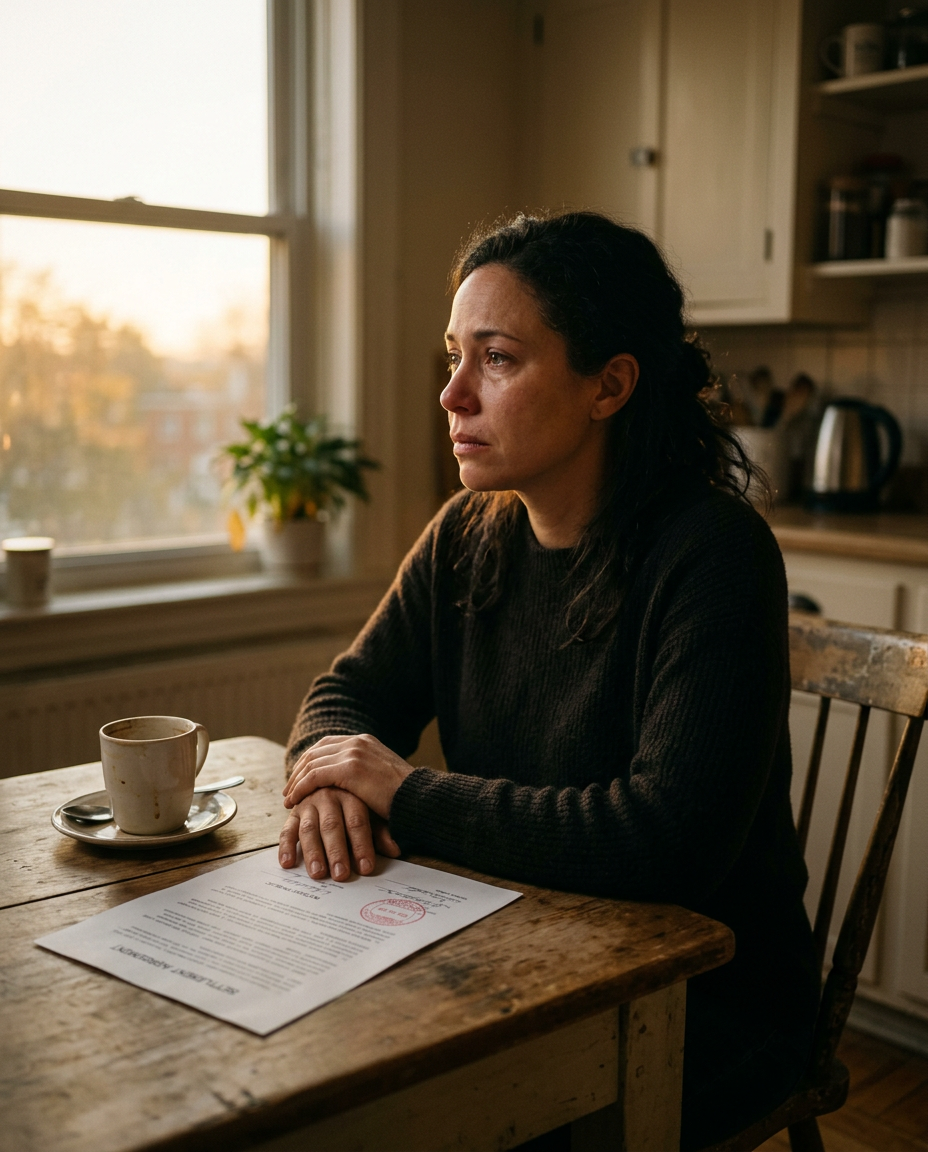
I sat in my kitchen for a long time.
The coffee got cold.
The light shifted across the table.
I thought about my mother’s face. The way she used to hold my hand and say, “When I’m gone, the house is for both of you. Promise me you will not fight.”
I had promised.
Karen had not been in the room.
Three days later, I called a lawyer. A woman named Janet Parsons who worked out of a small office on Federal Street and charged me a consultation fee I paid in two installments.
“Did your mother have a will?” Janet asked.
“Karen said she didn’t.”
“Did you check?”
I had not checked.
Janet leaned back. “In New Jersey, if there is no will, the estate is divided equally among surviving children. Your sister had no legal right to sell that house without your consent.”
I felt my jaw tighten.
“But she did.”
“Then we have a problem — but it’s her problem, not yours.”
Janet made some calls. She pulled records from the county clerk. She contacted the title company.
And then she found it.
The thing Karen did not know existed.
Two days before she died, our mother had gone to a notary. She could barely stand. A home health aide had driven her. She had signed a document — a transfer-on-death deed.
The house was never part of the estate.
It had been transferred directly to me.
Only to me.
My mother had known.
She had known Karen would do exactly what she did.
She had known Karen would take everything and call it handling it.
So she had made sure the house could not be taken.
When Janet showed me the document, I could see my mother’s handwriting. Shaky. Small. The letters barely holding together.
But the signature was real. The notary seal was real. The filing date was two days before she died.
The house was mine. Legally, fully, mine.
Which meant the $212,000 Karen had collected from the sale — of a house she did not own — was money she owed me.
Janet filed the paperwork on a Thursday.
By Monday, Karen called me screaming.
“What the hell did you do?”
“I didn’t do anything, Karen. Mom did.”
“This is insane. You’re telling me she gave you the house? Just you?”
“Yes.”
“Why?”
I let the silence sit.
Karen already knew why. She had spent twenty-two days pretending I did not exist, and our mother had spent her last forty-eight hours making sure I would not disappear.
“The title company is demanding I return the sale proceeds,” Karen said. Her voice was thinner now. The confidence was draining.
“That sounds right.”
“Rosa, I spent the money. Greg and I — we paid off the boat. We paid off credit cards. There’s maybe eleven thousand left.”
“Then you owe me two hundred and one thousand dollars.”
“I don’t have it!”
“I know.”
There was a long silence.
“Mom wouldn’t have wanted this,” Karen whispered.
“Mom is the one who did this.”
Karen hung up.
The mediation happened six weeks later in a small conference room in Cherry Hill. Karen sat across from me with swollen eyes and a lawyer she clearly could not afford. Greg was not there. I later learned he had moved out the week before.
The mediator reviewed the deed. He reviewed the sale records. He reviewed the title company’s demand for restitution.
Then he looked at Karen.
“Mrs. Hartwell, you sold a property you did not own. The proceeds must be returned in full to the rightful owner.”
Karen looked at me like I had set a trap.
But I had not set anything.
Our mother had.
From her deathbed, with a shaking hand and a notary who made house calls, Dolores Medina had protected the daughter who had protected her.
I did not gloat.
I did not say I told you so.
I sat there and thought about my mother’s hand in mine, and the promise I had made.
“Promise me you will not fight.”
I had not fought, Mom.
I had just shown up.
And you made sure that was enough.
The mediator laid out the terms. Karen would repay the full $212,000 plus legal costs. Since she had already spent most of it, a payment plan was structured over five years with a lien placed on her Moorestown house — the five-bedroom she shared with Greg, the one with the boat in the driveway.
If she missed a payment, the lien could be enforced.
Karen’s lawyer tried to argue hardship. The mediator listened politely and then pointed to the deed.
“Your client sold property she did not own. The hardship is self-created.”
Karen stared at the table.
I wanted to feel sorry for her. Part of me did — the part that still remembered her braiding my hair on the school bus, the part that remembered her defending me against Tommy Pratt in third grade when he called me a name I will not repeat.
But that Karen was gone.
Maybe she had been gone for years, and I had just not noticed.
After the mediation, I walked to my car in the parking structure. It was raining. Not hard — just enough to make the concrete dark and the air smell like wet asphalt.
I sat in the Civic and did not start the engine.
I thought about the last conversation I had with my mother.
It was the night before she went to the notary. I did not know about the notary then. I just knew she was having a good day — one of those rare afternoons where the pain backed off enough for her to eat half a bowl of soup and watch her telenovela without wincing.
I was on the couch. She was in her chair.
“Rosa,” she said.
“Yeah, Ma.”
“You think Karen will be okay?”
I looked at her. She was staring at the television but not watching it.
“I think Karen takes care of Karen,” I said.
My mother nodded slowly.
“And you take care of everyone else.”
She said it like a fact. Not a compliment. Not a criticism. Just something she had observed over sixty-eight years of living and forty-one years of watching me.
“You’re the one who shows up,” she said. “That’s not nothing. That’s everything.”
I did not understand what she meant that night.
I understood it now.
The next morning, she called the home health aide and asked to be driven to a notary. The aide — a woman named Patrice who I later tracked down and thanked — told me my mother had been clear and specific, even though her hands were shaking.
“She said, ‘I need to protect the one who stayed.'” Patrice told me this over the phone, and her voice broke on the word stayed.
I pulled over on the side of Route 130 and cried for twenty minutes.
Not because of the money.
Because my mother, in the last clear act of her life, had seen me.
She had seen me on the couch at 3 a.m. when the morphine wore off and she was scared.
She had seen me holding her hand during the tests that told us the chemo was not working.
She had seen me learning how to use the hospital bed, how to time the medication, how to puree the food, how to not cry in front of her even when I was falling apart.
She had seen all of it.
And she had done something about it.
The weeks after the mediation were quiet.
Karen did not call. I did not call her.
I heard through my father — who had been quietly absent through all of this, who had told me “stay out of it” when I first found out about the sale, who had eaten casserole at the funeral and then driven back to his apartment in Trenton — that Karen and Greg were divorcing.
I did not feel satisfaction.
I felt tired.
The money came in installments. The first payment arrived on the 15th of the month — a wire transfer to the account Janet had set up for me. $3,533.33.
I stared at the number on my phone and thought about how my mother had clipped coupons too. How she had bought the house on Vine Street in 1987 for $47,000 with a government loan and a second job at the dry cleaners. How she had paid it off in seventeen years by never buying anything new and never throwing anything away.
The house had been her life’s work.
And she had given it to me.
Not because I was her favorite. She never used that word. She never compared us.
But because I had stayed.
I used the first payment to pay off my credit card. The one I had maxed out buying gas and groceries during the four months I had been at my mother’s house, not working, not earning, just being there.
I used the second payment to fix the transmission on the Civic.
I used the third to start a savings account.
I did not buy anything extravagant. I did not take a trip. I did not post about it.
I just kept teaching fourth grade. I just kept showing up.
Six months after the mediation, I got a letter.
Not an email. A letter. Handwritten, on cream stationery I recognized from my mother’s desk drawer.
It was from Karen.
It was three pages long. I read it at my kitchen table with the same cup of coffee that had gone cold the morning Mrs. Delgado texted me.
The letter did not apologize. Not directly. Karen was not built for that.
But it said this:
“I replay that morning in the kitchen every day. The morning you called. I was eating a granola bar and checking Zillow for houses in Cape May. I did not even pause when you said the word ‘sold.’ I just kept chewing.
I did not see you during those four months. I told myself you were handling it because you did not have a life to go back to. I told myself I had a career, a husband, a mortgage — that my absence was justified because my presence was not required.
Mom knew. She knew before I did.
She knew I would take the house if I could. She knew I would call it handling it. She knew I would spend the money before the ink was dry.
And she knew you would not fight.
So she fought for you.
I am not asking for forgiveness. I am telling you that I see it now.
The house was never the house. The house was Mom saying: I see the one who stayed.
I see you, Rosa.
I’m sorry I didn’t.”
I folded the letter and put it back in the envelope.
I did not call Karen.
Not yet.
But I put the letter in the drawer of my nightstand, next to the photograph of my mother at the beach in Wildwood — the one where she is squinting in the sun and laughing at something off-camera, the one where she looks like someone who has never been afraid of anything.
She had been afraid.
She had been dying and afraid and in pain and she had still gotten herself to a notary.
I think about that more than the money.
I think about the strength it takes to protect someone when you are the one who needs protecting.
I think about my mother’s handwriting on that deed — the letters barely holding together, the signature that wobbled but did not stop.
She signed my name into existence one last time.
And this time, it counted.
I still teach fourth grade. I still drive the Civic, though the transmission works better now.
I have not bought a house. I am not sure I want to.
But sometimes, when I drive past Vine Street on my way to the grocery store, I slow down.
The new owners put in a garden. There are marigolds in the front bed where my mother used to grow tomatoes.
The house looks different. The door is blue now. It used to be green.
But it is still standing.
And so am I.
My mother once told me that the bravest thing a person can do is not fight.
It is show up.
Show up when it is hard. Show up when no one is watching. Show up when the person you are showing up for cannot say thank you.
Show up anyway.
I did.
And from a deathbed, with a shaking hand and a notary who made house calls, my mother showed up for me.
That was the last thing she did.
And it was enough.