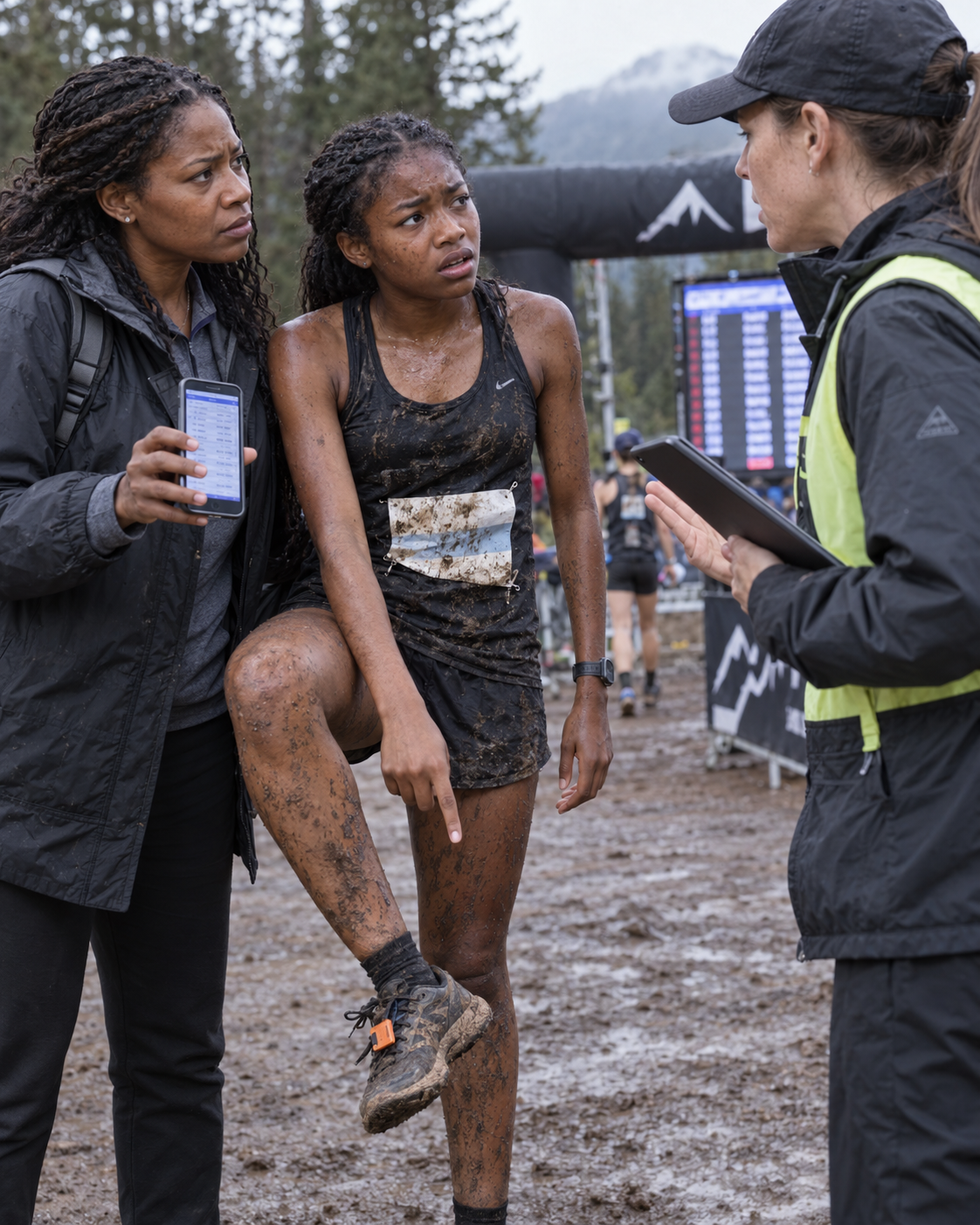
My daughter’s name appeared on the finish screen for eleven minutes.
**AMARA BROOKS — 2:14:07 — THIRD**
She saw it before the medic guided her into the recovery tent. I photographed it with her muddy shoulder and crooked race bib in the corner of the frame.
When we came back out, her name was gone.
The first three finishers were now listed as two. Beneath them, a separate line showed Amara’s bib number beside three red letters.
**DQ**
Amara stared at the screen.
“For what?”
A volunteer checked his tablet.
“Missed checkpoint four.”
“That’s impossible,” she said. “I stopped there.”
Amara had not simply passed checkpoint four at mile nine. She had knelt beside another runner there for nearly six minutes, holding the girl’s head out of the mud while a course marshal called for a medic.
I had watched part of it through the event’s live tracker. Her dot stopped. Then the emergency icon appeared.
Now race director Celeste Rainer walked toward us with a radio clipped to her vest.
“Your timing chip did not register at checkpoint four,” she said.
Amara lifted one shoe. The orange chip was still laced beneath the mud.
“The mat wasn’t there.”
Celeste’s expression remained neutral. “The checkpoint was relocated this morning for safety.”
“No one told us.”
“It was covered in the briefing.”
I had downloaded the final briefing packet to my phone the night before. I opened it.
Checkpoint four was marked beside the old stone water trough on Hawthorn Loop. That was where Amara had stopped. That was where the injured runner had been treated.
Celeste glanced at the map.
“An event-day update superseded that document.”
“Where was the update posted?”
“At the start.”
Amara shook her head. “The announcer warned us about loose rock after mile twelve. Nothing about mile nine.”
Celeste told us to file an appeal by four that afternoon. Then she turned toward the next finisher as if a form could contain what had just happened.
Pine Ridge was Amara’s last regional qualifier before the state mountain-running championship. She needed a top-five finish or a time under two hours eighteen minutes. Her erased result met both standards.
The appeal fee was fifty dollars. If the panel ruled that she had skipped part of the course, she could also receive a conduct notation that other race organizers would see.
Amara sat on the grass and unlaced her chip.
“I followed every flag,” she said.
I believed her before I examined a single record.
Believing her was not the same as proving where the race had placed its equipment.
I worked as a mapping technician for the county public-works department. Most days, I checked drainage inventories and corrected road coordinates after repair crews moved signs or culverts. It was ordinary work built around one principle: when the map and the ground disagree, record both before someone edits either.
We started with the evidence we already had.
Amara’s watch trace followed the published course to the old water trough. The GPS was accurate within several yards, not inches, but it showed no shortcut. Her heart rate dropped while she stopped with the injured runner. A photograph taken by a spectator showed her beside the green checkpoint-four flag at 9:12 a.m.
The flag was there.
The timing mat was not.
I asked the medical tent for the incident number. The injured runner was Keira Shaw, a sixteen-year-old from another club. Her father gave permission for the lead medic to confirm only the facts relevant to our appeal: the team had been dispatched to the published checkpoint four, and Amara had remained with Keira until they arrived.
That should have been enough to show Amara reached mile nine.
Celeste rejected the first appeal at 2:35.
Her written reason said the medical response occurred at “an unofficial aid point approximately 0.3 miles from the electronic checkpoint.” It added that all runners were responsible for following event-day markings.
The claim created a larger problem.
If the old water trough had become unofficial, why had the checkpoint-four flag, water table, marshal, and medical location remained there?
Amara read the decision twice.
“They moved one piece and blamed me for finding the rest.”
We returned to Hawthorn Loop before course crews removed the markers.
The old water trough sat beside a green flag printed with the number four. Empty paper cups filled a trash bag tied to the table. Spray-painted arrows directed runners through the loop and back toward the ridge.
Three-tenths of a mile downhill, we found the timing mat across a wider service road. A small laminated sign on a tree said **4B**.
No race map mentioned checkpoint 4B.
A storm two nights earlier had washed gravel across the narrow section between the trough and service road. Moving the electronic mat may have been a reasonable safety decision. Leaving the numbered flag and marshal behind while creating a second, differently marked location was not.
It allowed runners to pass the place the course called checkpoint four without ever crossing the mat that decided whether they had been there.
I photographed both locations with the time and coordinates visible on my field app. Amara walked the connecting trail.
Halfway down, a strand of red course tape blocked the most direct route.
The arrows at the trough sent runners left, along the original loop. The mat sat to the right, beyond the tape.
“You couldn’t reach both without turning around,” she said.
At the race office, Celeste refused to accept new photographs in person. She said the deadline had closed when we submitted the first appeal.
“It is 3:18,” I said. “Your form says four.”
“The panel has already reviewed this bib.”
“Then reopen it.”
“We cannot keep revisiting results because a parent dislikes them.”
Amara stepped between us.
“This is my appeal.”
Celeste looked at her. “Then you should understand that repeated challenges can turn a simple missed mat into a sportsmanship issue.”
The warning made Amara go quiet.
It made me take notes.
We submitted a supplemental appeal by email at 3:31 and copied the regional mountain-running association that certified the event.
On the drive home, Keira’s father called.
Keira had been discharged with a sprained wrist and mild concussion. She remembered Amara reaching her at the green flag. More importantly, she said several runners had shouted that they could not find the timing mat.
By evening, eleven other names had moved from the finish list to disqualified.
Their watch traces were different in pace but nearly identical in route. All followed the published loop. All passed the old water trough. None crossed the relocated mat.
The disqualifications did not affect only slow or inexperienced runners. They affected anyone who trusted the numbered flag more than an unnumbered fork downhill.
The association acknowledged our appeal Saturday morning and ordered the race to preserve timing, course, radio, and briefing records. Results would remain provisional for forty-eight hours.
Celeste called me ten minutes later.
She offered to restore Amara’s third-place finish using her watch time, provided we withdrew the challenge to the course certification.
“Why only Amara?” I asked.
“Her aid to an injured runner gives us discretion.”
“What about the other eleven?”
“They did not provide assistance.”
The offer was designed to separate the most sympathetic case from the structural problem.
I put the phone on speaker.
Amara listened, then said, “If you put me back because I helped Keira, you can still say everyone else cheated.”
Celeste replied, “I am trying to protect your opportunity.”
“My opportunity was the time I ran on the course you marked.”
Amara declined the private reinstatement.
That choice cost her certainty. If the association upheld the disqualification, she would lose both the finish and the last scheduled qualifier.
On Sunday, the timing contractor sent records directly to the association. Every mat controller transmitted its activation coordinates before the race. Checkpoint four’s unit had been powered at 6:47 a.m. on the service road, not at the certified map location.
The course radio log explained why.
At 6:31, Celeste approved moving the mat because of washed gravel. A safety marshal then warned that the old arrows would send runners away from the new point. He requested either a course closure or time to remark the fork.
Celeste answered that the live broadcast began at eight and instructed him to “make the existing loop work.”
At 8:06—six minutes after the first wave started—the marshal reported that runners were splitting at the fork.
No general stop was called.
The event had known about the conflict before Amara reached it.
The appeals hearing took place by video Monday morning. Amara attended in her school library with me beside her. Celeste joined from the race office. The panel included an athlete representative, a course certifier, and a safety official.
Celeste argued that emergency conditions justified changing the checkpoint and that elite competitors were expected to respond to markings on the ground.
The certifier displayed our two photographs.
“Which marking controlled?” he asked. “The flag labeled four on the certified route, the arrows continuing the loop, the red tape blocking the shortcut, or the sign labeled four-B beside the relocated mat?”
Celeste said volunteers had failed to remove outdated materials.
The safety official played the 6:31 radio exchange. Celeste had been told the materials were still in place.
Then Amara spoke.
She did not argue that helping Keira entitled her to special treatment.
“I stopped because someone was hurt,” she said. “But I reached the same checkpoint as eleven people who didn’t stop. If my watch time counts only because I helped, the course problem disappears and they stay disqualified.”
The athlete representative asked what she wanted the panel to do.
“Do not call us cheaters for following the route we were given.”
The panel did not award Amara third place.
It ruled that Pine Ridge could not serve as a qualifier because the controlling checkpoint had been moved off the certified route without a workable course correction. All twelve disqualifications were removed from athlete conduct records. Entry fees were refunded, and the association added a replacement qualifier three weeks later at no cost to affected runners.
Celeste was removed from course-control duties pending a safety review. The event’s sponsor kept funding the replacement race after requiring an independent course lead.
It was not the outcome Amara had trained for. Her 2:14:07 remained in the record as an exhibition time, not an official podium finish.
For two days, she was furious.
Then she returned to training.
At the replacement qualifier, every checkpoint had a flag, a mat, and an official standing together. The route map showed the same coordinates the equipment transmitted. Keira, her wrist in a brace, waited near the finish with her father.
Amara crossed in sixth place.
For several seconds, neither of us looked at the screen.
Then her time appeared: 2:16:42.
She had missed the top five by one position and qualified on time by seventy-eight seconds.
Her name stayed where it was.
Keira cheered. Amara bent over with her hands on her knees, laughing and crying at once.
I took no photograph of the screen that day.
I did not need proof before it vanished.