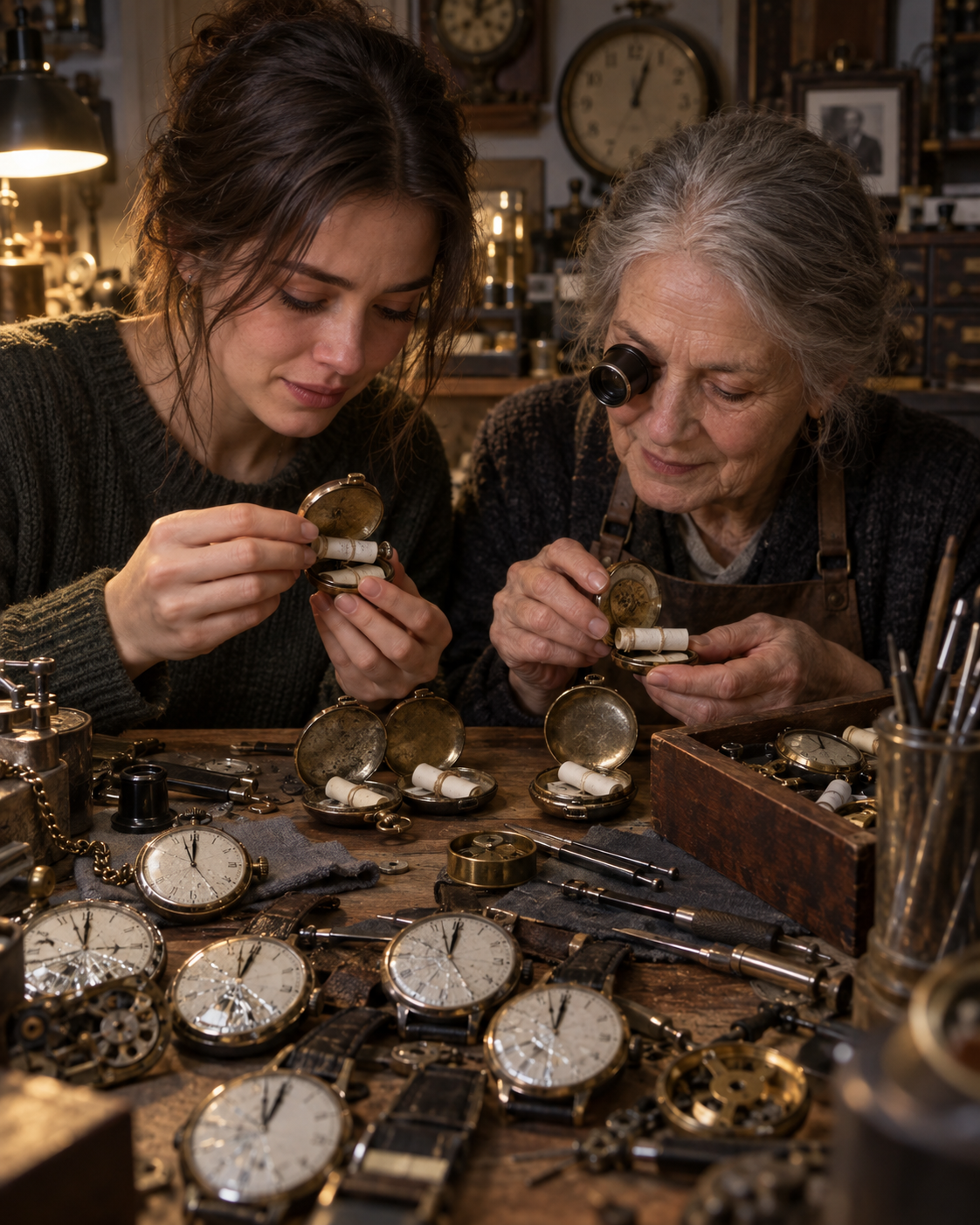
Every watch in my father’s workshop had stopped at 4:17.
There were forty of them—cheap plastic, silver pocket watches, children’s watches with cracked cartoon faces. After his funeral, I assumed he had staged a message about the time he died.
But Dad died at 9:03 in the morning.
I took the box to Mina, the watchmaker who had shared his shop wall for twenty years. She opened the first case and found no gears.
Inside was a tightly rolled paper with a name and phone number.
Each watch held one. Some also contained a date and a short repair note: **bus fare**, **night class**, **dentist**, **first month**.
Dad had repaired watches for customers who could not pay. When they insisted on repaying him, he asked them to help someone else and tell him when they did. The stopped watches recorded those returned favors.
“Why 4:17?” I asked.
Mina handed me the last watch. Its paper carried my mother’s name.
At 4:17 one winter morning, years before I was born, Mom’s car broke down outside Dad’s shop while she was driving a frightened teenager to a shelter. Dad fixed the car, refused payment, and joined the drive because the roads were icy. He later said that minute was when he learned help could travel farther than the person receiving it.
I wanted to display all forty watches at his memorial. Mina objected. The names belonged to living people who had not agreed to become my father’s tribute.
We contacted them privately. Twenty-three consented to have their stories shared without full names. Nine asked for their watches back. Four numbers were disconnected. The rest declined.
The memorial display contained only the approved watches and blank cards for the others. No one was asked to reveal whom they had helped.
Afterward, I tried to continue Dad’s system. It failed immediately. People brought me requests I could not evaluate, and I was neither a mechanic nor a social worker.
So Mina and I partnered with a neighborhood emergency fund. The remaining watch cases became numbered tokens for donors, while trained staff handled applications confidentially. Contributors could mark the moment they chose to pass help forward, or leave the hands moving.
I kept Mom’s watch. It still reads 4:17, but now I understand that it does not mark an ending.
It marks the minute my father stopped measuring what people owed him.