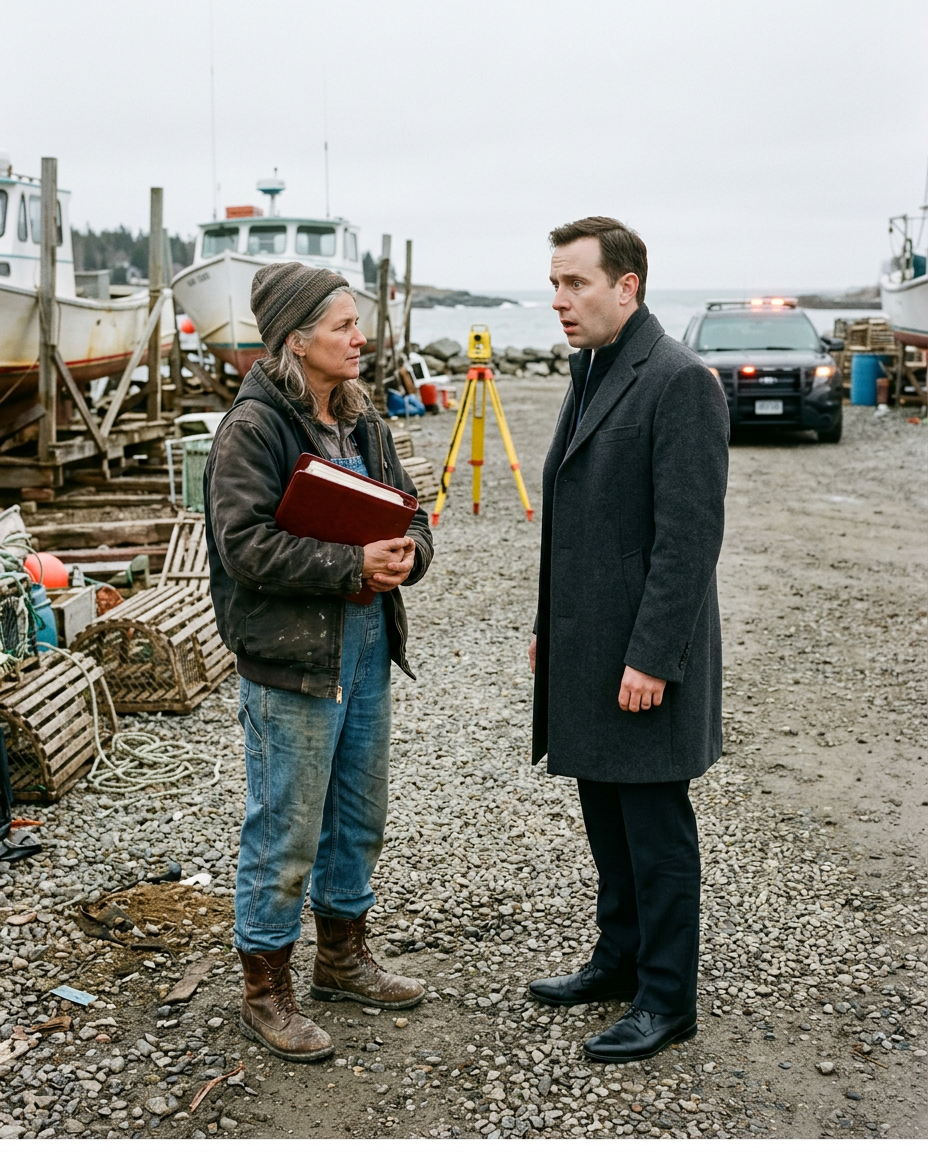
My cousin Julian arrived at Vance Marine Basin at 7:15 on a damp Tuesday morning with two chartered black SUVs, a private security guard, and a zoning surveyor holding blueprints for twenty-four luxury waterfront condominiums.
Uncle Arthur had been buried less than forty-eight hours earlier in the coastal cemetery overlooking Rockland Harbor.
I had grease on my knuckles and salt dried on my work boots from replacing the bilge pump on old Mr. Higgins’ lobster boat.
I had run that boatyard beside Uncle Arthur for twenty-six years while Julian lived in a glass high-rise in Boston, openly mocking the diesel fumes and low profit margins of our family’s three-generation maritime shop.
Julian stepped out onto the gravel slipway wearing an Italian wool overcoat and pointed a polished leather shoe at the open hangar doors.
He did not say hello or offer condolences.
He handed me a stiff manila folder stamped by a downtown Boston law firm and told me I had forty-five minutes to pack my personal tools into my pickup truck before his security guard locked the chain-link gates.
He looked around at the repair docks, the wooden skiffs on dry cradles, and the twelve commercial moorings that kept seventy local fishermen afloat through winter.
He smirked and said Uncle Arthur’s 2005 last will and testament named him the sole shareholder of Vance Marine Corporation.
He announced that he had already signed a twelve-million-dollar acquisition contract with a private development consortium out of Portland.
He told me I was nothing more than an hourly mechanic who had overstayed her welcome, and that by noon, the heavy demolition excavators would be rolling through the main gate.
I wiped my hands on an oily rag and watched his surveyor begin setting up yellow tripod markers across the gravel lot.
Julian pulled a silver Montblanc pen from his pocket and signed the formal trespass warning his security guard thrust toward my chest.
He laughed and said I was stubborn just like my uncle, but that court orders and corporate stock certificates did not care about sentiment.
He told the security guard to escort me to the public road if I took one more step toward the office.
I did not argue with him or raise my voice.
I walked into the small cedar-shingled harbor office, opened the fireproof floor safe beneath Uncle Arthur’s desk, and retrieved the heavy crimson binder stamped with the Maine Department of Marine Resources seal from June 2011.
When I walked back out onto the gravel pier, Julian had already signaled the flatbed tow truck to drag my tool trailer off the property.
I held up the certified state conveyance documents and looked his lead surveyor directly in the eyes.
Julian sneered and asked me if I really thought a mechanic’s invoice was going to stop a twelve-million-dollar land development deal.
I turned to the county sheriff who had just pulled into the driveway after Julian called them to remove me for criminal trespass.
I handed the deputy the certified deed to the submerged tidelands and riparian shoreline access rights that Julian had never bothered to check.
Julian’s smirk vanished the second the deputy began reading the first paragraph aloud.
In Maine maritime law, Vance Marine Corporation owned only the two upland acres where the empty storage shed and parking gravel sat.
Back in 2011, when the state updated coastal zoning regulations and the corporation faced bankruptcy from harbor dredging taxes, Uncle Arthur and I reorganized the harbor titles.
I had personally invested my life savings of eighty-four thousand dollars to purchase the permanent ninety-nine-year submerged tideland deed, the pier pilings, the boat ramp launch rights, and the narrow twenty-foot coastal access strip connecting the road to the water under my private LLC.
Without my submerged tideland deed, the upland parcel Julian inherited was completely landlocked from the water and legally forbidden from placing docks, slips, or waterlines into the harbor.
The lead surveyor immediately took off his hard hat, examined the registered state map, and told Julian that his luxury marina condominium blueprints were completely worthless without my written consent.
The deputy sheriff looked at Julian, handed back his trespass warning, and stated that I was the rightful property owner of the active docks and access corridor.
Julian’s face turned pale white as his private security guard quietly stepped back toward the SUVs.
Thirty minutes later, the developers cancelled their twelve-million-dollar contract when their legal team confirmed my ironclad ownership.
Julian was left holding an empty upland gravel lot with seventy thousand dollars in back property taxes and zero water access.
Three months later, his Boston attorney contacted me offering to sell the corporate upland parcel for a fraction of its assessed value just to stop paying property maintenance.
I bought the upland gravel parcel from him for fifty thousand dollars in cash, reuniting the entire harbor property under my name.
Vance Marine Basin remains open today, servicing the local fishing fleet just as Uncle Arthur intended.