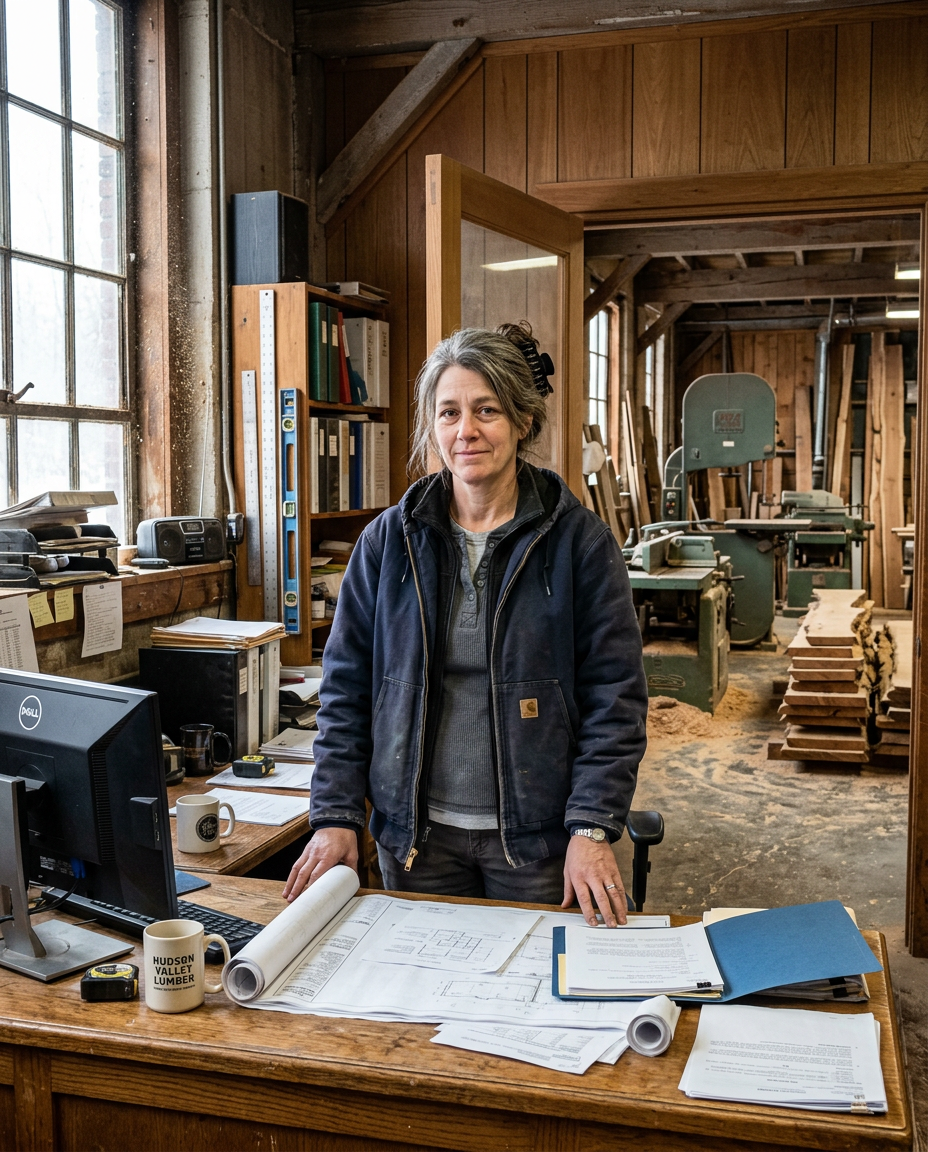
My brother-in-law pulled into the lumberyard at 7:15 a.m. on a freezing Tuesday morning with two private security guards and a commercial locksmith.
My father-in-law, Arthur Sterling, had been buried just seventy-two hours earlier at St. Peter’s Cemetery in Red Hook, New York.
For nine years, I lived in the small apartment above Sterling Architectural Millwork, running the shop floor by day and managing Arthur’s round-the-clock Parkinson’s care by night.
During those nine years, his son Greg lived in a high-rise in Chicago, visiting exactly twice and contributing zero dollars toward his father’s medical bills or the shop’s mounting municipal tax burdens.
I was the one who changed Arthur’s oxygen tanks, balanced the payroll for our six master carpenters, and kept the eighty-year-old family business from going under.
When Greg stepped out of his rental SUV in his tailored overcoat, he did not offer condolences or ask how the funeral went.
He walked straight into the sawdust-scented main office, tossed a manila folder onto my desk, and told the locksmith to start changing the deadbolts on every exterior entrance.
“You have thirty minutes to pack your clothes into two cardboard boxes, Nora,” Greg said, refusing to look me in the eye as he leaned against the drafting table.
He waved a copy of Arthur’s 2013 will, which stated in plain black ink that the Sterling parcel and real estate would revert entirely to Arthur’s sole surviving biological son upon his death.
“You were my father’s paid caregiver and a shop manager who drew a weekly salary,” Greg sneered, crossing his arms. “The charity ride is officially over, and my developers are converting this yard into luxury storage units by the end of next month.”
I sat quietly behind my father-in-law’s battered oak desk, sipping my black coffee while the locksmith began drilling out the cylinder on the front showroom door.
“Greg, you haven’t checked the Dutchess County property registry since 2018, have you?” I asked calmly.
Greg laughed, pulling a crisp linen handkerchief from his pocket to wipe a fleck of fine cedar dust from his lapel.
“I don’t need to check a registry when I hold the original family deed and the last will, Nora,” he snapped. “Now hand over the master keys and the combination to the floor safe before I have these two guards physically carry you across the property line.”
At that exact moment, two Dutchess County Sheriff cruisers pulled into the gravel drive, their yellow roof lights flashing silently against the frost-covered cedar siding.
Greg smiled arrogantly, assuming the deputies were arriving in response to the private trespassing dispatch call his attorney had scheduled for eight o’clock sharp.
He strutted out onto the loading dock, waving the deputies toward the office door while pointing an aggressive finger directly at my face.
“Deputy, thank God you’re here,” Greg announced loudly. “I am the sole property heir, and this former employee is refusing to vacate my commercial premises.”
Deputy Miller didn’t look at Greg; he walked straight up the wooden steps, tipped his hat to me, and asked if I had the certified blue binder ready.
I stood up from the desk, unlocked the steel firebox behind the counter, and walked out onto the dock holding a thick, notarized document bearing the official seal of the State Supreme Court.
Greg’s confident smirk began to waver as the deputy took the folder, scanned the first page, and immediately turned toward Greg’s private security guards.
“Mr. Sterling, you need to tell your locksmith to stop working immediately and step off this property,” Deputy Miller stated firmly.
Greg’s face flushed bright red as he lunged forward, waving his laminated 2013 will in the deputy’s face.
“Are you out of your mind?” Greg yelled. “That is my father’s will! I own this land! She is nothing more than an in-law who looked after him!”
Deputy Miller calmly adjusted his utility belt and pointed to the second section of the document in his hands.
Back in November of 2019, Greg had secretly leveraged the millwork’s commercial operating account to secure a $385,000 personal business loan for his failed condominium venture in Evanston.
When Greg defaulted on that note six months later, the regional lending bank placed an immediate foreclosure lien on all machinery, inventory, and the commercial ground lease of the Sterling property.
Arthur had been devastated, weeping in his wheelchair at the kitchen table as the bank threatened to seize the timber shop that had supported our family for three generations.
Rather than let Arthur die in financial ruin, I sold the three-bedroom colonial house I had inherited from my own parents in Kingston and used the $420,000 in proceeds to quietly buy out the entire defaulted promissory note through an independent LLC.
Arthur had then legally executed an absolute mortgage assignment and a ninety-nine-year master commercial lease directly to my entity, granting me full first-position collateral over every board, saw, tool, and square foot of the yard.
Under New York state property law, a real estate inheritance passed through a will remains entirely subordinate to senior secured debt instruments and active commercial ground leases.
“Greg, you do inherit the bare underlying land title,” I said, stepping to the edge of the dock.
“However, you also inherit the outstanding $385,000 default judgment against that title, which has been accruing nine percent statutory interest for four years under my LLC.”
I handed him a certified payoff demand letter issued by my commercial real estate attorney the previous afternoon.
“The total payoff to clear my senior lien is currently $524,600, due within ten business days,” I continued.
“If you cannot wire that full amount by next Friday at five o’clock, my lien forecloses automatically, and the county clerk executes the deed transfer directly to me.”
Greg’s hands shook so violently that the papers slipped from his fingers, fluttering down into the damp sawdust on the gravel driveway.
He looked desperately at his hired security guards, but both men immediately turned around, got into their sedan, and drove out through the gate without saying a word.
The locksmith hastily packed his tools into his van, apologized to Deputy Miller, and sped away behind them.
“You planned this,” Greg whispered, his voice cracking as the reality of his half-million-dollar liability set in. “You knew he was leaving the title to me.”
“I didn’t plan your greed, Greg,” I replied evenly. “I spent nine years saving this business and protecting your father while you tried to bleed him dry from a thousand miles away.”
Deputy Miller informed Greg that any further unauthorized entry onto the commercial mill yard would result in his immediate arrest for criminal trespass.
Greg stood alone in the cold for several seconds, staring at the historic wooden building where his father had worked for fifty years, before trudging back to his rental vehicle in complete silence.
Ten days later, the statutory deadline passed without a single wire transfer from Chicago, and the Dutchess County registrar recorded the final deed under my name.
Today, Sterling Architectural Millwork is thriving, our six master carpenters still have their jobs, and Arthur’s portrait hangs proudly above the main drafting table where it belongs.