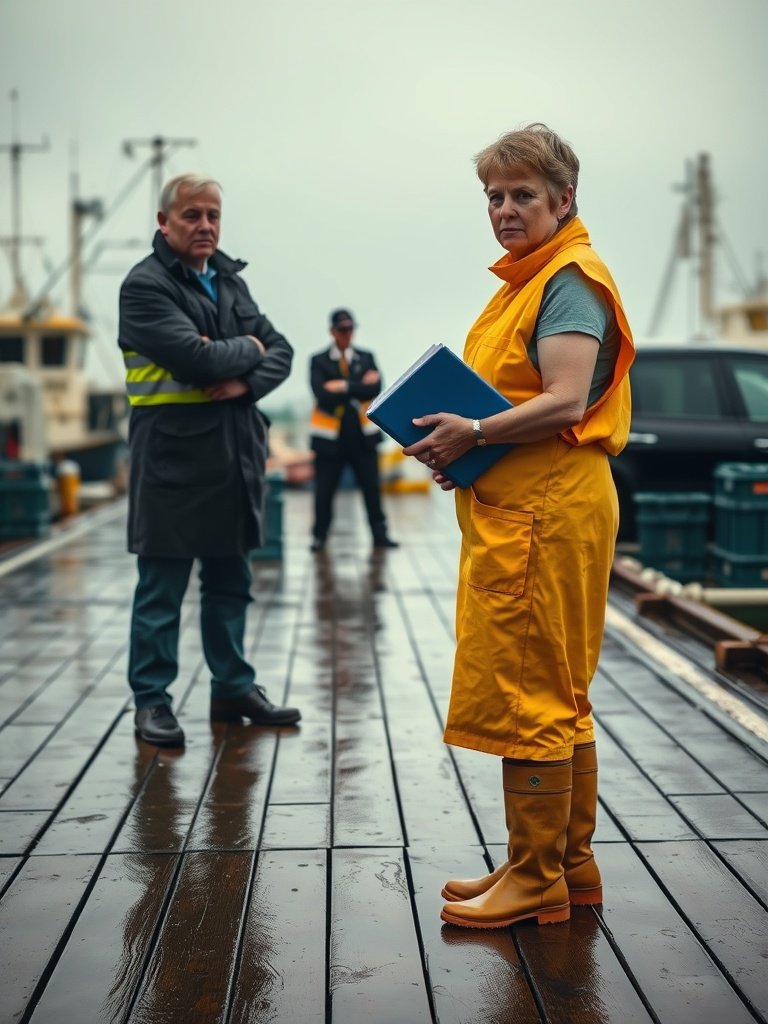
For twenty-six years, I woke up at four o’clock in the morning to run the Vance Commercial Cold Storage dock in Cape May, New Jersey.
My hands were permanently rough from hauling ice crates, handling heavy diesel compressors, and managing forty local trawlers that relied on our deep-water pier to survive.
My younger brother, Julian, left Cape May in 1998 to work at a boutique private-equity brokerage in Manhattan and never looked back.
Whenever our father asked him to come home for Thanksgiving, Julian would sneer and say he had outgrown the smell of dead bunker and diesel exhaust.
When our father, Thomas Vance, passed away on October 14, 2023, Julian did not even attend the memorial service at the harbor chapel.
Instead, he arrived at the pier on Tuesday morning at exactly 7:15 a.m. in a chauffeured black SUV, accompanied by two corporate lawyers and two armed county constables.
I was wearing my heavy yellow rubber apron and drinking black coffee out of a thermos when Julian stepped onto the wet timber decking in a tailored cashmere overcoat.
He did not say hello or offer a single word of condolence about our father.
He tossed a thick manila envelope onto the stainless steel sorting table and told me I had fifteen minutes to clear my personal belongings out of the office.
Julian informed me that as the owner of 60 percent of the original 1994 family holding company shares, he had officially signed a $4.8 million redevelopment contract with Harbor Crest Luxury Living.
He said the cold-storage plant was being demolished within forty-eight hours to make way for a forty-unit private yacht marina and luxury condominiums.
When I told him our father built this facility specifically to protect the independent fishing fleet, Julian laughed directly in my face.
He looked at the two constables and told them I was an uneducated family laborer who had freeloaded off our father’s asset for three decades.
He handed me a corporate check for $4,500 and called it a generous severance package for an unskilled dockworker.
One of the constables stepped forward and told me that if I did not surrender the keys to the main gate immediately, I would be arrested for criminal trespassing on private commercial property.
Julian pulled out a heavy pair of bolt cutters from the trunk of his SUV, handed them to a hired locksmith, and ordered him to sever the padlocks on my master office door.
My crew of eight dockworkers stood frozen in the cold morning mist, watching Julian sneer as my twenty-six years of hard labor were reduced to a pile of broken locks.
I did not scream, I did not cry, and I did not beg him for mercy.
I calmly set my coffee thermos down on the timber bench and walked over to my 2008 Ford F-250 parked near the access road.
I unlocked the glove compartment and pulled out a worn, blue waterproof binder containing the official documents from the state capital in Trenton.
I walked back to the center of the pier and handed the certified legal folder directly to the lead county constable.
Julian rolled his eyes, checked his gold wristwatch, and told the officer to throw the worthless piece of junk into the harbor water.
But the lead constable adjusted his glasses, scanned the official state seal on page one, and his face instantly lost all of its color.
The constable looked up from the parchment, turned his head toward Julian, and cleared his throat with a look of pure dread.
The officer informed Julian that Vance Commercial Cold Storage LLC only held the corporate title to the wooden shed structures above the water line.
In October 2014, when Hurricane Sandy nearly destroyed the harbor, our father needed $220,000 to rebuild the seawall, the reinforced concrete pilings, and the sole access causeway connecting the pier to the public road.
Julian had refused to contribute a single penny toward the hurricane repairs, famously texting our father that the family dock was a sinking financial liability.
To save the family business, I had mortgaged my own private home and taken out a state emergency maritime infrastructure bond in my individual name.
In exchange for my personal funding, the New Jersey Department of Environmental Protection Bureau of Tidelands Management granted me an exclusive, 99-year irrevocable riparian sovereign easement over the entire underwater seabed, the causeway, and the seawall.
The constable handed the papers back to me and sternly told Julian that the LLC owned zero ground beneath the timber floorboards.
Without my signed daily written entry permit, every single vehicle, construction crew, and developer entering the pier was committing a third-degree state felony by trespassing across my sovereign riparian zone.
Julian began screaming at his corporate lawyers, but both attorneys reviewed the state seal, looked at each other, and closed their leather briefcases in dead silence.
The lead developer from Harbor Crest Luxury Living stepped out of the luxury SUV, looked at the tideland deeds, and immediately called his corporate office to cancel the $4.8 million acquisition due to fatal title failure.
Julian stood on the damp gravel causeway as the developers drove away, realizing he had personally borrowed $450,000 in bridge loans against a property he had no legal right to enter.
I instructed the constables to escort my brother and his locksmith off my causeway immediately before I pressed formal criminal trespass charges.
Four months later, facing personal bankruptcy and mounting municipal tax penalties on an unusable wooden shell, Julian was forced to sell all 60 percent of his LLC shares to me for exactly $10,000.
Today, the Vance Commercial Cold Storage dock remains fully operational, providing affordable ice, fuel, and berths to forty independent Cape May fishing crews who know their harbor is safe forever.