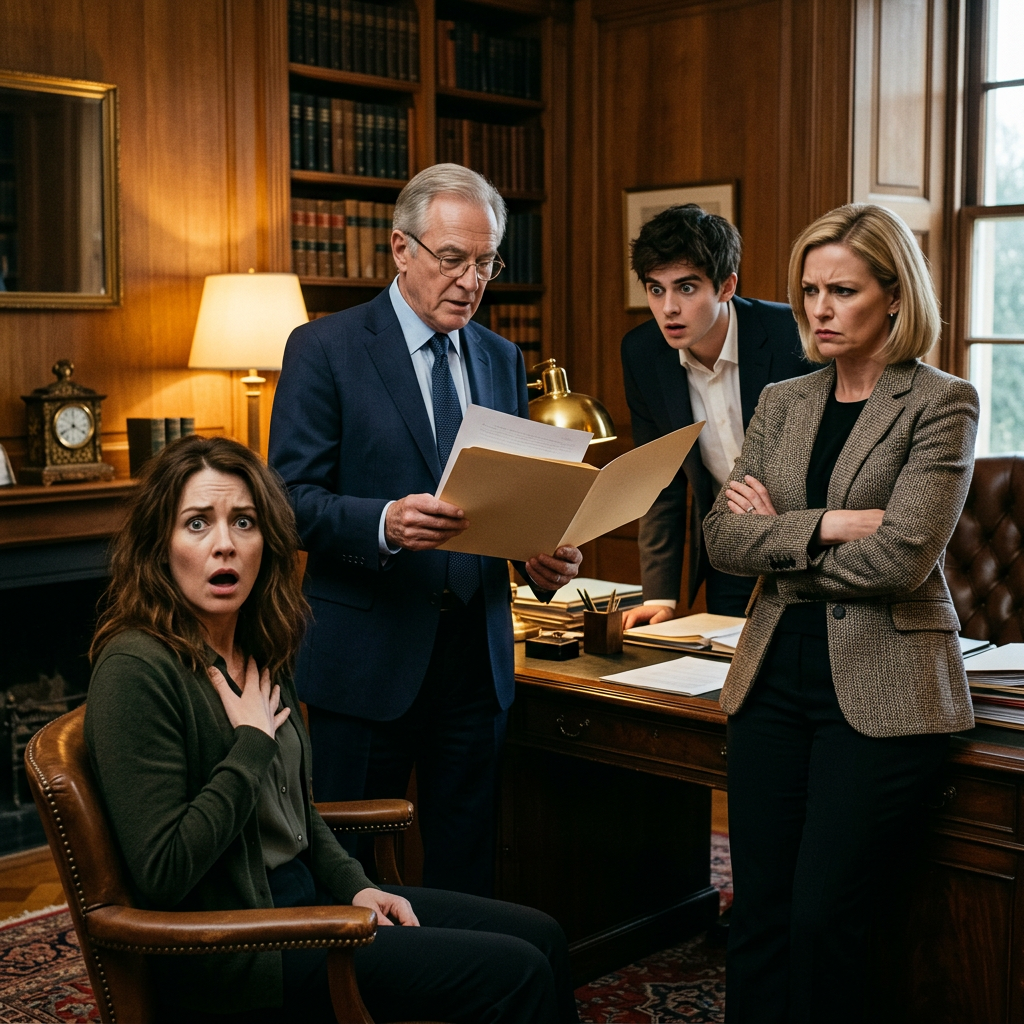
My mother left me her house in her will. My sister brought a notary to take it away.
When the notary knocked on my door, I thought it was a mistake.
I thought, maybe he has the wrong address.
Maybe he is looking for someone else on this street, someone who actually owes money or signed something they should not have.
But he said my name.
He said it clearly, like a judge reading a verdict.
“Are you Elena Marsh?”
“I am.”
“You have been served. There is a petition to contest the transfer of property located at 14 Sycamore Lane.”
I stood in the doorway holding a dish towel.
The kitchen smelled like the soup I had just made for my daughter.
And in that moment, I did not understand what was happening.
Because my mother had been dead for eleven days.
Eleven days.
I had not even finished sorting her clothes.
I had not yet found the courage to open the drawer where she kept her perfume, because I knew the smell would undo me.
And already, my sister was trying to take the house.
My mother gave me the house.
She told me in the hospital, three days before she passed.
She held my hand and said, “The house is yours, Elena. I put it in the trust. Your sister knows. I made sure she knows.”
I nodded because I could not speak.
My mother had been sick for two years.
I was the one who drove her to every appointment.
I was the one who sat in the waiting room reading outdated magazines while she had her treatments.
I was the one who learned to change the bandages, to crush the pills into her applesauce when she could no longer swallow, to sleep on the chair beside her bed when the nights got bad.
My sister Caroline visited twice.
Twice in two years.
Once at Christmas, and once when she needed $4,000 for a “business opportunity” that turned out to be her boyfriend’s truck.
My mother gave her the money.
My mother always gave Caroline money.
It was easier than saying no.
But the house — the small house on Sycamore Lane with the porch that sagged on the left side and the kitchen window that faced the morning sun — that was mine.
My mother made it mine.
She told me she had set up a transfer-on-death deed years ago.
She said, “I did it when your father was still alive. He witnessed it. The lawyer notarized it. The house skips probate. It goes straight to you.”
I asked why she never told me before.
She said, “Because I did not want Caroline to make you feel guilty for something you did not ask for.”
I understood.
Caroline had a way of making people feel guilty for things they did not do.
So when the notary handed me the papers, I read them standing in the doorway.
Caroline was claiming that our mother had been “unduly influenced.”
That I had “manipulated” her into changing the deed.
That our mother was not of sound mind when she made the transfer.
I felt my hands shake.
Not from fear.
From the kind of anger that starts in your chest and moves outward until even your fingertips feel hot.
Because Caroline had not been there.
She had not held my mother’s hand during the treatments.
She had not heard her cry at 3 a.m. when the pain broke through the medication.
She had not been the one to find the hospice nurse’s number when the breathing changed.
She had not been there for any of it.
And now she wanted the house.
I called my mother’s lawyer the next morning.
His name was Mr. Adler.
He had been our family lawyer for twenty years.
He had drawn up the trust, the deed, the will.
When I told him what Caroline had filed, he was quiet for a long time.
Then he said, “Elena, your mother anticipated this.”
“What do you mean?”
“She anticipated that Caroline would try. She made sure we were prepared.”
He told me to come to his office at 2 p.m. on Thursday.
He said to bring the papers the notary had served.
He said, “Wear something you would wear to court. Not because we are going to court. Because Caroline might be there.”
Caroline was there.
She was sitting in the waiting room of Mr. Adler’s office when I arrived.
She was wearing a blazer I recognized — it was our mother’s.
She had taken it from the closet I had not yet sorted.
She looked at me the way she always looked at me — like I was someone who had gotten lucky and did not deserve it.
“Elena,” she said.
“Caroline.”
“You could just sign it over,” she said. “You know I need it more than you do.”
I did not respond.
Because what she meant was: I want it, and wanting it is the same as deserving it.
Mr. Adler called us in.
He sat behind his desk with a folder that was thicker than I expected.
Caroline spoke first.
She always spoke first.
“My mother was not in her right mind when she changed that deed. Elena was living with her, controlling her medications, controlling her access to people. She pressured our mother. Any reasonable person can see that.”
Mr. Adler listened.
He nodded.
He let her finish.
Then he opened the folder.
“Caroline,” he said, “your mother came to my office alone on March 14, 2022. She drove herself. She was not on any medication at that time. She was not in treatment. She was completely lucid.”
He pulled out a document.
“This is a recorded video statement. Your mother insisted on it. She said she wanted there to be no ambiguity.”
He turned his laptop around and pressed play.
My mother’s face appeared on the screen.
She looked tired but clear-eyed.
She was sitting in Mr. Adler’s office, in the same chair I was sitting in now.
She said:
“My name is Margaret Marsh. I am of sound mind and body. I am making this statement voluntarily, without coercion from anyone, including my daughter Elena. I am transferring my house at 14 Sycamore Lane to Elena through a transfer-on-death deed because she has been my caretaker, my companion, and my true family for the past two years. My daughter Caroline has had every opportunity to be present and has chosen not to be. This is my decision. It reflects my wishes. I do not want it contested.”
The video ended.
The room was silent.
Caroline’s face had gone white.
Mr. Adler then placed three more documents on the table.
A letter from my mother’s oncologist, dated the same week, confirming she was mentally competent.
A notarized affidavit from the hospice nurse, who had witnessed the deed signing.
And a copy of the trust document, which included a clause I had never seen:
“In the event that any beneficiary contests this transfer, that beneficiary shall forfeit any and all claims to the estate, including any prior bequests.”
Caroline had not just lost the house.
She had lost everything else my mother had left her — the small inheritance, the jewelry, the savings account.
By filing the contest, she had triggered the forfeiture clause.
Mr. Adler looked at Caroline.
“You can withdraw the petition now, or you can proceed and lose everything. Your mother made sure of that.”
Caroline stood up.
She did not look at me.
She walked out.
I heard her heels on the hallway floor, getting quieter, until they were gone.
I sat in Mr. Adler’s office for a long time after that.
I cried.
Not because of the house.
Because my mother had known.
She had known that Caroline would come for it.
She had known that I would not fight back on my own.
So she had fought for me, in advance, from that chair in the lawyer’s office, while she was still strong enough to do it.
She had protected me from beyond.
I drove home that evening.
The soup was still in the fridge.
My daughter was asleep on the couch.
I sat on the porch of the house that was mine — that had always been meant to be mine — and I watched the morning sun come through the kitchen window, the way it did every day, the way my mother had loved.
And I whispered, “Thank you, Mom.”
I never heard from Caroline again.
She did not call.
She did not write.
She did not come to the memorial I held for our mother three weeks later.
Sometimes I think about her sitting in that waiting room, wearing our mother’s blazer, believing she was entitled to something she had never earned.
But I do not think about it often.
Because the house is mine.
The porch still sags on the left side.
The kitchen window still faces the morning sun.
And every time I sit there with my coffee, I feel my mother beside me.
Not as a ghost.
As a promise kept.
Check the comments below for the continuation.